DeFi
CFTC Submits Crypto Market Rules to White House Amid Congressional Stall

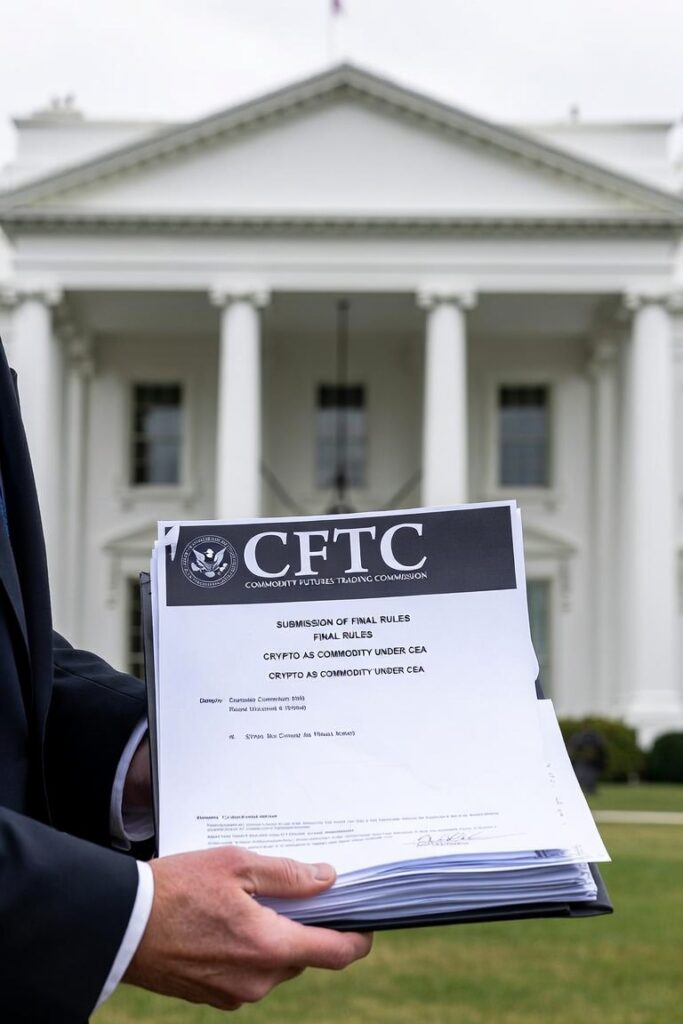
Congress would not open debate. The futures regulator opened a docket instead.
On September 17 — two days after the Senate failed cloture on the CLARITY Act 49–50 — the Commodity Futures Trading Commission sent “Regulation Crypto Asset Transactions and Regulation Crypto Asset Markets” to the White House Office of Information and Regulatory Affairs. The entry sits on reginfo.gov as RIN 3038-AF80, received that Thursday, status pending review. It is the only CFTC item in the OIRA queue. Chair Michael Selig is the agency’s only sitting commissioner. The CFTC declined to publish the text. That is not a footnote. There is no Federal Register proposal yet, no comment period, and no binding obligation on an exchange.
Prerule, not a rule
OIRA has the package at the prerule stage. Under Executive Order 12866, preliminary actions get a shorter White House look — about 10 working days — versus up to 90 days for proposed and final rules. Some coverage treated the filing as a finished draft on a 90-day clock. The dashboard says prerule. Either way, the next public step is still a Commission vote, then an NPRM, then comments. One recap put a realistic effective date in late 2027 if the process runs clean. Treat “CFTC writes market structure” as a direction of travel, not as Tuesday’s compliance memo.
Selig had already telegraphed the path. In August he told staff to use existing Commodity Exchange Act authority if CLARITY stalled: a CFTC market-structure regime for crypto assets, including how developers offer protocols, and earlier work on leveraged, margined or financed retail crypto trading plus a possible specialized designated contract market category. The two titles in the RIN — Transactions and Markets — match that split. Spot digital commodities were the prize CLARITY would have handed the CFTC in statute. Without the statute, Selig is trying to build the closest thing the CEA will bear. How far that authority actually stretches is the fight that will start the day the text is public.
Agencies filling the hole Congress left
The same week the SEC issued a five-year Innovation Exemption for permissioned venues trading rights-bearing tokenized NMS stock. The CFTC separately gave no-action relief so certain passive software providers — including some wallet interfaces — can connect users to regulated derivatives markets without registering as introducing brokers. That is the post-CLARITY operating system: Atkins on tokenized equities, Selig on commodity-asset markets, both under old statutes, neither waiting for seven Democratic votes that do not exist. Prediction books on a 2026 CLARITY law that tagged ~30% after the “final draft” now sit near 7%. The legislative overhang is smaller. The agency-overhang is larger. You trade one uncertainty for another that has a docket number.
What this does not do
It does not list bitcoin as a commodity in a new way. It does not approve a spot product. It does not tell Coinbase how to custody. It does not settle the SEC/CFTC border CLARITY was written to draw. Industry can call it pragmatic. Counsel will call it a prerule with no text. Market reaction was muted next to bitcoin’s reclaim of $81,000 and the 50-week moving average — which is the correct order of operations. Price does not wait for OIRA. Compliance departments do.
If OIRA clears the package, Selig still has to vote a proposal out of a one-commissioner agency, survive comment, and defend the CEA theory in court. That is slower than a statute and narrower than the bill that died. It is also the only federal market-structure process still moving. The White House now has the file. The industry does not have the rules. Those are different sentences, and only one of them happened last week.

The content on CoinReporter.io is for informational purposes only and is not financial or investment advice. Cryptocurrency investments are highly volatile and risky. Always conduct your own research and consult a qualified financial advisor before making any investment decisions. CoinReporter.io and its authors are not liable for any losses resulting from actions based on this website’s content.





Bitcoin traded in a tight range near $75,000–$76,000 for much of November 8 before settling lower, closing the CoinMarketCap snapshot at $74,585, down 1.54% on the day. The asset remained on track for a fifth consecutive weekly loss. Total market capitalization hovered near $2.54 trillion with 24-hour volume around $29 billion and Bitcoin dominance near 60%. Ethereum lagged more sharply at $2,121, down 5.16%. Broader altcoins underperformed, with reports noting that 40 of the top 50 coins were lower on the week in one snapshot.
ETF outflows flip 2026 flows negative
U.S. spot Bitcoin ETFs suffered their worst week since late June, posting $1.28 billion in net outflows for the week of November 2–6, according to SoSoValue data. This erased the funds’ year-to-date gains and left them with roughly $914 million in net outflows for calendar 2026. Daily flows were negative on Monday ($398.6 million), Tuesday ($115.6 million), Thursday ($430.2 million), and Friday ($411.9 million), with only a modest $74.6 million inflow on Wednesday. BlackRock’s IBIT drove the bulk of the selling—roughly $403 million on Friday alone. Spot ether ETFs also extended a losing streak, shedding $365.3 million for the week. The outflows coincided with post-midterm market pressure, a stronger-than-expected jobs report that raised December Fed rate-hike odds, and broader risk-asset weakness. Cumulative inflows since the January 2024 launch remain substantial at roughly $55–56 billion, but the reversal of 2026’s positive balance marks a clear deterioration in institutional demand.
Vitalik Buterin on ETH as a store of value
Ethereum co-founder Vitalik Buterin argued on X on November 8 that the network should focus on positioning ETH primarily as a store of value rather than optimizing around transaction-fee burns. “ETH as store of value (SoV) makes much more sense to focus on than ETH as fee-burning token,” he wrote. He outlined that the fee-burn thesis was never as strong as it appeared in the 2021–2023 cycle, that maximizing fees can conflict with decentralization and censorship resistance, and that SoV aligns with Ethereum’s core strengths in security, privacy, and long-term stability. Buterin endorsed keeping EIP-1559 intact but said holders should not be concerned even if burns remain below 10% of break-even indefinitely. “The value of ETH comes from elsewhere.” ETH traded near $2,120–$2,240 on the day of the posts.
Binance France sets December 31 account closures
Binance France notified customers that all accounts will close as of December 31, 2026, citing an orderly cessation of activities after the entity failed to secure a Markets in Crypto-Assets (MiCA) authorization before the end of the transitional period. Deposits are already blocked; withdrawals remain open. From November 29, remaining balances will incur a monthly maintenance fee of 0.025% (minimum 10 USDC). Only fully emptied accounts before that date avoid the charge. Assets left after December 31 may be treated as inactive and subject to conversion, transfer, or other handling under Binance’s terms. The move follows progressive service restrictions across parts of the EU.
Keplr/Web3Auth wallet incident
Keplr Wallet paused Google and Apple logins after reports of unauthorized transactions on accounts created via social login (powered by Web3Auth). Accounts secured by recovery phrases or hardware wallets were unaffected. Web3Auth stated that a vulnerability in its infrastructure exposed certain private keys and that it conducted white-hat recovery operations, moving funds from vulnerable wallets to published recovery addresses holding roughly $5.6–6.0 million. On-chain analysis initially flagged large outflows from tens of thousands of Cosmos-ecosystem and Injective wallets. Final loss figures and the return process for affected users remain subject to ongoing verification.
Other developments
Core Scientific indicated it expects to complete its exit from Bitcoin mining by the end of 2026 and enter 2027 as a pure-play high-density colocation/AI data-center provider. AI/HPC leasing has grown to roughly 92% of revenue in recent periods. The Bank of Russia finalized rules allowing non-qualified retail investors to purchase Bitcoin, Ether, and USDT through licensed intermediaries starting November 17, 2026. A Finnish project has deployed approximately 30 Bitcoin mining systems that double as residential heating; at prices above roughly $70,000, each unit generates slightly more revenue than the electricity it consumes. Binance reopened withdrawals for Hyperliquid’s HYPE and Aptos’s APT on November 8 as part of the progressive restoration of services following its October 29 security incident. Separately, Binance’s once-significant Bitcoin mining pool has nearly disappeared from block-production rankings ahead of a planned November 10 closure.
The week’s price action reflected ETF outflows, post-election and macro sensitivity, and residual pressure from earlier security events. With Bitcoin on track for a fifth straight weekly loss and institutional flows turning negative for 2026, near-term volatility is expected to remain elevated as markets continue to digest the jobs data, regulatory shifts, and ongoing exchange recovery efforts. All market figures are sourced from CoinMarketCap’s November 8 historical snapshot unless otherwise noted. Prices are volatile; always verify live data.


Bitcoin Slips Toward $74,600
Bitcoin traded in a tight range near $75,000–$76,000 for much of November 8 before settling lower, closing the CoinMarketCap snapshot...


Bitcoin Crashes Toward $75K
Bitcoin closed November 6 near $75,900 after an intense sell-off that pushed it as low as roughly $74,800 intraday—its weakest...


Crypto Market Stabilizes After Sharp Dip
Bitcoin recovered from multi-week lows near $75,200 and stabilized above $76,000 on November 6, 2026, as the market absorbed a...


Elizabeth Warren Expected to Chair Senate Banking Committee After Democratic Midterm Sweep
Longtime crypto critic Senator Elizabeth Warren is positioned to lead the powerful Senate Banking Committee when the new Congress convenes...


Bitcoin Dips to Multi-Week Lows Near $75,200 Before Recovering Above $76,000
Bitcoin briefly tumbled below $76,000 on November 6, 2026, reaching multi-week lows near $75,200 before buyers stepped in and the...


Bitcoin Rebounds Past $80,000 as Midterms Conclude and Markets Digest Binance Hack Details
Bitcoin staged a sharp V-shaped recovery on November 4, reclaiming $80,000 after briefly touching a seven-week low near $75,600–$75,700. The...


Bitcoin Volatility and ETF Outflows Amid Elections and Hack Fallout
Bitcoin experienced sharp swings in early November, dipping below $76,000 to multi-week lows near $75,700 as residual fallout from the...


Binance SAFU Fund Falls Below $800 Million Threshold After Record Hack Coverage
Binance has drawn down roughly half of its Secure Asset Fund for Users (SAFU), leaving the Bitcoin reserve near 7,500...


Bitcoin Falls Below $77,000 as Chip Stocks Sell Off Ahead of U.S. Midterms
Bitcoin traded under $77,000 on November 3, 2026, down roughly 2% over 24 hours, as a deepening sell-off in semiconductor...


U.S. Spot Bitcoin ETFs See Multi-Hundred-Million Outflows as Post-Hack Caution Weighs
U.S. spot Bitcoin ETFs recorded substantial net outflows in the sessions surrounding the Binance security incident, with redemptions totaling roughly...
-

 Crypto1 month ago
ESMA gives EU crypto firms three months to exit non-MiCA stablecoins
-

 Bitcoin4 weeks ago
Strategy (MicroStrategy) Adds 250 Bitcoin, Holdings Reach 848,250 BTC
-

 DeFi4 weeks ago
Bitcoin Drops Below $82,000 Amid $770M+ in Liquidations as Volatility Spikes
-

 DeFi1 month ago
Government-linked wallets move seized coins
-

 Bitcoin1 month ago
Spot bitcoin ETFs flip to a ~$487 million outflow
-

 Bitcoin1 month ago
Bitcoin loses $84,000 as Hormuz attacks lift oil and yields
-

 DeFi1 month ago
Winklevoss files a 0.25% Zcash ETF
-

 DeFi4 weeks ago
U.S. Spot Bitcoin and Ethereum ETFs See Significant Weekly Outflows
-
DeFi4 weeks ago
Bitcoin Holds Above $84,000, Shrugging Off Heavy ETF Outflows as Oil Declines
-

 DeFi1 month ago
Uptober stalls ahead of the Fed minutes
-
 DeFi4 weeks ago
TRON Q3 2026 Report: $2.21 Trillion in Stablecoin Settlement Volume
-

 Crypto1 month ago
Ether funds were already bleeding
-

 DeFi3 weeks ago
Arbitrum Rallies on Stablecoin Growth Program as DeFi Tokens Outperform
-

 DeFi2 weeks ago
LUNC Hits 462B Burned After v4.1.1 Upgrade
-
 DeFi3 weeks ago
Bitcoin and Ethereum Spot ETFs Record Substantial Weekly Outflows
-

 DeFi3 weeks ago
BNB Standard Corporation
-

 DeFi3 weeks ago
Nine Crypto Firms Launch Quantum Alliance to Set Post-Quantum Standards
-

 DeFi4 weeks ago
South Korea Blocks Domestic Access to 27 Unregistered Crypto Exchange Websites, Including KuCoin and MEXC
-

 DeFi3 weeks ago
Swiss FINMA Approves First Retail Bitcoin ETF Holding BTC Directly
-

 DeFi3 weeks ago
U.S. Spot Bitcoin ETFs Post Best Inflow Day in Nearly a Month
-

 DeFi2 weeks ago
Binance-Linked Transfer Triggers 347 Million LUNC Burn
-

 DeFi3 weeks ago
Strive Discloses Additional Bitcoin Purchases, Holdings Reach 36,818 BTC
-

 DeFi4 weeks ago
Inflation Shock Triggers Nearly $1 Billion in Liquidations as Bitcoin Tests $80,000
-

 DeFi3 weeks ago
World Liberty Financial’s USD1 Stablecoin Sheds Over $400 Million in Market Cap Amid Redemptions
-

 DeFi4 weeks ago
Ethereum Foundation-Linked Wallets Transfer 4,393 ETH (~$11 Million) to Kraken
-

 DeFi4 weeks ago
Binance Rolls Out AI Trading Interface Globally After 150,000-User Beta
-

 DeFi3 weeks ago
Crypto Hacks and Losses Reach $1.18 Billion in Q3 2026 Across 107 Incidents
-

 DeFi2 weeks ago
Crypto Liquidations Surge Past $400 Million in Hours as Bitcoin Briefly Dips Below $80,000
-

 Crypto2 weeks ago
DTCC Launches Tokenization Service Covering Approximately $30 Trillion in Securities
-

 Crypto2 weeks ago
Memecoin PEPE Rallies on Reported Large Holdings Linked to Justin Sun; Broader Tokenization Debate Continues
-

 DeFi4 weeks ago
Bitcoin Drops Below $81,000 as Hotter U.S. CPI Revives Rate-Hike Fears and Asian Equities Tumble
-
 DeFi3 weeks ago
Bitcoin Slides Below $81,500 as Tech Sell-Off and Elevated Oil Prices Hit Risk Assets
-

 DeFi2 weeks ago
Ripple Secures Final OCC Approval for National Trust Bank to Oversee RLUSD
-

 Bitcoin2 weeks ago
Federal Reserve Holds Rates Steady as Bitcoin Trades Near $80,000; December Hike Odds Rise
-

 DeFi3 weeks ago
Mt. Gox Extends Creditor Repayment Deadline to October 2027
-

 DeFi3 weeks ago
Strive Adds $335 Million in Bitcoin to Corporate Treasury