DeFi
Nine Crypto Firms Launch Quantum Alliance to Set Post-Quantum Standards


Nine blockchain organizations—including Hacken, Midnight Foundation, Quantus, Postquant Labs, Keystone, American Fortress, Intmax, Abelian, and The Vault—formed the Quantum Alliance around October 15–16, 2026. Announced from Lisbon, the group aims to develop shared, testable standards for post-quantum readiness across networks, wallets, and infrastructure, modeled partly on open standards bodies such as the Internet Engineering Task Force (IETF).
The alliance estimates that roughly 6–6.4 million BTC (about 30% of supply) have exposed public keys, including early pay-to-public-key outputs, reused addresses, and some attributed to early holders. At prices near $81,000–$81,500 around October 17, this exposure represents a substantial paper value. Current quantum computers cannot practically derive private keys from elliptic-curve signatures via algorithms such as Shor’s, but members differ on timelines—some project a realistic threat window by the late 2020s (around 2028), while others stress uncertainty and the need for migration planning regardless of exact dates.
Working groups cover blockchain migration (including handling exposed keys and dormant accounts), post-quantum zero-knowledge systems, wallet and key security, and cross-chain compatibility. The effort focuses on open guidance, public definitions of “quantum readiness” (covering signatures, key management, consensus, zero-knowledge proofs, and peer-to-peer connections), testing criteria, benchmarks, and reference designs rather than enforced upgrades. Proposals are intended to advance on public evidence and working implementations without voting weight tied to corporate size or token holdings.
Bitcoin and Ethereum continue to rely primarily on elliptic-curve signatures, which a sufficiently powerful future quantum computer could theoretically challenge. The alliance includes base-layer protocols, privacy networks, rollups, hardware wallet makers, and security auditors, spanning multiple layers of the stack. Members such as Quantus (which uses NIST ML-DSA from genesis) and Abelian (lattice-based) already incorporate post-quantum elements, while others focus on wallets, custody, and tooling. The initiative does not claim protocol-level changes for Bitcoin Core or Ethereum, emphasizing voluntary standards and testing to help the broader industry prepare.

The content on CoinReporter.io is for informational purposes only and is not financial or investment advice. Cryptocurrency investments are highly volatile and risky. Always conduct your own research and consult a qualified financial advisor before making any investment decisions. CoinReporter.io and its authors are not liable for any losses resulting from actions based on this website’s content.




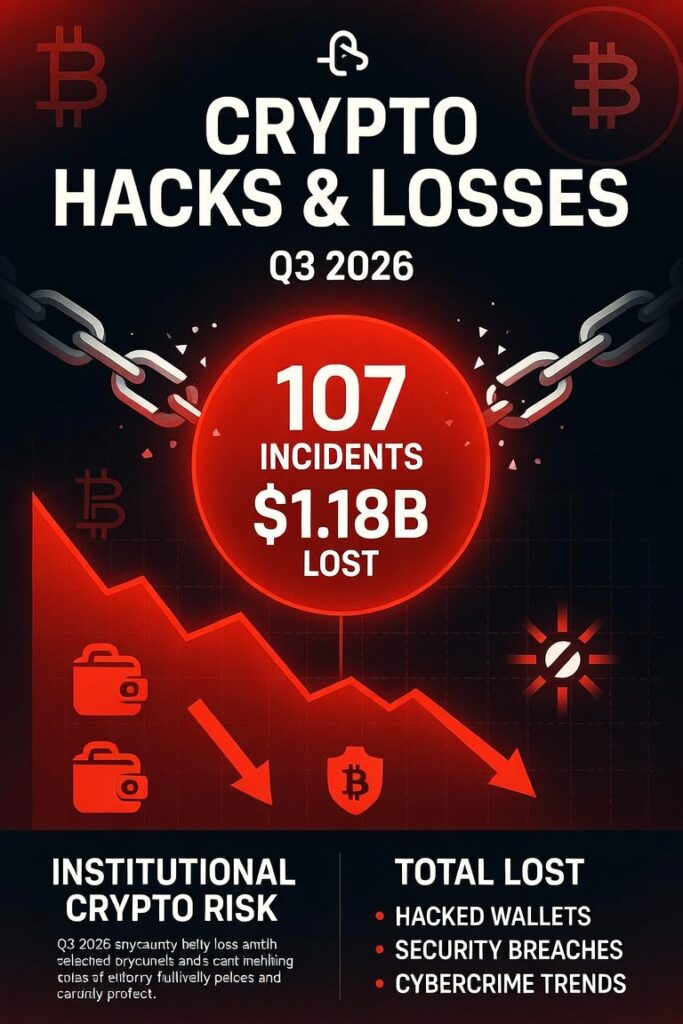
Security firm Hacken reported that crypto hacks and related losses totaled $1.18 billion across 107 incidents in the third quarter of 2026. The figure was 55% higher than the previous quarter and underscored persistent security challenges even as overall market capitalization recovered toward the $2.7–3 trillion range earlier in the year. Audit badges and conventional security signals did not fully mitigate the risks in several high-profile cases, according to the analysis.
Approximately $906–907 million (about 77% of the total) stemmed from compromised suppliers or developer tools, publicly available security fixes that were not installed, or components excluded from the most recent security reviews. Major incidents included a Bitget exchange breach involving third-party security infrastructure (reported between roughly $352–387 million) and an exploit affecting the Liquid Network (around $320 million). Smart contract issues accounted for a large share of the number of incidents, while access-control and operational failures drove significant value losses. About one-third of the gross losses were later returned, reversed, or covered by operators.
The data serves as a reminder of operational and smart-contract risks amid growing institutional participation and on-chain activity. Hacken noted that many attacks targeted systems outside the typical scope of standard audits, such as signing infrastructure, third-party tools, and supplier components. The concentration of losses in a relatively small number of large incidents further highlighted how single points of failure can drive the majority of quarterly damage even as the broader market expands.

Crypto Hacks and Losses Reach $1.18 Billion in Q3 2026 Across 107 Incidents
Security firm Hacken reported that crypto hacks and related losses totaled $1.18 billion across 107 incidents in the third quarter...


Strive Discloses Additional Bitcoin Purchases, Holdings Reach 36,818 BTC
Strive reported acquiring approximately 1,223 BTC for roughly $100 million between October 14 and 16, 2026, at an average price...


Arbitrum Rallies on Stablecoin Growth Program as DeFi Tokens Outperform
Arbitrum (ARB) led major altcoin gains on October 19, 2026, rising 6–9% toward the $0.20 level, driven by the Arbitrum...


World Liberty Financial’s USD1 Stablecoin Sheds Over $400 Million in Market Cap Amid Redemptions
World Liberty Financial’s USD1 stablecoin saw its market capitalization decline by more than $400 million over roughly two weeks, falling...


Strategy Adds 267 Bitcoin for $22.1 Million, Bringing Holdings to 848,517 BTC
Strategy (formerly MicroStrategy) disclosed in a Monday SEC filing that it purchased 267 BTC for approximately $22.1 million between October...


JPMorgan Expands JPM Coin Deposit Token to Ethereum Mainnet for Institutional Clients
JPMorgan Chase announced on October 19, 2026, that its dollar-denominated deposit token, JPM Coin (JPMD), is now available on Ethereum...


Bitcoin Rebounds Above $82,000 as China GDP Beats Estimates and Nasdaq Futures Recover; DeFi Leads Altcoin Gains
Bitcoin extended a rebound above the $82,000 level on October 19, 2026, recovering from a weekend dip near $80,700, as...

Bitcoin and Ethereum Spot ETFs Record Substantial Weekly Outflows
U.S. spot Bitcoin ETFs recorded roughly $228.4 million in net outflows over the five sessions ending October 16, 2026, while...


Stablecoin Remittances Shown 84% Cheaper Than Traditional Bank Transfers
Analysis published around October 17, 2026, indicated that stablecoin-based remittances can be approximately 84% cheaper than traditional bank transfers in...


Circle Targets 40 Emerging Markets
Circle Targets 40 Emerging Markets for USDC as Visa Direct Moves Stablecoin Prefunding into Production Circle is preparing a significant...
-

 DeFi4 weeks ago
Bitcoin Reclaims $81,000 and Closes Above Key 50-Week Moving Average
-

 DeFi3 weeks ago
Hong Kong Moves Licensed Stablecoins Onto Exchanges and Into Fund Settlement
-

 Crypto2 weeks ago
ESMA gives EU crypto firms three months to exit non-MiCA stablecoins
-

 Crypto2 weeks ago
Binance Burns 334.88 Million LUNC in October Fee Batch as Second Transaction Lifts the Day’s Total
-

 DeFi4 weeks ago
Coinbase Adds Fixed-Rate Bitcoin-Backed Loans via Morpho Midnight
-

 Bitcoin2 weeks ago
SEC clears listing path for first U.S. 3x Bitcoin and Ether ETFs
-

 DeFi3 weeks ago
TOKEN2049 Opens in Singapore Next Week as the City Leads Regional Crypto Flow
-

 DeFi3 weeks ago
Robinhood Puts Hedge-Fund Tools in the App as Macro Turns Softer
-

 DeFi3 weeks ago
HSBC Names Its Hong Kong Stablecoin RedCoin, and Starts With PayMe
-

 Bitcoin1 week ago
Strategy (MicroStrategy) Adds 250 Bitcoin, Holdings Reach 848,250 BTC
-

 DeFi4 weeks ago
Solana Advances Alpenglow Upgrade to Public Testnet
-

 Bitcoin3 weeks ago
Strategy Adds Another 1,665 BTC, Lifting Holdings to 847,666
-

 Bitcoin2 weeks ago
Bitcoin breaks under $84,000 as oil spikes on Hormuz tanker attacks
-

 DeFi1 week ago
Bitcoin Drops Below $82,000 Amid $770M+ in Liquidations as Volatility Spikes
-

 Bitcoin4 weeks ago
Record ETF Inflows and a Short Squeeze Drive Bitcoin’s $87,000 Break
-

 DeFi3 weeks ago
South Korea Ranks Second in On-Chain Crypto Holdings as the Tax Date Holds
-
 DeFi4 weeks ago
CFTC Submits Crypto Market Rules to White House Amid Congressional Stall
-
 DeFi4 weeks ago
Bitcoin Surges Above $87,000 as Crypto Market Cap Reclaims $3 Trillion
-

 Bitcoin3 weeks ago
Coinbase Receives CFTC Approval for U.S. Derivatives Clearinghouse
-
DeFi4 weeks ago
Bitcoin Surges Above $87,000 on ETF Inflows and Massive Short Squeeze
-

 Bitcoin4 weeks ago
X Partners With Coinbase, Kraken, Gemini and Brokers to Trade From the Timeline
-

 Crypto2 weeks ago
Treasury and FinCEN drop unhosted-wallet and mixer surveillance proposals
-

 DeFi3 weeks ago
BTSE Receives a Full Licence to Trade and Custody Crypto in Bhutan
-

 DeFi1 month ago
SEC Opens Pathway for Tokenized U.S. Equities After Legislative Setback
-

 DeFi1 month ago
Circle Launches Arc Mainnet with Institutional Validators Including BlackRock and Visa
-

 Bitcoin4 weeks ago
Strategy Resumes Bitcoin Buying, Adds 950 BTC
-

 DeFi2 weeks ago
Government-linked wallets move seized coins
-

 DeFi1 week ago
Bitcoin Holds Above $84,000, Shrugging Off Heavy ETF Outflows as Oil Declines
-

 Crypto3 weeks ago
Singapore Reclaims the Regional Crypto Lead at $284 Billion as the Rest of CSAO Shrinks
-

 DeFi4 weeks ago
Avalanche Gains on NYSE Tokenization Testing Reports
-

 Crypto2 weeks ago
CFTC opens Regulation CTX and CAM after Clarity Act stalls
-

 DeFi2 weeks ago
Winklevoss files a 0.25% Zcash ETF
-

 Bitcoin1 month ago
Institutional Crypto Infrastructure Advances: Deutsche Bank Custody and Related Moves
-

 Bitcoin2 weeks ago
Spot bitcoin ETFs flip to a ~$487 million outflow
-

 Bitcoin2 weeks ago
Bitcoin loses $84,000 as Hormuz attacks lift oil and yields
-
 DeFi4 weeks ago
Bitcoin Pulls Back Below $84,000 After Hitting Multi-Month Highs Near $87,000