Bitcoin
Bitcoin Plunges Below $70,000 Amid Stablecoin Outflows and Macro Pressures

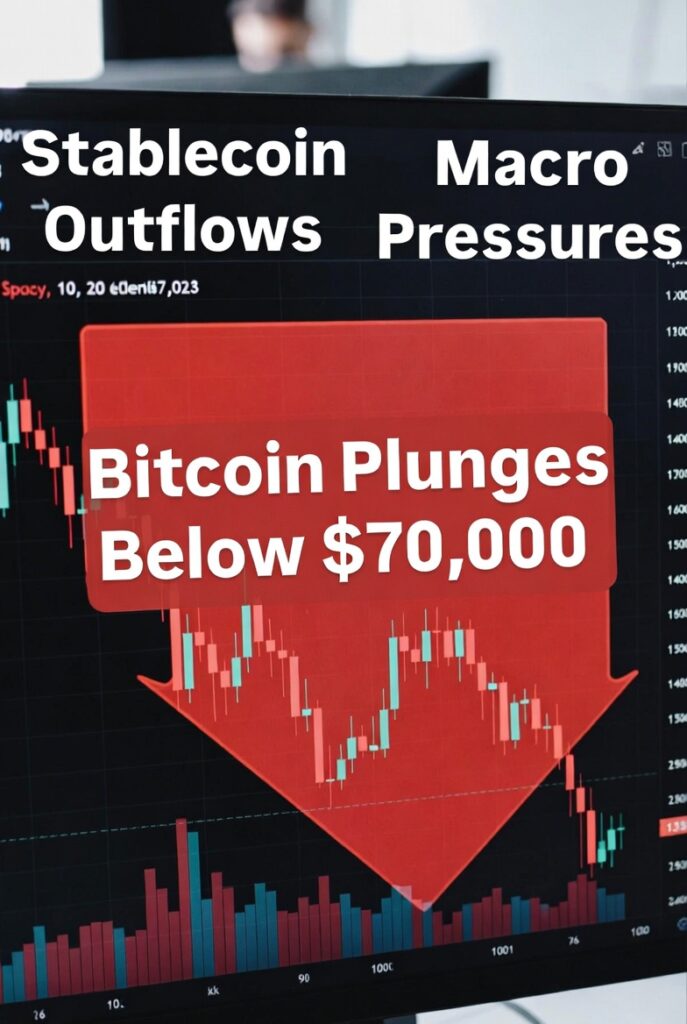
Bitcoin has broken below the psychologically important $70,000 level in early Asian trading on February 16, 2026, accelerating a sell-off that has now erased more than $2 trillion from the global cryptocurrency market capitalization since the late-2025 all-time highs near $126,000.
BTC last traded around $68,900–$69,200 (down ~4–5% in the past 24 hours), dragging the total crypto market cap below $2.4 trillion for the first time since mid-November 2025. Ethereum fell sharply to $1,980–$2,020, while most altcoins posted losses of 6–12%, reflecting broad-based risk aversion.
Primary Drivers of the Decline
Analysts and on-chain data point to a confluence of factors:
- Massive stablecoin outflows
Since early December 2025, approximately $13.8–$14.2 billion has exited major stablecoins (primarily USDT and USDC), according to Glassnode, CryptoQuant, and DefiLlama trackers. The outflows accelerated in January–February 2026 amid rising real yields and uncertainty over Fed policy direction. Reduced stablecoin supply acts as a direct liquidity drain from crypto trading pairs. - Derivatives deleveraging
Open interest in Bitcoin perpetual futures has dropped ~22% from December peaks, with funding rates remaining deeply negative for weeks. Liquidations over the past 72 hours exceeded $1.9 billion (longs dominant), but the process has been described as “orderly deleveraging” rather than blind panic selling. Platforms like Coinbase Advanced Trade and Binance Futures have seen leverage ratios compress significantly. - Macro and cross-asset pressures
Sharp corrections in AI-related technology stocks (down 12–18% YTD in many cases) have triggered broader risk-off flows. Persistent uncertainty around Federal Reserve leadership transitions, sticky core inflation prints, and mixed labor-market signals continue to keep real yields elevated — a historically difficult environment for high-beta assets like crypto.
Institutional Footing Holds — For Now
Despite the headline price action, several indicators suggest the correction has not yet triggered widespread institutional capitulation:
- Spot Bitcoin ETF holdings remain broadly stable, with only modest net outflows (~$800 million–$1.1 billion over the past month) compared to the scale of the drawdown.
- On-chain long-term holder (LTH) supply continues to rise slowly, with minimal distribution from wallets holding >1 year.
- Corporate Bitcoin treasuries (MicroStrategy, Tesla, Metaplanet, etc.) have shown no major sales announcements.
This relative resilience among larger holders contrasts with retail-driven liquidations and supports the narrative that the current phase is primarily a leverage flush rather than a fundamental rejection of the asset class.
Production Cost Floor and Near-Term Outlook
Glassnode and The Block data indicate Bitcoin’s estimated all-in production cost (including electricity, hardware depreciation, and operational overhead) has fallen to approximately $76,000–$77,000 — now above spot price for the first time since mid-2025. While not an ironclad floor, this level historically attracts miner capitulation selling exhaustion and bargain hunting.
Key levels to watch:
- Immediate support: $65,000–$68,000 (prior consolidation zone + 200-day EMA)
- Deeper support: $58,000–$62,000 (2025 accumulation base)
- Resistance: $72,000–$74,000 (needs reclaim to neutralize bearish structure)
Broader Implications and Recovery Path
The ongoing correction underscores crypto’s continued sensitivity to macro conditions and leverage cycles. Yet it also highlights maturing risk-management practices: lower average leverage, more orderly deleveraging, and stronger institutional balance sheets compared to 2021–2022.
A sustained recovery will likely require:
- Stabilization or reversal in stablecoin flows (renewed minting)
- Clearer Fed signals (softer inflation data or dovish commentary)
- Positive regulatory catalysts (progress on U.S. market-structure bills)
- Return of risk-on sentiment in equities, particularly AI/tech
Until those pieces align, volatility remains elevated and downside risks persist. For now, the market appears to be in a classic “wait-and-see” consolidation phase — painful for leveraged participants, but potentially healthy for the ecosystem’s long-term foundation.
CoinReporter will continue monitoring ETF flows, stablecoin supply changes, and macro data releases for early signs of reversal.

The content on CoinReporter.io is for informational purposes only and is not financial or investment advice. Cryptocurrency investments are highly volatile and risky. Always conduct your own research and consult a qualified financial advisor before making any investment decisions. CoinReporter.io and its authors are not liable for any losses resulting from actions based on this website’s content.
























- Bitcoin slipped below $63,000 on Wednesday, trading at $62,601 as of 17:13 UTC, according to CoinGecko, as Alternative.me’s Fear & Greed Index stood at 11, or Extreme Fear.
- Federal Reserve Governor Christopher Waller told CNBC the Fed may need to “shock people” with a 50-basis-point rate hike at its Dec. 8–9 meeting.
- U.S. spot bitcoin ETFs lost a net $239.9 million on Tuesday, Farside Investors data show, and the Fed’s October minutes are due at 7:00 p.m. in London.
Bitcoin slipped below $63,000 on Wednesday, according to this crypto market analysis, as Alternative.me’s Fear & Greed Index remained at Extreme Fear and Federal Reserve Governor Christopher Waller warned that officials may need a 50-basis-point rate hike in December.
The largest cryptocurrency traded at $62,601 as of 17:13 UTC on Nov. 18, down 2.0% over 24 hours, according to CoinGecko. Ether was at $1,748.87, down 2.0%, while Solana traded at $72.94, up 0.6%. CoinGlass put bitcoin’s session low near $62,250.
The Crypto Fear & Greed Index stood at 11 on Nov. 18, a reading Alternative.me classifies as Extreme Fear. It was 12 on Tuesday and has been in Extreme Fear since at least Nov. 14, when the same series printed 13.
The index is a daily snapshot of market sentiment, not proof that traders are selling because of the reading itself. Even so, a print of 11 shows how uneasy the market has become after bitcoin lost ground through mid-November and failed to hold the $64,000–$66,000 range that had contained prices since Nov. 15.
Fund flows have added to the pressure. U.S. spot bitcoin exchange-traded funds lost a net $239.9 million on Tuesday, according to Farside Investors, with BlackRock’s iShares Bitcoin Trust (IBIT) accounting for $209.5 million of the withdrawals. That reversed a slim $7.9 million inflow on Monday.
The Tuesday outflow is the same figure CoinReporter reported earlier on Wednesday. Farside’s public table still showed a blank line for Nov. 18 as of late afternoon in London, so Wednesday’s ETF flows had not yet been published by the data provider.
Forced selling showed up in the futures market. CoinGlass data showed about $150.06 million of bitcoin futures liquidations over 24 hours as of Wednesday afternoon, with long positions making up 74% of that total. That is smaller than the $1.9 billion wipeout when bitcoin last fell to a three-month low below $63,000, but leveraged bulls were again caught.
Waller’s Warning and Strategy Shares
Waller, speaking to CNBC on Wednesday, said inflation is “headed in the wrong direction, and it’s spreading out.” He argued that a half-point increase is probably necessary at the Fed’s Dec. 8–9 meeting, or a quarter-point move plus a clear signal of another hike in January.
“You might need to, like, shock people,” Waller said. Rate futures were still fully pricing a quarter-point December hike, rather than the larger move he prefers, CNBC reported. Minutes of the Fed’s Oct. 27–28 meeting, when policymakers voted 10–2 to hold rates at 3.75% to 4%, are due at 19:00 UTC, or 7:00 p.m. in London.
CoinDesk’s live market blog said Strategy’s perpetual preferred stock, STRC, fell 3% to $95.75 on Wednesday afternoon, its lowest level since August, even as the company has been buying the shares back. Strategy’s common shares, MSTR, were down 4% at $92.11.
The move in Strategy stock adds to a difficult stretch after the company’s bitcoin holdings fell about $9.5 billion below their average cost. A further break in bitcoin would keep pressure on both the common shares and the preferred stock.
The next test for sentiment is the Fed minutes and whether bitcoin can reclaim $63,000. As of 17:13 UTC on Nov. 18, bitcoin was at $62,601 on CoinGecko, still above the session low near $62,250 but well below the range that had held since mid-November.


Bitcoin ETFs Extend Outflow Streak to Eight Days as Traders Brace for Nvidia Earnings
U.S. spot bitcoin exchange-traded funds recorded net outflows of $68.6 million on Monday, according to data from Farside Investors, extending...


Aster CEO Blames Likely Malicious Liquidations as ASTER Token Plunges 32% in Minutes
Key takeaways Aster chief executive Leonard Leung said the team is investigating after the ASTER token jumped above $0.71 and...


Coinone Warns of Phishing After Breach at Support Contractor Exposes 11 Data Types
Key takeaways South Korean crypto exchange Coinone has warned customers about phishing and identity theft after an attacker breached MetaM,...


Bitcoin Tests $75,200 Support
Total crypto market capitalization hovered near $2.50–2.54 trillion on November 9, 2026. Bitcoin dominance remained elevated at roughly 59–60%. The...


Bitcoin Slips Toward $74,600
Bitcoin traded in a tight range near $75,000–$76,000 for much of November 8 before settling lower, closing the CoinMarketCap snapshot...


Bitcoin Crashes Toward $75K
Bitcoin closed November 6 near $75,900 after an intense sell-off that pushed it as low as roughly $74,800 intraday—its weakest...


Crypto Market Stabilizes After Sharp Dip
Bitcoin recovered from multi-week lows near $75,200 and stabilized above $76,000 on November 6, 2026, as the market absorbed a...


Elizabeth Warren Expected to Chair Senate Banking Committee After Democratic Midterm Sweep
Longtime crypto critic Senator Elizabeth Warren is positioned to lead the powerful Senate Banking Committee when the new Congress convenes...


Bitcoin Dips to Multi-Week Lows Near $75,200 Before Recovering Above $76,000
Bitcoin briefly tumbled below $76,000 on November 6, 2026, reaching multi-week lows near $75,200 before buyers stepped in and the...


Bitcoin Rebounds Past $80,000 as Midterms Conclude and Markets Digest Binance Hack Details
Bitcoin staged a sharp V-shaped recovery on November 4, reclaiming $80,000 after briefly touching a seven-week low near $75,600–$75,700. The...
-

 DeFi3 weeks ago
LUNC Hits 462B Burned After v4.1.1 Upgrade
-
 DeFi1 month ago
Bitcoin and Ethereum Spot ETFs Record Substantial Weekly Outflows
-

 DeFi4 weeks ago
Arbitrum Rallies on Stablecoin Growth Program as DeFi Tokens Outperform
-

 DeFi4 weeks ago
BNB Standard Corporation
-

 DeFi1 month ago
Nine Crypto Firms Launch Quantum Alliance to Set Post-Quantum Standards
-

 Crypto3 weeks ago
DTCC Launches Tokenization Service Covering Approximately $30 Trillion in Securities
-

 DeFi4 weeks ago
Binance-Linked Transfer Triggers 347 Million LUNC Burn
-

 DeFi4 weeks ago
Swiss FINMA Approves First Retail Bitcoin ETF Holding BTC Directly
-

 DeFi4 weeks ago
U.S. Spot Bitcoin ETFs Post Best Inflow Day in Nearly a Month
-

 DeFi4 weeks ago
World Liberty Financial’s USD1 Stablecoin Sheds Over $400 Million in Market Cap Amid Redemptions
-

 DeFi4 weeks ago
Strive Discloses Additional Bitcoin Purchases, Holdings Reach 36,818 BTC
-

 Crypto3 weeks ago
Memecoin PEPE Rallies on Reported Large Holdings Linked to Justin Sun; Broader Tokenization Debate Continues
-

 DeFi4 weeks ago
Crypto Hacks and Losses Reach $1.18 Billion in Q3 2026 Across 107 Incidents
-

 DeFi3 weeks ago
Ripple Secures Final OCC Approval for National Trust Bank to Oversee RLUSD
-

 Bitcoin3 weeks ago
Federal Reserve Holds Rates Steady as Bitcoin Trades Near $80,000; December Hike Odds Rise
-

 DeFi4 weeks ago
Crypto Liquidations Surge Past $400 Million in Hours as Bitcoin Briefly Dips Below $80,000
-

 Crypto3 days ago
Ether ETFs Lose $399 Million for Seventh Straight Week, Nearing Record Outflow Streak
-

 DeFi4 weeks ago
Bitcoin Slides Below $81,500 as Tech Sell-Off and Elevated Oil Prices Hit Risk Assets
-
DeFi1 week ago
Bitcoin Tests $75,200 Support
-

 DeFi4 weeks ago
Mt. Gox Extends Creditor Repayment Deadline to October 2027
-

 DeFi4 weeks ago
JPMorgan Expands JPM Coin Deposit Token to Ethereum Mainnet for Institutional Clients
-

 DeFi4 weeks ago
Strive Adds $335 Million in Bitcoin to Corporate Treasury
-

 DeFi1 month ago
Circle Targets 40 Emerging Markets
-

 Crypto3 weeks ago
Hyperliquid Permanently Burns Nearly 5% of Maximum HYPE Supply Amid Broader Token Burn Trends
-

 DeFi3 weeks ago
Stablecoin Issuers and Partners Freeze Billions Linked to Binance Incident
-
DeFi2 weeks ago
Bitcoin Rebounds Past $80,000 as Midterms Conclude and Markets Digest Binance Hack Details
-

 DeFi4 weeks ago
Strategy Adds 267 Bitcoin for $22.1 Million, Bringing Holdings to 848,517 BTC
-
Bitcoin2 days ago
Bitcoin ETFs Extend Outflow Streak to Eight Days as Traders Brace for Nvidia Earnings
-
DeFi2 weeks ago
Bitcoin Crashes Toward $75K
-

 DeFi4 weeks ago
BlackRock Files for “Buffer” Bitcoin ETF (Ticker: PBIT)
-

 Crypto6 days ago
DTCC Adds Solana to Tokenization Service, Targeting Second Half of 2027
-

 DeFi4 weeks ago
Mastercard Advances AI Agent Payments
-

 Bitcoin13 hours ago
Crypto Market Analysis: Bitcoin Slips Below $63,000 as Fear Grips Traders
-

 DeFi3 weeks ago
Moody’s Assigns Investment-Grade A2 Rating to Ripple’s RLUSD; Coinbase Lists the Stablecoin
-

 DeFi2 weeks ago
Bitcoin Falls Below $77,000 as Chip Stocks Sell Off Ahead of U.S. Midterms
-
DeFi2 weeks ago
Bitcoin Dips to Multi-Week Lows Near $75,200 Before Recovering Above $76,000