Crypto
Revolutionizing Stablecoins: The Proposal for USTD on Terra Luna Classic

In the ever-evolving world of decentralized finance (DeFi), innovation often emerges from the ashes of past failures. The Terra Luna ecosystem, once rocked by the dramatic collapse of its algorithmic stablecoin USTC in 2022, is now the backdrop for a bold new proposal: USTD, a decentralized and fully automated yield-bearing stablecoin designed to rebuild trust and utility on the Terra Luna Classic (LUNC) blockchain. This idea, recently floated in a detailed thread on X by community member @Doncho_MIOFF, aims to address the shortcomings of its predecessor while introducing features that could attract a new wave of investors and developers.
The Genesis of USTD: Learning from USTC’s Downfall
Terra Luna Classic, the original chain that survived the 2022 crash, has been striving for revival. USTC, formerly known as UST, was an algorithmic stablecoin pegged to the US dollar through a mint-and-burn mechanism tied to LUNA tokens. Its depegging led to a catastrophic loss of billions in value, eroding confidence in the ecosystem. Enter USTD—a “new generation” stablecoin proposed as a native asset on LUNC, explicitly crafted to avoid the pitfalls of over-reliance on unsustainable incentives like those seen in the Anchor Protocol, which offered artificially high yields that contributed to the crash.
The proposal positions USTD as a decentralized alternative, free from centralized control by any single entity. Unlike USTC, which depended on market arbitrage and external incentives, USTD emphasizes built-in automation and real-world yield generation. The concept draws inspiration from modern DeFi trends, where stablecoins are evolving beyond mere peg stability to offer passive income directly to holders.
How USTD Would Work: Automation and Yield at Its Core
At the heart of USTD is its yield-bearing mechanism, which sets it apart from traditional stablecoins like USDT or USDC. Holders wouldn’t need to stake or lock their tokens in separate protocols; yields would accrue automatically in users’ wallets. This “hands-off” approach is powered by underlying liquidity positions within the Terra Luna Classic ecosystem.
The protocol would likely leverage automated smart contracts to manage stability and yield distribution. For instance:
- Peg Maintenance: USTD could use over-collateralization with diverse assets or oracle-fed pricing to maintain its $1 peg, reducing the algorithmic risks that doomed USTC.
- Yield Generation: Real yields—potentially from transaction fees, liquidity provision rewards, or integrated DeFi pools—would be distributed proportionally to holders. This contrasts with “empty promises” of high APYs that aren’t backed by sustainable economics.
- Decentralization: Governed by community DAOs or on-chain voting, USTD avoids the single-point-of-failure issues seen in centralized stablecoins.
While technical specifics like smart contract architecture or exact collateral types aren’t fully detailed in the proposal, the emphasis is on native integration with LUNC. This could boost on-chain activity, as USTD transactions would contribute to the blockchain’s staking rewards and overall utility.
The Appeal: Pros of a Yield-Bearing Stablecoin on LUNC
Proponents highlight several advantages that could make USTD a game-changer:
- Passive Income for Holders: In a market where yields are king, automatic earnings could draw retail and institutional users seeking low-risk returns without additional steps.
- Decentralized Control: No corporate oversight means greater resilience to regulatory pressures or internal mismanagement.
- Ecosystem Boost: As a native stablecoin, USTD could fuel DeFi growth on Terra Luna Classic, attracting dApps, DEXs, and lending protocols. This might help revive LUNC’s price and market cap, which has lingered in the shadows post-crash.
- Sustainability: By tying yields to genuine liquidity and network activity, USTD avoids the hyperinflationary traps of past models.
In essence, USTD could serve as the foundational asset for a revitalized Terra ecosystem, much like how USDC anchors Circle’s operations or DAI supports MakerDAO.
Potential Pitfalls: Risks and Challenges
No innovation is without hurdles, and the proposal candidly acknowledges them:
- Technical Complexity: Building a fully automated system requires robust smart contracts, which could introduce bugs or exploits if not audited thoroughly.
- Liquidity and Adoption: Stability depends on deep liquidity pools; without widespread use, USTD risks depegging during market volatility.
- Regulatory Scrutiny: Yield-bearing stablecoins might face heightened oversight, especially in regions like the US or EU, where authorities are cracking down on crypto yields resembling securities.
- Lingering Trust Issues: The shadow of USTC’s failure looms large. Convincing the community to embrace another stablecoin on the same chain will require transparency and proven mechanics.
These risks underscore the need for rigorous testing, perhaps through testnets or phased rollouts, to build confidence.
Impact on Terra Luna Classic: A Path to Redemption?
For Terra Luna Classic, USTD represents more than just a token—it’s a potential catalyst for rebirth. A successful stablecoin could:
- Drive Utility: Increase transaction volumes, staking participation, and developer interest.
- Attract Capital: Lure back investors who fled post-2022, positioning LUNC as a competitive Layer 1 chain.
- Foster DeFi Growth: Enable lending, borrowing, and yield farming natively, reducing reliance on cross-chain bridges.
If implemented safely, USTD could mirror the success of projects like Frax or Aave’s GHO, which combine stability with yield. However, failure could further tarnish Terra’s reputation, making community buy-in crucial.
Conclusion: Innovation vs. Caution in DeFi’s Next Chapter
The USTD proposal is an ambitious step toward redeeming Terra Luna Classic’s legacy. By focusing on decentralization, automation, and real yields, it addresses core flaws in previous designs while aligning with DeFi’s push for user-centric finance. Yet, as the thread wisely notes, success hinges on balancing innovation with risk management and community involvement.
As discussions unfold—potentially through governance proposals or whitepaper releases—the crypto world will watch closely. Could USTD spark a Terra renaissance, or is it another chapter in stablecoin experimentation? Only time, and perhaps a bit of blockchain magic, will tell. For now, it’s a reminder that in crypto, second chances often come with smarter blueprints.

The content on CoinReporter.io is for informational purposes only and is not financial or investment advice. Cryptocurrency investments are highly volatile and risky. Always conduct your own research and consult a qualified financial advisor before making any investment decisions. CoinReporter.io and its authors are not liable for any losses resulting from actions based on this website’s content.








Spreek, a security researcher, said on October 22 that someone with Swell DAO’s operational hot keys pushed up the exchange rates of its swETH and rswETH liquid staking tokens at the 1% hourly cap without any new ETH behind them.
The reports emerged hours after cloud platform Railway revealed that an intruder might have accessed stored secrets of customers.
Odysseus counted five hikes of about 1% across both tokens
Spreek shared the findings on X at 01:28 UTC, saying the admin keys for both tokens “appear to be compromised (railway related?)”. Attackers were “raising NAV by max 1% (unbacked) each hour,” the post said.
Phylax Systems founder Odysseus called it “BOT-key abuse,” noting three swETH and two rswETH rate hikes of about 1% apiece. Swell’s published oracle code confines submission of repricing snapshots to the BOT role only.
That bot runs on hot keys. Hot keys are online and sign without a human.
Ethereum records show one address submitting swETH snapshots at 23:02 UTC on October 21 and then again at 00:04 and 01:08 UTC on October 22. Reported numbers as of October 22 show swETH around 3.0% above 1.133254 ETH.
rswETH was up about 2.0% from 1.082464 ETH.
Railway said on Oct. 21 that it observed anomalous activity in systems that store customer environment variables and that an outsider may have had access to decrypted contents for some. Among the secrets stored there are API keys and registry credentials.
The platform froze all deployments and urged all users to roll stored secrets.
The same day, crypto investigator Tay said an attacker had drained around $371,000 from wallets on at least 19 EVM chains with keys stored on Railway. There has been no confirmation of a tie between the Railway breach and Swell.
Four malicious upgrade contracts could take about 2,500 ETH
Swell said on X at 03:03 UTC on Oct 22, it was aware of reports of “suspicious activity on the swETH and rswETH contracts” and was investigating with its security partners. “No ETH has left the swETH or rswETH withdrawal or deposit contracts,” the team wrote, adding no action was needed.
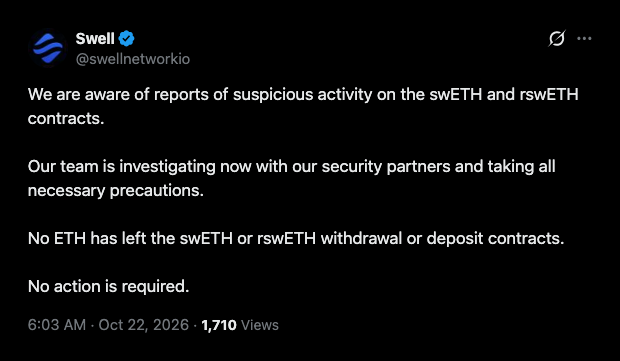
Swell paused deposits and withdrawals for swETH and rswETH on October 23 and said it would resume them once NAV returns to the correct value.
Spreek also reported four malicious upgrade contracts deployed that could take around 2,500 ETH if executed. Odysseus reckoned that Swell was holding 2,513 ETH, adding that the amount “is NOT confirmed loss.”
At the time of the reports, none of the upgrades had been run.
Some of the details in the research were reportedly compiled with AI assistance and are unverified.
Only a fraction of higher rates is reportedly priced into DEX prices. Swell’s liquid staking and liquid restaking products each held around $29 million in total value locked on October 23, while data sources point to a market cap for rswETH between $27 million and $58 million.
In a lending market that prices swETH or rswETH off the on-chain rate, that inflated number would count as collateral. Cryptopolitan tracked the same contagion path with KelpDAO’s rsETH exploit spreading to Layer 2 lending markets.
Leaked keys were also behind the Fearless Wallet extension that sent the private keys of Polkadot users to an attacker’s server.
If you’re reading this, you’re already ahead. Stay there with our newsletter.


Binance-Linked Transfer Triggers 347 Million LUNC Burn
Binance-Linked Transfer Triggers 347 Million LUNC Burn, Pushing All-Time Total Past 462 Billion On October 23, 2026, a large transfer...


Bitcoin Slides Below $81,500 as Tech Sell-Off and Elevated Oil Prices Hit Risk Assets
Bitcoin fell sharply on October 22, 2026, trading near $81,300–$81,600 with a market capitalization of roughly $1.63–$1.64 trillion after dropping...


BNB Standard Corporation
BNB Standard (Nasdaq: BNC) to Ring Nasdaq Opening Bell on October 26 Under New CEO Alex Odagiu Binance co-founder Changpeng...


Mastercard Advances AI Agent Payments
Mastercard opened early access and demonstrated live transactions for its Agent Pay for Machines system. The platform allows AI agents...


JPMorgan
J.P. Morgan Asset Management included Bitcoin for the first time in its long-term capital market assumptions, projecting a 10% compound...


Strive Adds $335 Million in Bitcoin to Corporate Treasury
Nasdaq-listed Strive purchased 4,045 BTC between October 12 and 16, 2026, at an average price of roughly $82,803 per coin...


BlackRock Files for “Buffer” Bitcoin ETF (Ticker: PBIT)
BlackRock filed with the SEC on October 19, 2026, for the iShares Bitcoin Managed Protection ETF (proposed ticker PBIT). The...


Mt. Gox Extends Creditor Repayment Deadline to October 2027
The rehabilitation trustee for the collapsed Mt. Gox exchange pushed the creditor repayment deadline to October 31, 2027, with Tokyo...


U.S. Spot Bitcoin ETFs Post Best Inflow Day in Nearly a Month
U.S. spot Bitcoin ETFs recorded $526.7 million in net inflows on October 19, 2026, the largest single-day haul since September...


Swiss FINMA Approves First Retail Bitcoin ETF Holding BTC Directly
Switzerland’s Financial Market Supervisory Authority (FINMA) approved the country’s first retail exchange-traded fund that holds Bitcoin directly on October 20,...
-

 DeFi1 month ago
Bitcoin Reclaims $81,000 and Closes Above Key 50-Week Moving Average
-

 DeFi3 weeks ago
Hong Kong Moves Licensed Stablecoins Onto Exchanges and Into Fund Settlement
-

 Crypto2 weeks ago
ESMA gives EU crypto firms three months to exit non-MiCA stablecoins
-

 Crypto3 weeks ago
Binance Burns 334.88 Million LUNC in October Fee Batch as Second Transaction Lifts the Day’s Total
-

 DeFi1 month ago
Coinbase Adds Fixed-Rate Bitcoin-Backed Loans via Morpho Midnight
-

 Bitcoin2 weeks ago
Strategy (MicroStrategy) Adds 250 Bitcoin, Holdings Reach 848,250 BTC
-

 Bitcoin3 weeks ago
SEC clears listing path for first U.S. 3x Bitcoin and Ether ETFs
-

 DeFi3 weeks ago
TOKEN2049 Opens in Singapore Next Week as the City Leads Regional Crypto Flow
-

 DeFi3 weeks ago
Robinhood Puts Hedge-Fund Tools in the App as Macro Turns Softer
-

 DeFi3 weeks ago
HSBC Names Its Hong Kong Stablecoin RedCoin, and Starts With PayMe
-

 DeFi4 weeks ago
Solana Advances Alpenglow Upgrade to Public Testnet
-

 DeFi2 weeks ago
Bitcoin Drops Below $82,000 Amid $770M+ in Liquidations as Volatility Spikes
-

 Bitcoin2 weeks ago
Bitcoin breaks under $84,000 as oil spikes on Hormuz tanker attacks
-

 Bitcoin4 weeks ago
Strategy Adds Another 1,665 BTC, Lifting Holdings to 847,666
-

 Bitcoin1 month ago
Record ETF Inflows and a Short Squeeze Drive Bitcoin’s $87,000 Break
-

 DeFi3 weeks ago
South Korea Ranks Second in On-Chain Crypto Holdings as the Tax Date Holds
-

 DeFi1 month ago
Bitcoin Surges Above $87,000 as Crypto Market Cap Reclaims $3 Trillion
-

 DeFi1 month ago
CFTC Submits Crypto Market Rules to White House Amid Congressional Stall
-

 Bitcoin1 month ago
X Partners With Coinbase, Kraken, Gemini and Brokers to Trade From the Timeline
-
DeFi1 month ago
Bitcoin Surges Above $87,000 on ETF Inflows and Massive Short Squeeze
-

 Crypto3 weeks ago
Treasury and FinCEN drop unhosted-wallet and mixer surveillance proposals
-

 Bitcoin4 weeks ago
Coinbase Receives CFTC Approval for U.S. Derivatives Clearinghouse
-

 DeFi3 weeks ago
BTSE Receives a Full Licence to Trade and Custody Crypto in Bhutan
-

 Crypto3 weeks ago
Singapore Reclaims the Regional Crypto Lead at $284 Billion as the Rest of CSAO Shrinks
-

 DeFi2 weeks ago
Bitcoin Holds Above $84,000, Shrugging Off Heavy ETF Outflows as Oil Declines
-

 DeFi2 weeks ago
Government-linked wallets move seized coins
-

 Bitcoin1 month ago
Strategy Resumes Bitcoin Buying, Adds 950 BTC
-

 DeFi2 weeks ago
Winklevoss files a 0.25% Zcash ETF
-

 Bitcoin2 weeks ago
Spot bitcoin ETFs flip to a ~$487 million outflow
-

 DeFi2 weeks ago
Uptober stalls ahead of the Fed minutes
-

 Bitcoin2 weeks ago
Bitcoin loses $84,000 as Hormuz attacks lift oil and yields
-

 DeFi1 week ago
U.S. Spot Bitcoin and Ethereum ETFs See Significant Weekly Outflows
-

 Crypto3 weeks ago
CFTC opens Regulation CTX and CAM after Clarity Act stalls
-

 DeFi1 month ago
Avalanche Gains on NYSE Tokenization Testing Reports
-

 Crypto2 weeks ago
Ether funds were already bleeding
-

 DeFi4 weeks ago
Quant Surges After Selection for U.S. Bank On-Chain Payments Initiative