DeFi
Quant Surges After Selection for U.S. Bank On-Chain Payments Initiative

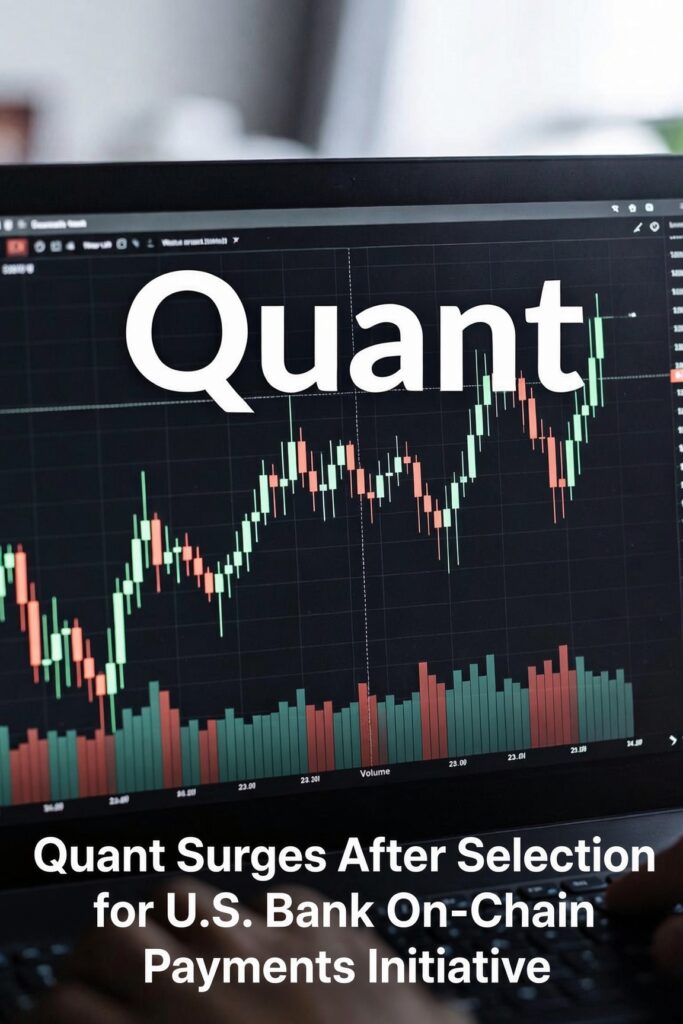
The token that talks to bank rails just got named on the biggest U.S. clearing network.
On September 24, The Clearing House — owned by 25 of the largest U.S. banks, including names that sit on JPMorgan, Citi, Bank of America and Wells Fargo letterhead — selected Quant to power its On-Chain Money Initiative. The project is a shared network so institutions of any size can clear and settle tokenized deposits with each other, not only inside one bank’s walled garden. Quant supplies interoperability, orchestration and transaction management, and hooks the new rail to the pipes already running: RTP and CHIPS. TCH’s existing systems already clear more than $2 trillion a day across wire, ACH, check image and real-time payments. Target availability: first half of 2027. Details on who goes live first are still coming.
What Quant actually won
Tokenized deposits are bank liabilities on a ledger — same insurance and supervision as a deposit, programmable and faster to move. Large U.S. banks already have their own versions. They do not talk to each other. TCH’s job is the interbank layer: customer of Bank A pays customer of Bank B, then the banks settle with each other. Quant also becomes the Tokenised Deposits-as-a-Service option for TCH members that do not have their own stack yet. The firm is already on the U.K. Great British Tokenised Deposit work, which just ran live customer transactions. Gilbert Verdian called tokenized deposits the default way banks move money on-chain and TCH “the heart of the U.S. banking system.” Sal Karakaplan at TCH called it proven tech that can scale.
That is middleware for regulated money. It is not “QNT is the new dollar.” Banks will not need to hold the token to send a deposit. The trade is that a scarce interoperability token reprices when the issuer is written into U.S. clearing architecture.
The tape did the rest
QNT had spent months in a roughly $60–$80 range. After the announcement it led large-cap gainers: +27% on the print day, then a multi-session run that various desks marked from about +150% to well over +300% on a seven-day window, with prints from the high $90s through $180–$190 and some later snapshots higher still. Volume and active addresses spiked — Santiment flagged 2,064 active addresses on September 24, a one-year high. Mid- and large-cap alts caught a bid the same week. Treat the exact handle as a moving target; treat the ranking as settled: QNT was the week’s institutional-narrative winner.
What is priced, what is not
H1 2027 is not next Tuesday. Participation lists are open. TCH selected a vendor after a competitive process announced in June; it did not put QNT in CHIPS. A 300% week on a 14.9 million cap supply can unwind as fast as it printed if the next press release is a timeline slip. The fundamental sentence is still large: the operator of America’s high-value and real-time clearing chose a crypto-native interoperability shop to stitch tokenized deposits to RTP and CHIPS.
That sits next to Circle’s Arc, the ECB’s Pontes, DBS–Citi weekend tokenized dollars, and the SEC’s tokenization exemption. Banks are picking rails. Quant just got written onto one that already moves $2 trillion a day — in software, not in token velocity. The token moved anyway. That is how these headlines trade.

The content on CoinReporter.io is for informational purposes only and is not financial or investment advice. Cryptocurrency investments are highly volatile and risky. Always conduct your own research and consult a qualified financial advisor before making any investment decisions. CoinReporter.io and its authors are not liable for any losses resulting from actions based on this website’s content.







Bitcoin rebounded to trade near or above $84,000 on Monday, October 12, 2026, recovering from earlier dips toward the low $83,000s and demonstrating resilience after the largest weekly outflows from U.S. spot Bitcoin ETFs since June.
According to CoinDesk and CoinGecko-linked data, the leading cryptocurrency traded near $84,050 after slipping to around $83,500 earlier in the session. It had closed the prior day in the roughly $83,600–$83,800 range with a modest daily gain, supported by a broader recovery in risk assets as oil prices eased.
U.S.-listed spot Bitcoin ETFs recorded approximately $681 million in net outflows over the previous week (October 5–9), ending a three-week inflow streak and marking the heaviest weekly withdrawal since June, per SoSoValue and related flow data. Fidelity’s FBTC led the withdrawals with roughly $380 million, while products including BlackRock’s IBIT and ARK’s ARKB also saw substantial redemptions. Two heavy sessions—around $485–487 million on October 7 and $244 million on October 8—drove most of the selling, before a modest roughly $21 million inflow on October 9 helped stabilize flows.
Despite the institutional outflows, Bitcoin held key levels. Analysts pointed to $82,000 as important near-term support, with the recovery occurring even as total ETF assets stood near $105–106 billion. The price action suggested other buyers—potentially including longer-term holders or corporate treasuries—were absorbing supply.
Broader Market Gains and Macro Backdrop
The rebound extended across much of the top tier. Ethereum traded in the roughly $2,540–$2,565 range, while Solana, XRP, and Avalanche advanced, with Avalanche among the stronger performers in the major altcoins. Most of the top 10 assets posted gains on the day, though weekly performance for many remained mixed after earlier declines that had pushed Bitcoin toward $80,000–$81,000 lows amid surging oil and Treasury yields.
Falling oil prices provided a lift to risk assets. West Texas Intermediate (WTI) futures declined about 1.8% to near $90.28, reversing a Thursday spike that had injected uncertainty. The move followed President Donald Trump’s announcement of an agreement for Russia to supply 300,000 metric tons of diesel to international and domestic markets, alongside signs of eased geopolitical tensions related to energy and the Middle East. Brent crude remained elevated but softened from recent highs above $100–$105.
Elevated U.S. Treasury yields and a firm dollar continued as background pressures, keeping some investors cautious on non-yielding assets like Bitcoin. BTC dominance hovered in the 56–60% range depending on the data provider.
Whale Activity, Outlook, and Catalysts
On-chain and market reports indicated continued selective accumulation by large holders. Whales added roughly 15,000 BTC (valued near $1.2 billion) over a recent 72-hour window amid the prior sell-off, consistent with broader patterns of larger wallets adding exposure even as retail and some institutional flows were mixed. Corporate treasury buyers also remained active on a selective basis.
Attention now turns to upcoming U.S. inflation data, with the Consumer Price Index (CPI) due around October 14. The print is widely viewed as the next major catalyst, with potential implications for Federal Reserve policy expectations ahead of the late-October FOMC meeting. A hotter-than-expected reading could renew pressure via yields and the dollar, while a softer print might support further risk-asset recovery.
Bitcoin’s ability to reclaim and hold the $84,000 area after the ETF outflow week and oil-driven volatility highlights relative strength in the spot market. However, resistance in the $85,000–$86,000 zone and ongoing sensitivity to macro factors—yields, energy prices, and inflation data—leave the near-term path dependent on whether buyers can sustain the recovery beyond the current rebound.


Bitcoin Holds Above $84,000, Shrugging Off Heavy ETF Outflows as Oil Declines
Bitcoin rebounded to trade near or above $84,000 on Monday, October 12, 2026, recovering from earlier dips toward the low...


ESMA gives EU crypto firms three months to exit non-MiCA stablecoins
The European Securities and Markets Authority on 8 October told national supervisors that MiCA-authorised crypto firms should stop providing services...


Uptober stalls ahead of the Fed minutes
Seasonality lost to bonds. October has been positive for bitcoin in 10 of the past 13 years, and 21Shares had...


Government-linked wallets move seized coins
Early on-chain reads put about $103 million in motion: 833.6 BTC, roughly $71.6 million, to Coinbase Prime, and 40,285 BNB,...


Winklevoss files a 0.25% Zcash ETF
Winklevoss Asset Services filed for a spot Zcash ETF, proposed Nasdaq ticker WINK, with Gemini as custodian and a 0.25%...


Spot bitcoin ETFs flip to a ~$487 million outflow
Tuesday’s US spot bitcoin ETFs took in about $119 million, the fourth inflow in five sessions. Wednesday reversed that. SoSoValue-linked...


Bitcoin loses $84,000 as Hormuz attacks lift oil and yields
Bitcoin closed at $83,275.93, down 2.67%, after Iran stepped up attacks on tankers in the Strait of Hormuz. Brent rose...


Binance Burns 334.88 Million LUNC in October Fee Batch as Second Transaction Lifts the Day’s Total
Binance removed 334,879,422 Terra Luna Classic (LUNC) from circulation on October 1, the headline transaction in its monthly exchange burn...


TOKEN2049 Opens in Singapore Next Week as the City Leads Regional Crypto Flow
TOKEN2049 runs October 7–8 at Marina Bay Sands. Organisers expect more than 25,000 people, from more than 7,000 companies and...


BTSE Receives a Full Licence to Trade and Custody Crypto in Bhutan
BTSE has a full financial-services licence in Gelephu Mindfulness City. The company said on September 29 that the Gelephu Financial...
-

 DeFi3 weeks ago
Bitcoin Reclaims $81,000 and Closes Above Key 50-Week Moving Average
-

 DeFi1 month ago
Solana Sets Record with Over 263,000 New Tokens Minted in a Single Day
-

 DeFi2 weeks ago
Hong Kong Moves Licensed Stablecoins Onto Exchanges and Into Fund Settlement
-
Crypto4 days ago
ESMA gives EU crypto firms three months to exit non-MiCA stablecoins
-

 DeFi3 weeks ago
Coinbase Adds Fixed-Rate Bitcoin-Backed Loans via Morpho Midnight
-

 DeFi1 month ago
Visa Stablecoin Settlement Volume Hits $20 Billion Annualized Run Rate
-
Crypto1 week ago
Binance Burns 334.88 Million LUNC in October Fee Batch as Second Transaction Lifts the Day’s Total
-

 DeFi2 weeks ago
Robinhood Puts Hedge-Fund Tools in the App as Macro Turns Softer
-

 DeFi4 weeks ago
Senate Rejects CLARITY Act Cloture in 49-50 Vote, Dealing Major Blow to U.S. Crypto Market Structure
-
DeFi2 weeks ago
TOKEN2049 Opens in Singapore Next Week as the City Leads Regional Crypto Flow
-

 Bitcoin7 days ago
SEC clears listing path for first U.S. 3x Bitcoin and Ether ETFs
-

 Bitcoin2 weeks ago
Strategy Adds Another 1,665 BTC, Lifting Holdings to 847,666
-

 DeFi3 weeks ago
CFTC Submits Crypto Market Rules to White House Amid Congressional Stall
-

 DeFi2 weeks ago
HSBC Names Its Hong Kong Stablecoin RedCoin, and Starts With PayMe
-

 DeFi3 weeks ago
Solana Advances Alpenglow Upgrade to Public Testnet
-
 DeFi3 weeks ago
Bitcoin Surges Above $87,000 as Crypto Market Cap Reclaims $3 Trillion
-

 DeFi2 weeks ago
South Korea Ranks Second in On-Chain Crypto Holdings as the Tax Date Holds
-

 DeFi3 weeks ago
Bitcoin Surges Above $87,000 on ETF Inflows and Massive Short Squeeze
-

 DeFi1 month ago
Bitmine Immersion Continues Aggressive ETH Accumulation
-

 Bitcoin2 weeks ago
Coinbase Receives CFTC Approval for U.S. Derivatives Clearinghouse
-

 Bitcoin3 weeks ago
X Partners With Coinbase, Kraken, Gemini and Brokers to Trade From the Timeline
-

 Bitcoin3 weeks ago
Record ETF Inflows and a Short Squeeze Drive Bitcoin’s $87,000 Break
-
 Bitcoin6 days ago
Bitcoin breaks under $84,000 as oil spikes on Hormuz tanker attacks
-

 DeFi1 month ago
First U.S. Staked TRX ETF (Canary TRXS) Debuts
-

 Bitcoin1 month ago
Block (Jack Dorsey) Applies for U.S. Trust Bank Charter
-

 DeFi4 weeks ago
Senate Republicans Release “Final” CLARITY Act Draft Ahead of September 15 Cloture Vote
-

 Crypto7 days ago
Treasury and FinCEN drop unhosted-wallet and mixer surveillance proposals
-
DeFi2 weeks ago
BTSE Receives a Full Licence to Trade and Custody Crypto in Bhutan
-

 DeFi4 weeks ago
SEC Opens Pathway for Tokenized U.S. Equities After Legislative Setback
-

 Bitcoin1 month ago
Crypto Market Faces Pressure as Bitcoin Tests Support Near $78K Amid Macro Headwinds
-

 Bitcoin3 weeks ago
Strategy Resumes Bitcoin Buying, Adds 950 BTC
-

 DeFi4 weeks ago
Circle Launches Arc Mainnet with Institutional Validators Including BlackRock and Visa
-

 Bitcoin4 weeks ago
Metaplanet Reverses Course, Erasing ~$220 Million in Warrant Value
-

 DeFi4 weeks ago
Federal Reserve
-

 DeFi1 month ago
Circle to Acquire Tazapay for $400 Million
-

 DeFi3 weeks ago
Avalanche Gains on NYSE Tokenization Testing Reports