Bitcoin
Russia Implements Strict Regulations Allowing Banks to Engage in Crypto Operations

In a landmark shift for the Eurasian cryptocurrency sector, Russia has introduced regulations permitting domestic banks to conduct cryptocurrency-related operations under stringent oversight, marking a significant step toward integrating digital assets into its tightly controlled financial system. Announced on October 10, 2025, during a major financial forum, the policy enables banks to handle activities such as crypto custody, trading, and tokenized asset management, while enforcing rigorous compliance measures to mitigate risks like money laundering and market volatility.
The new framework, effective from early 2026, imposes strict capital limits, requiring banks to maintain full coverage for the nominal value of crypto assets and cap such exposures at 1% of total capital. Enhanced Know Your Customer (KYC) protocols, real-time transaction monitoring, and mandatory reporting to the Central Bank of Russia (CBR) align with global anti-money laundering standards. First Deputy Governor Vladimir Chistyukhin emphasized, “This decision follows extensive consultations with the banking sector. We aim to integrate digital assets responsibly without compromising financial stability.”
Russia’s move reflects a strategic pivot from its historically cautious stance. In 2022, the CBR advocated banning cryptocurrencies, citing threats to monetary sovereignty. However, international sanctions have accelerated crypto’s role in facilitating cross-border trade, with Russian entities processing significant volumes in international crypto payments over the past two years. By channeling these flows through regulated banks, Russia seeks to legitimize and monitor them while prioritizing its state-backed digital ruble, set for full rollout by mid-2025. The digital ruble pilot, involving major banks, will supersede private cryptocurrencies for domestic payments, which remain prohibited for residents outside experimental regimes.
Crypto adoption in Russia is robust, with citizens holding approximately $10.15 billion in exchange wallets as of March 2025—a 27% year-over-year increase. Bitcoin dominates at 62.1%, followed by Ethereum at 22% and stablecoins like USDT and USDC at 15.9%. Around 20 million Russians, or 14% of the population, actively use crypto for remittances, e-commerce, and trade amid ruble volatility. Stablecoin payment volumes reached $19.4 billion year-to-date in 2025. However, retail participation faces restrictions: The regulations limit crypto trading and investment to qualified institutions and high-net-worth individuals under a three-year experimental regime.
For the Eurasian crypto ecosystem, this could catalyze institutional adoption. Analysts predict that regulated bank involvement will boost liquidity and confidence, positioning Russia as a potential hub for tokenized real-world assets and blockchain-based trade finance. The policy may influence neighboring Asia-Pacific markets, where countries face similar pressures. By mid-2026, major banks like Sberbank and VTB could drive a 20-30% increase in institutional crypto custody, according to industry forecasts.
Critics, however, warn of over-regulation stifling innovation. The stringent capital caps and monitoring requirements could favor large, state-aligned banks while discouraging smaller players and foreign investment. Penalties for non-compliance, including fines and operational suspensions, underscore the CBR’s firm grip, potentially mirroring restrictive models seen elsewhere. The digital ruble’s prominence also raises concerns about private cryptocurrencies being sidelined into niche roles, limiting their domestic utility.
Globally, Russia’s approach offers a model for balancing crypto growth with security. As other nations refine their frameworks, Russia’s blend of permission and prohibition highlights a sovereign-centric path: embrace crypto’s utility, but on strict terms. For investors, this signals cautious optimism—watch for bank pilots in Q1 2026, which could boost Bitcoin and stablecoin volumes in ruble-denominated trades. As the CBR cautioned, however, cryptocurrencies carry significant risks, urging investor vigilance.
Russia’s regulatory shift is not just about banks entering the crypto space; it’s a calculated move to harness blockchain’s potential while maintaining control. Whether this fosters a vibrant ecosystem or a tightly regulated one will unfold in the coming years, but Russia is clearly positioning itself to ride the global crypto wave.
Disclaimer
The content on CoinReporter.io is for informational purposes only and is not financial or investment advice. Cryptocurrency investments are highly volatile and risky. Always conduct your own research and consult a qualified financial advisor before making investment decisions. CoinReporter.io and its authors are not liable for any losses resulting from actions based on this website’s content.

The content on CoinReporter.io is for informational purposes only and is not financial or investment advice. Cryptocurrency investments are highly volatile and risky. Always conduct your own research and consult a qualified financial advisor before making any investment decisions. CoinReporter.io and its authors are not liable for any losses resulting from actions based on this website’s content.





Strategy, Inc. (Nasdaq: MSTR), the company led by Executive Chairman Michael Saylor, acquired an additional 250 bitcoin for approximately $21.5 million between October 5 and October 11, 2026, at an average price of $86,194 per coin (including fees and expenses). The purchase brings the firm’s total holdings to 848,250 BTC.
The company funded the acquisition primarily through net proceeds of about $21 million from at-the-market sales of 125,183 shares of its Class A common stock (MSTR), with the remaining roughly $0.5 million drawn from its USD cash balance. No preferred stock was sold during the period. Strategy’s cumulative bitcoin investment now stands at roughly $64 billion, acquired at an average cost basis of approximately $75,444 per coin. At recent market prices, the holdings represent more than 4% of Bitcoin’s fixed 21 million supply cap and carry substantial unrealized gains.
In the same weekly update, Strategy reported repurchasing 1,932,145 shares of its STRC preferred stock (Variable Rate Series A Perpetual Stretch Preferred Stock) for an aggregate of about $192.4 million. The company maintains a large USD reserve—previously reported near $4.88–$5.5 billion—to support preferred stock dividends and interest payments on outstanding debt. Additional cash balances remain available for treasury activities, including further bitcoin purchases.
Saylor highlighted the latest acquisition on X with the familiar phrase “There’s always room for more orange,” continuing his long-running pattern of signaling accumulation. Strategy remains the largest publicly traded corporate holder of bitcoin. The move occurred against a backdrop of elevated volatility, with bitcoin trading in the roughly $81,000–$84,000 range around October 12 after earlier strength above $84,000.
The latest purchase marks continued, if more modest, weekly accumulation following larger buys in prior weeks. Strategy has paired ongoing bitcoin treasury expansion with active capital management, including preferred-stock repurchases, while relying on equity issuance and existing cash reserves to fund purchases.


Binance-Linked Transfer Triggers 347 Million LUNC Burn
Binance-Linked Transfer Triggers 347 Million LUNC Burn, Pushing All-Time Total Past 462 Billion On October 23, 2026, a large transfer...

Bitcoin Slides Below $81,500 as Tech Sell-Off and Elevated Oil Prices Hit Risk Assets
Bitcoin fell sharply on October 22, 2026, trading near $81,300–$81,600 with a market capitalization of roughly $1.63–$1.64 trillion after dropping...


BNB Standard Corporation
BNB Standard (Nasdaq: BNC) to Ring Nasdaq Opening Bell on October 26 Under New CEO Alex Odagiu Binance co-founder Changpeng...


Mastercard Advances AI Agent Payments
Mastercard opened early access and demonstrated live transactions for its Agent Pay for Machines system. The platform allows AI agents...


JPMorgan
J.P. Morgan Asset Management included Bitcoin for the first time in its long-term capital market assumptions, projecting a 10% compound...


Strive Adds $335 Million in Bitcoin to Corporate Treasury
Nasdaq-listed Strive purchased 4,045 BTC between October 12 and 16, 2026, at an average price of roughly $82,803 per coin...


BlackRock Files for “Buffer” Bitcoin ETF (Ticker: PBIT)
BlackRock filed with the SEC on October 19, 2026, for the iShares Bitcoin Managed Protection ETF (proposed ticker PBIT). The...


Mt. Gox Extends Creditor Repayment Deadline to October 2027
The rehabilitation trustee for the collapsed Mt. Gox exchange pushed the creditor repayment deadline to October 31, 2027, with Tokyo...


U.S. Spot Bitcoin ETFs Post Best Inflow Day in Nearly a Month
U.S. spot Bitcoin ETFs recorded $526.7 million in net inflows on October 19, 2026, the largest single-day haul since September...

Swiss FINMA Approves First Retail Bitcoin ETF Holding BTC Directly
Switzerland’s Financial Market Supervisory Authority (FINMA) approved the country’s first retail exchange-traded fund that holds Bitcoin directly on October 20,...
-

 DeFi1 month ago
Bitcoin Reclaims $81,000 and Closes Above Key 50-Week Moving Average
-

 DeFi3 weeks ago
Hong Kong Moves Licensed Stablecoins Onto Exchanges and Into Fund Settlement
-

 Crypto2 weeks ago
ESMA gives EU crypto firms three months to exit non-MiCA stablecoins
-

 Crypto3 weeks ago
Binance Burns 334.88 Million LUNC in October Fee Batch as Second Transaction Lifts the Day’s Total
-

 DeFi1 month ago
Coinbase Adds Fixed-Rate Bitcoin-Backed Loans via Morpho Midnight
-

 Bitcoin2 weeks ago
Strategy (MicroStrategy) Adds 250 Bitcoin, Holdings Reach 848,250 BTC
-

 Bitcoin3 weeks ago
SEC clears listing path for first U.S. 3x Bitcoin and Ether ETFs
-

 DeFi3 weeks ago
TOKEN2049 Opens in Singapore Next Week as the City Leads Regional Crypto Flow
-

 DeFi3 weeks ago
Robinhood Puts Hedge-Fund Tools in the App as Macro Turns Softer
-

 DeFi3 weeks ago
HSBC Names Its Hong Kong Stablecoin RedCoin, and Starts With PayMe
-

 DeFi4 weeks ago
Solana Advances Alpenglow Upgrade to Public Testnet
-

 DeFi2 weeks ago
Bitcoin Drops Below $82,000 Amid $770M+ in Liquidations as Volatility Spikes
-

 Bitcoin2 weeks ago
Bitcoin breaks under $84,000 as oil spikes on Hormuz tanker attacks
-

 Bitcoin3 weeks ago
Strategy Adds Another 1,665 BTC, Lifting Holdings to 847,666
-

 Bitcoin1 month ago
Record ETF Inflows and a Short Squeeze Drive Bitcoin’s $87,000 Break
-

 DeFi3 weeks ago
South Korea Ranks Second in On-Chain Crypto Holdings as the Tax Date Holds
-
 DeFi1 month ago
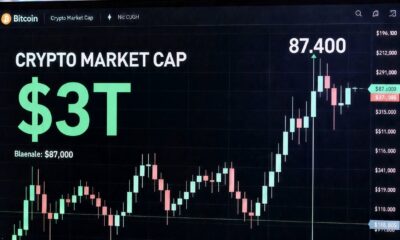
Bitcoin Surges Above $87,000 as Crypto Market Cap Reclaims $3 Trillion
-
 DeFi1 month ago
CFTC Submits Crypto Market Rules to White House Amid Congressional Stall
-

 Bitcoin1 month ago
X Partners With Coinbase, Kraken, Gemini and Brokers to Trade From the Timeline
-
DeFi1 month ago
Bitcoin Surges Above $87,000 on ETF Inflows and Massive Short Squeeze
-

 Crypto2 weeks ago
Treasury and FinCEN drop unhosted-wallet and mixer surveillance proposals
-

 Bitcoin3 weeks ago
Coinbase Receives CFTC Approval for U.S. Derivatives Clearinghouse
-

 DeFi3 weeks ago
BTSE Receives a Full Licence to Trade and Custody Crypto in Bhutan
-

 Crypto3 weeks ago
Singapore Reclaims the Regional Crypto Lead at $284 Billion as the Rest of CSAO Shrinks
-

 DeFi2 weeks ago
Bitcoin Holds Above $84,000, Shrugging Off Heavy ETF Outflows as Oil Declines
-

 DeFi2 weeks ago
Government-linked wallets move seized coins
-

 Bitcoin1 month ago
Strategy Resumes Bitcoin Buying, Adds 950 BTC
-

 DeFi2 weeks ago
Winklevoss files a 0.25% Zcash ETF
-

 Bitcoin2 weeks ago
Spot bitcoin ETFs flip to a ~$487 million outflow
-

 DeFi2 weeks ago
Uptober stalls ahead of the Fed minutes
-

 Bitcoin2 weeks ago
Bitcoin loses $84,000 as Hormuz attacks lift oil and yields
-
 Crypto2 weeks ago
CFTC opens Regulation CTX and CAM after Clarity Act stalls
-

 DeFi1 month ago
Avalanche Gains on NYSE Tokenization Testing Reports
-

 DeFi1 week ago
U.S. Spot Bitcoin and Ethereum ETFs See Significant Weekly Outflows
-

 Crypto2 weeks ago
Ether funds were already bleeding
-

 DeFi4 weeks ago
Quant Surges After Selection for U.S. Bank On-Chain Payments Initiative