Bitcoin
JP Morgan Signals Bright Future for Bitcoin: U.S. States’ Strategic Reserves Could Drive Sustained Growth

In a groundbreaking report, JP Morgan analysts have spotlighted a transformative trend for Bitcoin (#BTC), predicting that the cryptocurrency could see a “more sustained positive catalyst” as U.S. states increasingly adopt it for their strategic reserves. This development, combined with robust corporate buying, positions Bitcoin to potentially outperform traditional assets like gold in the second half of 2025. Here’s why this shift could be a game-changer for the crypto market.
U.S. States Embrace Bitcoin as a Reserve Asset
The idea of Bitcoin as a strategic reserve asset is gaining traction across the United States. According to JP Morgan’s latest analysis, led by managing director Nikolaos Panigirtzoglou, states like New Hampshire and Arizona are paving the way. New Hampshire now permits up to 5% of its reserves to be held in Bitcoin, while Arizona has launched its own Bitcoin reserve, committing to fund it without raising taxes. These moves signal a growing acceptance of Bitcoin as a legitimate financial instrument at the state level.
JP Morgan’s report highlights that as more states consider adding Bitcoin to their reserves, the trend could create a ripple effect, driving demand and stabilizing its value over time. “As the list grows, with other U.S. states potentially considering adding Bitcoin to their strategic reserves, this could turn out to be a more sustained positive catalyst for Bitcoin,” the analysts noted. This isn’t just a fleeting trend—posts on X reflect a similar sentiment, with users noting that the “dominos are falling” as states warm up to Bitcoin, potentially triggering a broader wave of adoption.
Corporate Buying Fuels Bitcoin’s Momentum
Beyond state-level adoption, corporate interest is another key driver of Bitcoin’s bullish outlook. Companies like Strategy (formerly MicroStrategy) and Metaplanet are doubling down on their Bitcoin holdings. Strategy aims to raise $84 billion for Bitcoin purchases by 2027, already achieving 32% of that goal. Meanwhile, Metaplanet reported a stellar Q1 FY2025, with its Bitcoin holdings surging to 6,796 BTC—a 3.9x increase year-to-date, adding over 5,000 BTC in 2025 alone. Despite a temporary ¥7.4 billion valuation loss in March, the company rebounded with ¥13.5 billion in unrealized gains as of May 12.
This corporate accumulation underscores Bitcoin’s growing appeal as a hedge against inflation and currency devaluation. JP Morgan analysts argue that these crypto-specific catalysts, combined with state-level support, are shifting capital flows away from gold and into Bitcoin. Since mid-April, gold has dropped nearly 8%, while Bitcoin has gained 18%, climbing past $104,500 this week—within 5% of its all-time high.
Bitcoin Outpacing Gold: A Zero-Sum Game
The JP Morgan report describes the current dynamic between Bitcoin and gold as a “zero-sum game,” where gains in one asset come at the expense of the other. Gold, which hit a 52-week peak of $3,509.9 per ounce on April 22, has since pulled back to $3,217, while Bitcoin’s market cap now stands at $2.06 trillion, with daily trading volume at $51.01 billion. The analysts attribute this shift to investor flows moving out of gold ETFs and into Bitcoin, a trend also reflected in futures data showing decreasing gold positions and increasing Bitcoin positions.
Bitcoin’s appeal as a “digital gold” is resonating with both institutional and state actors. Unlike gold, Bitcoin’s fixed supply of 21 million coins and its decentralized nature make it an attractive alternative in a world grappling with economic uncertainty. The analysts also point to the maturing crypto derivatives market—highlighted by recent acquisitions like Coinbase buying Deribit and Kraken acquiring NinjaTrader—as a sign of growing institutional confidence, which could further bolster Bitcoin’s upward trajectory.
Challenges and Skepticism Remain
Despite the optimism, not everyone is convinced of Bitcoin’s role as a reserve asset. Some U.S. states, like Florida, have halted efforts to create Bitcoin reserves due to concerns over its volatility. Globally, central banks such as the Swiss National Bank and the European Central Bank have rejected the idea, citing Bitcoin’s speculative nature and lack of alignment with long-term investment strategies. Critics also worry about the potential for politically motivated market distortions if governments begin stockpiling Bitcoin, drawing parallels to how the Strategic Petroleum Reserve influences oil markets.
Additionally, while the Trump administration has pushed for a Strategic Bitcoin Reserve at the federal level, skepticism persists about congressional approval and the feasibility of including smaller, riskier tokens beyond Bitcoin and Ethereum. These challenges highlight the need for careful regulatory frameworks to ensure Bitcoin’s integration into financial systems doesn’t destabilize markets.
The Road Ahead for Bitcoin
JP Morgan’s forecast paints a compelling picture: Bitcoin is poised for significant growth in the latter half of 2025, driven by state-level adoption and corporate investment. If more U.S. states follow New Hampshire and Arizona’s lead, the resulting demand could create a supply shock, further boosting Bitcoin’s price. Analysts on X echo this sentiment, with some calling the trend a “real institutional shift” that could solidify Bitcoin’s place in mainstream finance.
For investors, this signals a critical moment. Bitcoin’s current price of $104,000 reflects a 23% recovery this month and a year-to-date gain of nearly 60%. However, its volatility remains a concern, and potential investors should approach with caution. Strategies like dollar-cost averaging and secure storage solutions (e.g., hardware wallets) can help mitigate risks while capitalizing on Bitcoin’s long-term potential.
The dominos may indeed be falling, as JP Morgan suggests. With U.S. states and corporations leading the charge, Bitcoin could be on the cusp of a new era—one where it not only outshines gold but also cements its role as a strategic asset in the global financial landscape.

The content on CoinReporter.io is for informational purposes only and is not financial or investment advice. Cryptocurrency investments are highly volatile and risky. Always conduct your own research and consult a qualified financial advisor before making any investment decisions. CoinReporter.io and its authors are not liable for any losses resulting from actions based on this website’s content.






Strategy, Inc. (Nasdaq: MSTR), the company led by Executive Chairman Michael Saylor, acquired an additional 250 bitcoin for approximately $21.5 million between October 5 and October 11, 2026, at an average price of $86,194 per coin (including fees and expenses). The purchase brings the firm’s total holdings to 848,250 BTC.
The company funded the acquisition primarily through net proceeds of about $21 million from at-the-market sales of 125,183 shares of its Class A common stock (MSTR), with the remaining roughly $0.5 million drawn from its USD cash balance. No preferred stock was sold during the period. Strategy’s cumulative bitcoin investment now stands at roughly $64 billion, acquired at an average cost basis of approximately $75,444 per coin. At recent market prices, the holdings represent more than 4% of Bitcoin’s fixed 21 million supply cap and carry substantial unrealized gains.
In the same weekly update, Strategy reported repurchasing 1,932,145 shares of its STRC preferred stock (Variable Rate Series A Perpetual Stretch Preferred Stock) for an aggregate of about $192.4 million. The company maintains a large USD reserve—previously reported near $4.88–$5.5 billion—to support preferred stock dividends and interest payments on outstanding debt. Additional cash balances remain available for treasury activities, including further bitcoin purchases.
Saylor highlighted the latest acquisition on X with the familiar phrase “There’s always room for more orange,” continuing his long-running pattern of signaling accumulation. Strategy remains the largest publicly traded corporate holder of bitcoin. The move occurred against a backdrop of elevated volatility, with bitcoin trading in the roughly $81,000–$84,000 range around October 12 after earlier strength above $84,000.
The latest purchase marks continued, if more modest, weekly accumulation following larger buys in prior weeks. Strategy has paired ongoing bitcoin treasury expansion with active capital management, including preferred-stock repurchases, while relying on equity issuance and existing cash reserves to fund purchases.


Binance-Linked Transfer Triggers 347 Million LUNC Burn
Binance-Linked Transfer Triggers 347 Million LUNC Burn, Pushing All-Time Total Past 462 Billion On October 23, 2026, a large transfer...


Bitcoin Slides Below $81,500 as Tech Sell-Off and Elevated Oil Prices Hit Risk Assets
Bitcoin fell sharply on October 22, 2026, trading near $81,300–$81,600 with a market capitalization of roughly $1.63–$1.64 trillion after dropping...


BNB Standard Corporation
BNB Standard (Nasdaq: BNC) to Ring Nasdaq Opening Bell on October 26 Under New CEO Alex Odagiu Binance co-founder Changpeng...


Mastercard Advances AI Agent Payments
Mastercard opened early access and demonstrated live transactions for its Agent Pay for Machines system. The platform allows AI agents...


JPMorgan
J.P. Morgan Asset Management included Bitcoin for the first time in its long-term capital market assumptions, projecting a 10% compound...


Strive Adds $335 Million in Bitcoin to Corporate Treasury
Nasdaq-listed Strive purchased 4,045 BTC between October 12 and 16, 2026, at an average price of roughly $82,803 per coin...


BlackRock Files for “Buffer” Bitcoin ETF (Ticker: PBIT)
BlackRock filed with the SEC on October 19, 2026, for the iShares Bitcoin Managed Protection ETF (proposed ticker PBIT). The...


Mt. Gox Extends Creditor Repayment Deadline to October 2027
The rehabilitation trustee for the collapsed Mt. Gox exchange pushed the creditor repayment deadline to October 31, 2027, with Tokyo...


U.S. Spot Bitcoin ETFs Post Best Inflow Day in Nearly a Month
U.S. spot Bitcoin ETFs recorded $526.7 million in net inflows on October 19, 2026, the largest single-day haul since September...


Swiss FINMA Approves First Retail Bitcoin ETF Holding BTC Directly
Switzerland’s Financial Market Supervisory Authority (FINMA) approved the country’s first retail exchange-traded fund that holds Bitcoin directly on October 20,...
-

 DeFi1 month ago
Bitcoin Reclaims $81,000 and Closes Above Key 50-Week Moving Average
-

 DeFi3 weeks ago
Hong Kong Moves Licensed Stablecoins Onto Exchanges and Into Fund Settlement
-

 Crypto2 weeks ago
ESMA gives EU crypto firms three months to exit non-MiCA stablecoins
-

 Crypto3 weeks ago
Binance Burns 334.88 Million LUNC in October Fee Batch as Second Transaction Lifts the Day’s Total
-

 DeFi1 month ago
Coinbase Adds Fixed-Rate Bitcoin-Backed Loans via Morpho Midnight
-

 Bitcoin2 weeks ago
SEC clears listing path for first U.S. 3x Bitcoin and Ether ETFs
-

 Bitcoin2 weeks ago
Strategy (MicroStrategy) Adds 250 Bitcoin, Holdings Reach 848,250 BTC
-

 DeFi3 weeks ago
TOKEN2049 Opens in Singapore Next Week as the City Leads Regional Crypto Flow
-

 DeFi3 weeks ago
Robinhood Puts Hedge-Fund Tools in the App as Macro Turns Softer
-

 DeFi4 weeks ago
Solana Advances Alpenglow Upgrade to Public Testnet
-

 DeFi3 weeks ago
HSBC Names Its Hong Kong Stablecoin RedCoin, and Starts With PayMe
-

 DeFi2 weeks ago
Bitcoin Drops Below $82,000 Amid $770M+ in Liquidations as Volatility Spikes
-

 Bitcoin2 weeks ago
Bitcoin breaks under $84,000 as oil spikes on Hormuz tanker attacks
-

 Bitcoin3 weeks ago
Strategy Adds Another 1,665 BTC, Lifting Holdings to 847,666
-

 Bitcoin1 month ago
Record ETF Inflows and a Short Squeeze Drive Bitcoin’s $87,000 Break
-

 DeFi3 weeks ago
South Korea Ranks Second in On-Chain Crypto Holdings as the Tax Date Holds
-
 DeFi1 month ago
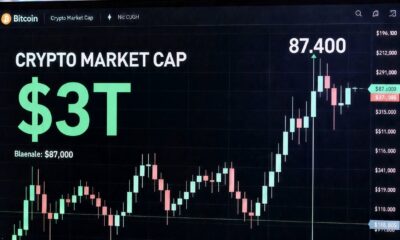
Bitcoin Surges Above $87,000 as Crypto Market Cap Reclaims $3 Trillion
-
 DeFi1 month ago
CFTC Submits Crypto Market Rules to White House Amid Congressional Stall
-

 Bitcoin1 month ago
X Partners With Coinbase, Kraken, Gemini and Brokers to Trade From the Timeline
-
DeFi1 month ago
Bitcoin Surges Above $87,000 on ETF Inflows and Massive Short Squeeze
-

 Crypto2 weeks ago
Treasury and FinCEN drop unhosted-wallet and mixer surveillance proposals
-

 Bitcoin3 weeks ago
Coinbase Receives CFTC Approval for U.S. Derivatives Clearinghouse
-

 DeFi3 weeks ago
BTSE Receives a Full Licence to Trade and Custody Crypto in Bhutan
-

 Crypto3 weeks ago
Singapore Reclaims the Regional Crypto Lead at $284 Billion as the Rest of CSAO Shrinks
-

 DeFi2 weeks ago
Bitcoin Holds Above $84,000, Shrugging Off Heavy ETF Outflows as Oil Declines
-

 DeFi2 weeks ago
Government-linked wallets move seized coins
-

 Bitcoin1 month ago
Strategy Resumes Bitcoin Buying, Adds 950 BTC
-

 DeFi2 weeks ago
Winklevoss files a 0.25% Zcash ETF
-

 Bitcoin2 weeks ago
Spot bitcoin ETFs flip to a ~$487 million outflow
-

 DeFi2 weeks ago
Uptober stalls ahead of the Fed minutes
-

 Bitcoin2 weeks ago
Bitcoin loses $84,000 as Hormuz attacks lift oil and yields
-

 Crypto2 weeks ago
CFTC opens Regulation CTX and CAM after Clarity Act stalls
-

 DeFi1 month ago
Avalanche Gains on NYSE Tokenization Testing Reports
-

 DeFi1 week ago
U.S. Spot Bitcoin and Ethereum ETFs See Significant Weekly Outflows
-

 Crypto2 weeks ago
Ether funds were already bleeding
-

 DeFi4 weeks ago
Quant Surges After Selection for U.S. Bank On-Chain Payments Initiative