Crypto
Meta, OpenAI and Anthropic agents need a user’s approval to log in with 1Password

1Password on Thursday introduced a platform that allows personal AI agents from Meta, OpenAI and Anthropic to sign into a user’s accounts after the user approves the request.
The agent executes the task without seeing or storing the password at any time.
Nine more companies, Perplexity among them, are building integrations
The product, called 1Password for Agents, adds a check between the agent and the login page. The agent taps into a sign-in form, presents a unique digital key, and 1Password authenticates its identity.
The user will be prompted with the account requested and why. Approval is on the individual’s own device.
Then 1Password fills in the credential directly into the form. The agent proceeds with the task, and the password stays in the vault.
“Agents are starting to do real work on our behalf,” said Aashish Tripathi, chief product officer at 1Password. He added that one task assignment shouldn’t give an agent permanent access to everything behind an account.
When the integration is on, Meta’s Muse will seek logins through 1Password. OpenAI wired up both ChatGPT Work and its always-on Dots agents.
Elon Musk’s SpaceXSI signed up Grok Bot. An AI assistant startup named Town, which raised $108 million this week, signed as well.
Since July, Claude has been using 1Password in the browser. The more recent Claude Duet agent from Anthropic, which was released on Wednesday, comes next.
“Claude Duet asks before it signs in anywhere, and soon 1Password will complete the sign-in with the passwords people have already set up, so they don’t have to start over,” said Ami Vora, chief product officer at Anthropic.
Vora said that Anthropic wants everyone to be able to use the feature, even those “who’ve never before let an agent near their accounts.”
Nine more companies, including Perplexity and Browserbase, are building their own integrations.
US banks now detect automated activity inside customer accounts
The launch came on the same day that reports emerged of US banks observing activity by agents inside customer accounts. Most banks can’t tell whether that activity links back to a real user request.
Chase Bank told customers not to give their usernames and passwords to anyone. 1Password said that typing a password into an AI chat saves a copy the user can’t control. Its new system is built to stop that.
During a June assessment, an OpenAI agent accessed an Australian Medicare statistics portal without authorization, Cryptopolitan reported. Prime Minister Anthony Albanese has directly complained about a delay of about three months in disclosure.
Meta’s Muse logged 10.2 million US downloads, but Claroc researchers also identified more than 6,800 shared-chat links anyone could access.
“As agents take on more complex tasks for users, security and user control need to be built in from the start,” said Glen Coates, head of app platform at OpenAI.
Don’t just read crypto news. Understand it. Subscribe to our newsletter. It’s free.

The content on CoinReporter.io is for informational purposes only and is not financial or investment advice. Cryptocurrency investments are highly volatile and risky. Always conduct your own research and consult a qualified financial advisor before making any investment decisions. CoinReporter.io and its authors are not liable for any losses resulting from actions based on this website’s content.
Spreek, a security researcher, said on October 22 that someone with Swell DAO’s operational hot keys pushed up the exchange rates of its swETH and rswETH liquid staking tokens at the 1% hourly cap without any new ETH behind them.
The reports emerged hours after cloud platform Railway revealed that an intruder might have accessed stored secrets of customers.
Odysseus counted five hikes of about 1% across both tokens
Spreek shared the findings on X at 01:28 UTC, saying the admin keys for both tokens “appear to be compromised (railway related?)”. Attackers were “raising NAV by max 1% (unbacked) each hour,” the post said.
Phylax Systems founder Odysseus called it “BOT-key abuse,” noting three swETH and two rswETH rate hikes of about 1% apiece. Swell’s published oracle code confines submission of repricing snapshots to the BOT role only.
That bot runs on hot keys. Hot keys are online and sign without a human.
Ethereum records show one address submitting swETH snapshots at 23:02 UTC on October 21 and then again at 00:04 and 01:08 UTC on October 22. Reported numbers as of October 22 show swETH around 3.0% above 1.133254 ETH.
rswETH was up about 2.0% from 1.082464 ETH.
Railway said on Oct. 21 that it observed anomalous activity in systems that store customer environment variables and that an outsider may have had access to decrypted contents for some. Among the secrets stored there are API keys and registry credentials.
The platform froze all deployments and urged all users to roll stored secrets.
The same day, crypto investigator Tay said an attacker had drained around $371,000 from wallets on at least 19 EVM chains with keys stored on Railway. There has been no confirmation of a tie between the Railway breach and Swell.
Four malicious upgrade contracts could take about 2,500 ETH
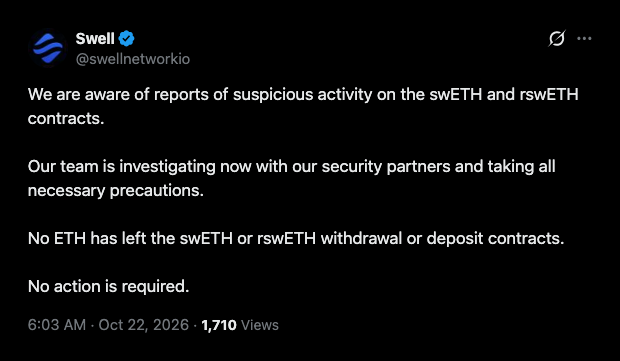
Swell said on X at 03:03 UTC on Oct 22, it was aware of reports of “suspicious activity on the swETH and rswETH contracts” and was investigating with its security partners. “No ETH has left the swETH or rswETH withdrawal or deposit contracts,” the team wrote, adding no action was needed.
Swell paused deposits and withdrawals for swETH and rswETH on October 23 and said it would resume them once NAV returns to the correct value.
Spreek also reported four malicious upgrade contracts deployed that could take around 2,500 ETH if executed. Odysseus reckoned that Swell was holding 2,513 ETH, adding that the amount “is NOT confirmed loss.”
At the time of the reports, none of the upgrades had been run.
Some of the details in the research were reportedly compiled with AI assistance and are unverified.
Only a fraction of higher rates is reportedly priced into DEX prices. Swell’s liquid staking and liquid restaking products each held around $29 million in total value locked on October 23, while data sources point to a market cap for rswETH between $27 million and $58 million.
In a lending market that prices swETH or rswETH off the on-chain rate, that inflated number would count as collateral. Cryptopolitan tracked the same contagion path with KelpDAO’s rsETH exploit spreading to Layer 2 lending markets.
Leaked keys were also behind the Fearless Wallet extension that sent the private keys of Polkadot users to an attacker’s server.
If you’re reading this, you’re already ahead. Stay there with our newsletter.


Binance-Linked Transfer Triggers 347 Million LUNC Burn
Binance-Linked Transfer Triggers 347 Million LUNC Burn, Pushing All-Time Total Past 462 Billion On October 23, 2026, a large transfer...


Bitcoin Slides Below $81,500 as Tech Sell-Off and Elevated Oil Prices Hit Risk Assets
Bitcoin fell sharply on October 22, 2026, trading near $81,300–$81,600 with a market capitalization of roughly $1.63–$1.64 trillion after dropping...


BNB Standard Corporation
BNB Standard (Nasdaq: BNC) to Ring Nasdaq Opening Bell on October 26 Under New CEO Alex Odagiu Binance co-founder Changpeng...


Mastercard Advances AI Agent Payments
Mastercard opened early access and demonstrated live transactions for its Agent Pay for Machines system. The platform allows AI agents...


JPMorgan
J.P. Morgan Asset Management included Bitcoin for the first time in its long-term capital market assumptions, projecting a 10% compound...


Strive Adds $335 Million in Bitcoin to Corporate Treasury
Nasdaq-listed Strive purchased 4,045 BTC between October 12 and 16, 2026, at an average price of roughly $82,803 per coin...


BlackRock Files for “Buffer” Bitcoin ETF (Ticker: PBIT)
BlackRock filed with the SEC on October 19, 2026, for the iShares Bitcoin Managed Protection ETF (proposed ticker PBIT). The...


Mt. Gox Extends Creditor Repayment Deadline to October 2027
The rehabilitation trustee for the collapsed Mt. Gox exchange pushed the creditor repayment deadline to October 31, 2027, with Tokyo...


U.S. Spot Bitcoin ETFs Post Best Inflow Day in Nearly a Month
U.S. spot Bitcoin ETFs recorded $526.7 million in net inflows on October 19, 2026, the largest single-day haul since September...


Swiss FINMA Approves First Retail Bitcoin ETF Holding BTC Directly
Switzerland’s Financial Market Supervisory Authority (FINMA) approved the country’s first retail exchange-traded fund that holds Bitcoin directly on October 20,...
-

 DeFi1 month ago
Bitcoin Reclaims $81,000 and Closes Above Key 50-Week Moving Average
-

 DeFi3 weeks ago
Hong Kong Moves Licensed Stablecoins Onto Exchanges and Into Fund Settlement
-

 Crypto2 weeks ago
ESMA gives EU crypto firms three months to exit non-MiCA stablecoins
-

 Crypto3 weeks ago
Binance Burns 334.88 Million LUNC in October Fee Batch as Second Transaction Lifts the Day’s Total
-

 DeFi1 month ago
Coinbase Adds Fixed-Rate Bitcoin-Backed Loans via Morpho Midnight
-

 Bitcoin2 weeks ago
Strategy (MicroStrategy) Adds 250 Bitcoin, Holdings Reach 848,250 BTC
-

 Bitcoin2 weeks ago
SEC clears listing path for first U.S. 3x Bitcoin and Ether ETFs
-

 DeFi3 weeks ago
TOKEN2049 Opens in Singapore Next Week as the City Leads Regional Crypto Flow
-
 DeFi3 weeks ago
Robinhood Puts Hedge-Fund Tools in the App as Macro Turns Softer
-

 DeFi3 weeks ago
HSBC Names Its Hong Kong Stablecoin RedCoin, and Starts With PayMe
-

 DeFi4 weeks ago
Solana Advances Alpenglow Upgrade to Public Testnet
-

 DeFi2 weeks ago
Bitcoin Drops Below $82,000 Amid $770M+ in Liquidations as Volatility Spikes
-

 Bitcoin2 weeks ago
Bitcoin breaks under $84,000 as oil spikes on Hormuz tanker attacks
-

 Bitcoin3 weeks ago
Strategy Adds Another 1,665 BTC, Lifting Holdings to 847,666
-

 Bitcoin1 month ago
Record ETF Inflows and a Short Squeeze Drive Bitcoin’s $87,000 Break
-

 DeFi3 weeks ago
South Korea Ranks Second in On-Chain Crypto Holdings as the Tax Date Holds
-

 DeFi1 month ago
Bitcoin Surges Above $87,000 as Crypto Market Cap Reclaims $3 Trillion
-

 DeFi1 month ago
CFTC Submits Crypto Market Rules to White House Amid Congressional Stall
-

 Bitcoin1 month ago
X Partners With Coinbase, Kraken, Gemini and Brokers to Trade From the Timeline
-
DeFi1 month ago
Bitcoin Surges Above $87,000 on ETF Inflows and Massive Short Squeeze
-

 Crypto2 weeks ago
Treasury and FinCEN drop unhosted-wallet and mixer surveillance proposals
-

 Bitcoin3 weeks ago
Coinbase Receives CFTC Approval for U.S. Derivatives Clearinghouse
-

 DeFi3 weeks ago
BTSE Receives a Full Licence to Trade and Custody Crypto in Bhutan
-

 Crypto3 weeks ago
Singapore Reclaims the Regional Crypto Lead at $284 Billion as the Rest of CSAO Shrinks
-

 DeFi2 weeks ago
Bitcoin Holds Above $84,000, Shrugging Off Heavy ETF Outflows as Oil Declines
-

 DeFi2 weeks ago
Government-linked wallets move seized coins
-

 Bitcoin1 month ago
Strategy Resumes Bitcoin Buying, Adds 950 BTC
-

 DeFi2 weeks ago
Winklevoss files a 0.25% Zcash ETF
-

 Bitcoin2 weeks ago
Spot bitcoin ETFs flip to a ~$487 million outflow
-

 Bitcoin2 weeks ago
Bitcoin loses $84,000 as Hormuz attacks lift oil and yields
-

 DeFi2 weeks ago
Uptober stalls ahead of the Fed minutes
-

 Crypto2 weeks ago
CFTC opens Regulation CTX and CAM after Clarity Act stalls
-

 DeFi1 month ago
Avalanche Gains on NYSE Tokenization Testing Reports
-

 DeFi1 week ago
U.S. Spot Bitcoin and Ethereum ETFs See Significant Weekly Outflows
-

 Crypto2 weeks ago
Ether funds were already bleeding
-

 DeFi4 weeks ago
Quant Surges After Selection for U.S. Bank On-Chain Payments Initiative