Crypto
Dogecoin Foundation breakup forces House of Doge into a corporate rename

House of Doge and its U.S. subsidiary have until Dec. 31, 2026, to remove “Doge” from their corporate names.
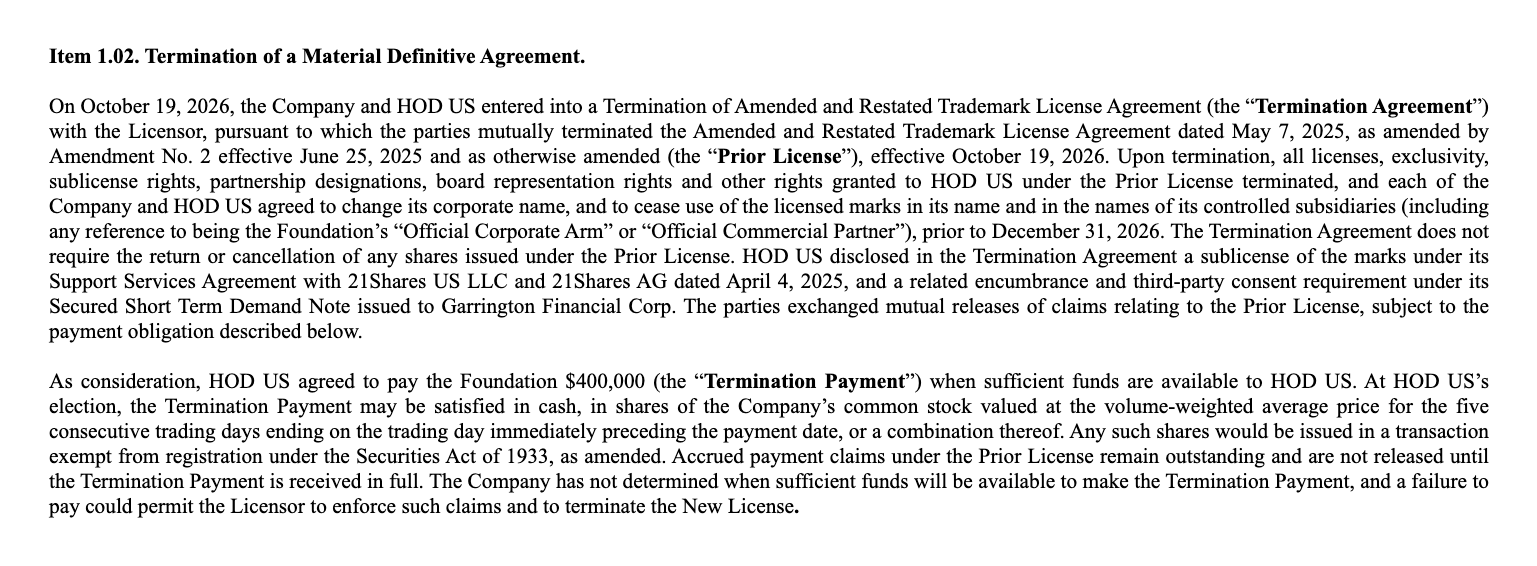
The deadline is part of the price of unwinding an exclusive trademark deal with the Dogecoin Foundation, as outlined in a Form 8-K filed with the SEC on October 23.
A new license covers only three 21Shares products until 2029
On October 19, the exclusive license was mutually terminated by both sides. It canceled the exclusivity, sub-licensing rights and partnership titles.
Neither company can any longer refer to itself as the Foundation’s “Official Corporate Arm” or “Official Commercial Partner.” Each must also scrub the marks from the names of its controlled subsidiaries.
House of Doge Inc. is the parent company, and trades on Nasdaq under HODO. Its Texas subsidiary, House of Doge (U.S.) Inc., was previously known as House of Doge Inc.
The company is contemplating a corporate rebrand, the filing says. It also plans to seek shareholder approval for a reverse stock split at its annual meeting.
CEO Marco Margiotta and CFO Charles Park resigned October 22. McQueen Labs chief executive Curt Hopkins took on both jobs on an interim basis.
On October 21, Dogecoin Labs was launched as the Foundation’s official commercial partner under CEO Jordan Jefferson.
The Dogecoin Foundation and MadeUpNumbers Ltd. grant the subsidiary a non-exclusive license to use the DOGECOIN and DOGE marks on only three products, as they existed on October 19, 2026.
They are the 21Shares Dogecoin ETF (TDOG), 21Shares Dogecoin ETP (DOGE) and 21Shares 2x Long Dogecoin ETF (TXXD). Any other product needs written approval from the Foundation, one product at a time.
Marks may not be used in corporate names, goods, payment products and unrelated financial products. New approved products pay the Foundation a percentage of net revenue, on a product-by-product basis, paid quarterly, with no minimum royalty and no up-front fee.
License expires October 19, 2029, with no automatic renewal. The 21Shares Dogecoin ETP has been trading in euros on Xetra and Gettex since April 8, 2025, with assets of around $9.49 million.
An unpaid $400,000 exit fee puts the new license at risk
The subsidiary agreed to pay the Foundation $400,000 to terminate the old deal, when it has enough money. Payment can be in cash, HODO shares, or both.
If a missed payment is not received within ten business days of notice, the Foundation may terminate the new license.
Accrued claims under the old license persist until the full $400,000 is collected.
Separately, the subsidiary is moving Such App’s software, source code, domains and cloud infrastructure to Dogecoin Labs. In return, it obtains $4 million worth of Labs stock, valued at a $120 million fully diluted pre-money valuation.
Dogecoin Labs does not assume any of the subsidiary’s liabilities or contracts. Closing requires consents and lien releases from secured lenders, and either side can walk if nothing closes within 30 days of October 19, which is November 18.
The same filing also included a binding letter of intent to purchase McQueen Labs’ MCQ Markets token platform for $15 million, plus its microlending business. The LOI shall expire automatically if no definitive agreement is executed by December 15, 2026.
House of Doge built its identity on the brand Dogecoin. It went public on Nasdaq through a reverse merger with Brag House Holdings, a deal that received backing from 98% of votes cast by Brag House shareholders in April 2026.
House of Doge partnered with Paxos, the firm that manages crypto backends for PayPal, Venmo and Interactive Brokers, in June, according to Cryptopolitan. As of October 2025, it held more than 837 million DOGE with 21Shares.
Dogecoin Labs plans to merge DogeOS application infrastructure with the MyDoge wallet and Such App.
On October 25, DOGE shed 1.2% over 24 hours to about $0.077. U.S. Dogecoin funds saw net outflows of around $538,000 that week.
Don’t just read crypto news. Understand it. Subscribe to our newsletter. It’s free.

The content on CoinReporter.io is for informational purposes only and is not financial or investment advice. Cryptocurrency investments are highly volatile and risky. Always conduct your own research and consult a qualified financial advisor before making any investment decisions. CoinReporter.io and its authors are not liable for any losses resulting from actions based on this website’s content.
China’s carmakers have officially outsold their Japanese rivals in Europe over an entire quarter for the first time, and the numbers show just how quickly the market is changing.
BYD and Chery, among others, are winning customers in a place where companies such as Toyota and Nissan have been operating for many years to date.
Dataforce reported that Chinese brand sales have almost doubled in September from last year, accounting for 12.7% of all car sales in Europe, against 11.9% for Japanese brands. The sales increase was largely due to hybrid vehicles; however, Volkswagen, Renault, and other European brands dominate the market.
China’s automakers are winning European customers faster than expected
Five years ago, Chinese brands barely accounted for 1% of European vehicle sales. Today, they’re challenging manufacturers that have been around for generations.
Toyota started selling cars in Europe in 1963 and now operates factories across the continent. Nissan has manufactured vehicles at its Sunderland plant in Britain since 1986.
The UK has become a particularly important market for Chinese companies. Chery’s Jaecoo 7 SUV was Britain’s best-selling model in both March and September.
The figures measure new vehicle registrations rather than factory production, making them an indication of what European customers are actually buying.
Meanwhile, things aren’t going particularly well for foreign automakers back in China.
Drivers in China are shunning Volkswagen and BMW cars to favor their local counterparts. The reason is that local carmakers are designing and selling new cars at a faster rate and more cheaply than their competitors.
The falling demand among the locals has forced manufacturers to look for foreign markets.
In the recent car show held in Paris, Chinese car brands such as Chery, BYD and Geely Zeekr unveiled various cars designed specifically for Europeans.
BYD Dolphin G DM-i was one of those cars that the Chinese carmaker revealed at the Paris auto show.
It was designed specifically for European drivers as it was an inexpensive plug-in hybrid car made by BYD.
Europe moves to restrict Chinese imports as BYD faces higher costs
The European Union is trying to slow the expansion, partly because Chinese manufacturers benefit from government subsidies.
Brussels has already introduced additional tariffs on battery-electric vehicles manufactured in China.
This month, European officials also reached a preliminary agreement to restrict Chinese hybrid imports to 350,000 vehicles annually.
But shipments of hybrids have actually accelerated as manufacturers prepare for possible additional restrictions.
The EU is considering another approach that would make locally manufactured vehicles eligible for certain subsidies and incentives.
One proposal would connect company-car tax benefits to European production. That could matter considerably in Germany, where businesses and fleet operators account for substantial vehicle purchases.
China is also introducing changes that could hurt its own exporters.
On October 12, Beijing announced that the VAT rebate on new-energy vehicle exports will fall from 13% to 9% starting April 1, 2027.
JPMorgan warned in a note on Tuesday that the smaller rebate, combined with the reinstated battery consumption tax, could damage industry profitability faster than previously expected.
BYD executive Liu said the company’s existing factories in Southeast Asia should limit the effect of the rebate reduction on regional sales.
Liu also expects BYD to expand its international manufacturing operations as the global oil shock strengthens demand for electric vehicles.
However, he said BYD has not decided whether to raise overseas selling prices to recover the additional tax costs, especially as competition between manufacturers becomes more aggressive.
Morgan Stanley estimated in an October 13 research note that BYD’s planned manufacturing capacity outside mainland China had reached one million electric vehicles, with Europe accounting for just 30%.
The expansion comes while the company faces considerable financial pressure at home.
BYD’s first-half net profit dropped more than 20% from a year earlier to 12.3 billion yuan ($1.84 billion), weighed down by declining domestic demand.
Chinese manufacturers are already preparing to build more vehicles directly inside Europe, potentially reducing their dependence on imported cars.
Chery is preparing manufacturing operations in Barcelona, while BYD is approaching completion of its new factory in Hungary.
Meanwhile, Zhejiang Leapmotor has started producing its B10 SUV at Stellantis’ Zaragoza factory in Spain, under a joint venture between the two companies.
Don’t just read crypto news. Understand it. Subscribe to our newsletter. It’s free.


Spot Bitcoin ETFs Reverse Course with Hundreds of Millions in Net Outflows
U.S. spot Bitcoin ETFs recorded substantial net outflows late last week, erasing much of the strong inflows seen earlier and...


Crypto Liquidations Surge Past $400 Million in Hours as Bitcoin Briefly Dips Below $80,000
Bitcoin briefly fell below the $80,000 level on Saturday, October 24, 2026—its weakest point in more than a month—triggering a...


Binance-Linked Transfer Triggers 347 Million LUNC Burn
Binance-Linked Transfer Triggers 347 Million LUNC Burn, Pushing All-Time Total Past 462 Billion On October 23, 2026, a large transfer...

Bitcoin Slides Below $81,500 as Tech Sell-Off and Elevated Oil Prices Hit Risk Assets
Bitcoin fell sharply on October 22, 2026, trading near $81,300–$81,600 with a market capitalization of roughly $1.63–$1.64 trillion after dropping...


BNB Standard Corporation
BNB Standard (Nasdaq: BNC) to Ring Nasdaq Opening Bell on October 26 Under New CEO Alex Odagiu Binance co-founder Changpeng...


Mastercard Advances AI Agent Payments
Mastercard opened early access and demonstrated live transactions for its Agent Pay for Machines system. The platform allows AI agents...


JPMorgan
J.P. Morgan Asset Management included Bitcoin for the first time in its long-term capital market assumptions, projecting a 10% compound...


Strive Adds $335 Million in Bitcoin to Corporate Treasury
Nasdaq-listed Strive purchased 4,045 BTC between October 12 and 16, 2026, at an average price of roughly $82,803 per coin...


BlackRock Files for “Buffer” Bitcoin ETF (Ticker: PBIT)
BlackRock filed with the SEC on October 19, 2026, for the iShares Bitcoin Managed Protection ETF (proposed ticker PBIT). The...


Mt. Gox Extends Creditor Repayment Deadline to October 2027
The rehabilitation trustee for the collapsed Mt. Gox exchange pushed the creditor repayment deadline to October 31, 2027, with Tokyo...
-

 Crypto3 weeks ago
ESMA gives EU crypto firms three months to exit non-MiCA stablecoins
-

 Crypto3 weeks ago
Binance Burns 334.88 Million LUNC in October Fee Batch as Second Transaction Lifts the Day’s Total
-

 DeFi4 weeks ago
Hong Kong Moves Licensed Stablecoins Onto Exchanges and Into Fund Settlement
-

 Bitcoin2 weeks ago
Strategy (MicroStrategy) Adds 250 Bitcoin, Holdings Reach 848,250 BTC
-

 Bitcoin3 weeks ago
SEC clears listing path for first U.S. 3x Bitcoin and Ether ETFs
-

 DeFi4 weeks ago
TOKEN2049 Opens in Singapore Next Week as the City Leads Regional Crypto Flow
-

 DeFi4 weeks ago
HSBC Names Its Hong Kong Stablecoin RedCoin, and Starts With PayMe
-

 DeFi2 weeks ago
Bitcoin Drops Below $82,000 Amid $770M+ in Liquidations as Volatility Spikes
-
 DeFi4 weeks ago
Robinhood Puts Hedge-Fund Tools in the App as Macro Turns Softer
-

 DeFi1 month ago
Solana Advances Alpenglow Upgrade to Public Testnet
-
 Bitcoin3 weeks ago
Bitcoin breaks under $84,000 as oil spikes on Hormuz tanker attacks
-

 Bitcoin4 weeks ago
Strategy Adds Another 1,665 BTC, Lifting Holdings to 847,666
-

 DeFi4 weeks ago
South Korea Ranks Second in On-Chain Crypto Holdings as the Tax Date Holds
-

 Crypto3 weeks ago
Treasury and FinCEN drop unhosted-wallet and mixer surveillance proposals
-

 Bitcoin4 weeks ago
Coinbase Receives CFTC Approval for U.S. Derivatives Clearinghouse
-

 Crypto4 weeks ago
Singapore Reclaims the Regional Crypto Lead at $284 Billion as the Rest of CSAO Shrinks
-

 DeFi4 weeks ago
BTSE Receives a Full Licence to Trade and Custody Crypto in Bhutan
-

 DeFi3 weeks ago
Government-linked wallets move seized coins
-

 DeFi3 weeks ago
Winklevoss files a 0.25% Zcash ETF
-

 DeFi2 weeks ago
Bitcoin Holds Above $84,000, Shrugging Off Heavy ETF Outflows as Oil Declines
-

 Bitcoin3 weeks ago
Spot bitcoin ETFs flip to a ~$487 million outflow
-

 Bitcoin3 weeks ago
Bitcoin loses $84,000 as Hormuz attacks lift oil and yields
-

 DeFi2 weeks ago
U.S. Spot Bitcoin and Ethereum ETFs See Significant Weekly Outflows
-

 DeFi3 weeks ago
Uptober stalls ahead of the Fed minutes
-

 Crypto3 weeks ago
CFTC opens Regulation CTX and CAM after Clarity Act stalls
-

 Crypto3 weeks ago
Ether funds were already bleeding
-

 DeFi4 weeks ago
Quant Surges After Selection for U.S. Bank On-Chain Payments Initiative
-
 DeFi1 month ago
Bitcoin Pulls Back Below $84,000 After Hitting Multi-Month Highs Near $87,000
-
 DeFi2 weeks ago
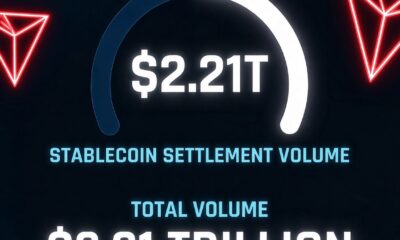
TRON Q3 2026 Report: $2.21 Trillion in Stablecoin Settlement Volume
-

 Bitcoin4 weeks ago
Spot Bitcoin ETFs Record Strongest Weekly Inflows of 2026, Flipping Year-to-Date Flows Positive
-

 DeFi4 weeks ago
Bitget Puts $300 Million Protection Fund Back After Hack
-

 Bitcoin3 weeks ago
Bitcoin rejected again under $87,400 as Uptober stalls
-

 DeFi1 month ago
21Shares Launches Europe’s First Zcash ETP Alongside ether.fi Product
-

 Bitcoin3 weeks ago
Third rejection at $87,000 while stocks print records
-
 DeFi1 week ago
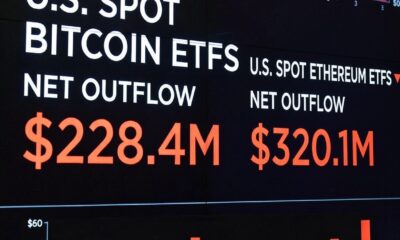
Bitcoin and Ethereum Spot ETFs Record Substantial Weekly Outflows
-

 Crypto3 weeks ago
Treasuries, triple leverage, a testnet fork, and a bank app