Crypto
Qubic opens claims portal after wallet seed flaw exposes 1,404 accounts

Qubic is now officially live again. The team has initiated their recovery process following the recent seed vulnerability that drained $1.4M in QU across 1.4k wallets. To support affected users, the platform has introduced a claims portal where impacted wallet holders can submit their requests.
According to Qubic Explorer, the blockchain resumed tick processing at 20:00 UTC on October 19. The network is now processing transactions past tick 85,371,949, following the emergency shutdown on Sunday.
Qubic’s claim portal is open till May next year
Qubic encouraged affected users to submit claims to restore their funds to their secure identities. The Qubic team explained that the computor quorum will be responsible for all decisions related to recovery and for implementing such actions. Users have until May 1, 2027, to submit claims.
The platform guaranteed users that when the blockchain network was unavailable, their funds were transferred to a secure escrow wallet. Such a transfer has become the basis for successful recovery. Nevertheless, the project warns that any web wallet created before the October 19 version 4.26.4 update is not secure.
It is vital to update your wallet, transfer all your assets to the new secure address, and stop using old wallets altogether, it said.
Primarily, the attacker made away with 2.94 trillion QU from 1,404 wallets. According to the network, the hack resulted from a weakness in seed generation, rather than the Qubic protocol itself.
It wrote, “The incident happened because these seeds are weak. That means the attacker can produce the same valid signature you can.” Though it has now confirmed that the seed-generation flaw had been addressed in the latest version of its web wallet.
Similarly, past security breaches have repeatedly shown that flaws in randomness generation can leave crypto wallets vulnerable to attacks. In particular, in late July, hackers exploited a firmware configuration vulnerability in Coinkite’s Coldcard, traced back to March 2021, to steal Bitcoin from users.
The hacking was done in four separate waves of fraudulent transactions. It started on July 30, 2026, when the hacker stole 594 BTC, almost $38 million, in just 25 minutes. Primarily, the security threat exploited a weakness in the hardware entropy generation of the affected crypto wallets.
Specifically, a bug in Coldcard firmware version 4.0.1, which was released in March 2021, broke the algorithm for generating the seed, leading to the formation of a recovery phrase with low entropy. As a result, the wallet configured with that firmware generated weak private keys, which could be easily cracked offline.
The flaw in the setup design led to a complete breakdown of cryptographic security, reducing the key space from 128 bits to just 40 bits on outdated hardware. According to research by Galaxy, the total number of losses stands at roughly 1,816 BTC, totaling almost $116 million USD, and 5,200 different addresses were used.
September saw two major crypto exploits
Blockchain security firm PeckShield documented 55 major exploits in September, with aggregate losses nearing $766.5 million. This represents a 462% increase compared to August’s total of $136.3 million. The bulk of losses came from the Bitget exchange hack (worth $387 million) and the Liquid Network breach (worth $320 million). Nevertheless, Liquid saw a $285 million return.
According to Gracy Chen, the CEO of Bitget, the attack resulted from an attacker manipulating backend transaction data to bypass the authorization process. The company will pay for the damage itself from the User Protection Fund, which has a balance exceeding $464 million. As for the Liquid Network incident, 4,000 BTC were withdrawn illegally.
The Qubic incident adds to a growing list of security failures affecting crypto users, exchanges, and wallet providers. Although the causes and scale of these breaches vary, they highlight the importance of secure key generation, rapid incident response, and transparent recovery procedures.
For Qubic, the immediate priority is to process claims while ensuring users migrate to secure wallet identities. The outcome of that process will determine how much of the stolen value can be recovered and how effectively the network restores user confidence.
If you’re reading this, you’re already ahead. Stay there with our newsletter.

The content on CoinReporter.io is for informational purposes only and is not financial or investment advice. Cryptocurrency investments are highly volatile and risky. Always conduct your own research and consult a qualified financial advisor before making any investment decisions. CoinReporter.io and its authors are not liable for any losses resulting from actions based on this website’s content.

The post Arbitrum Transactions Surpass 2.4 Billion as USDC Lending Hits $44 Million appeared first on Coinpedia Fintech News
Arbitrum is expanding its on-chain footprint, surpassing 2.4 billion lifetime transactions while USDC lending activity on Morpho reaches $44 million in TVL. These milestones highlight continued activity across the Ethereum Layer-2 network, particularly in trading, stablecoin settlements and decentralized lending. However, ARB’s price action remains weaker than its network activity suggests, with the token consolidating …


Strive Adds $335 Million in Bitcoin to Corporate Treasury
Nasdaq-listed Strive purchased 4,045 BTC between October 12 and 16, 2026, at an average price of roughly $82,803 per coin...


BlackRock Files for “Buffer” Bitcoin ETF (Ticker: PBIT)
BlackRock filed with the SEC on October 19, 2026, for the iShares Bitcoin Managed Protection ETF (proposed ticker PBIT). The...


Mt. Gox Extends Creditor Repayment Deadline to October 2027
The rehabilitation trustee for the collapsed Mt. Gox exchange pushed the creditor repayment deadline to October 31, 2027, with Tokyo...


U.S. Spot Bitcoin ETFs Post Best Inflow Day in Nearly a Month
U.S. spot Bitcoin ETFs recorded $526.7 million in net inflows on October 19, 2026, the largest single-day haul since September...
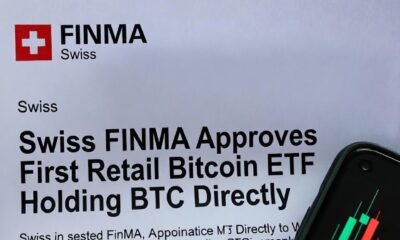

Swiss FINMA Approves First Retail Bitcoin ETF Holding BTC Directly
Switzerland’s Financial Market Supervisory Authority (FINMA) approved the country’s first retail exchange-traded fund that holds Bitcoin directly on October 20,...


Crypto Hacks and Losses Reach $1.18 Billion in Q3 2026 Across 107 Incidents
Security firm Hacken reported that crypto hacks and related losses totaled $1.18 billion across 107 incidents in the third quarter...


Strive Discloses Additional Bitcoin Purchases, Holdings Reach 36,818 BTC
Strive reported acquiring approximately 1,223 BTC for roughly $100 million between October 14 and 16, 2026, at an average price...


Arbitrum Rallies on Stablecoin Growth Program as DeFi Tokens Outperform
Arbitrum (ARB) led major altcoin gains on October 19, 2026, rising 6–9% toward the $0.20 level, driven by the Arbitrum...


World Liberty Financial’s USD1 Stablecoin Sheds Over $400 Million in Market Cap Amid Redemptions
World Liberty Financial’s USD1 stablecoin saw its market capitalization decline by more than $400 million over roughly two weeks, falling...


Strategy Adds 267 Bitcoin for $22.1 Million, Bringing Holdings to 848,517 BTC
Strategy (formerly MicroStrategy) disclosed in a Monday SEC filing that it purchased 267 BTC for approximately $22.1 million between October...
-

 DeFi1 month ago
Bitcoin Reclaims $81,000 and Closes Above Key 50-Week Moving Average
-

 DeFi3 weeks ago
Hong Kong Moves Licensed Stablecoins Onto Exchanges and Into Fund Settlement
-

 Crypto2 weeks ago
ESMA gives EU crypto firms three months to exit non-MiCA stablecoins
-

 Crypto3 weeks ago
Binance Burns 334.88 Million LUNC in October Fee Batch as Second Transaction Lifts the Day’s Total
-

 DeFi4 weeks ago
Coinbase Adds Fixed-Rate Bitcoin-Backed Loans via Morpho Midnight
-

 Bitcoin2 weeks ago
SEC clears listing path for first U.S. 3x Bitcoin and Ether ETFs
-

 DeFi3 weeks ago
TOKEN2049 Opens in Singapore Next Week as the City Leads Regional Crypto Flow
-

 DeFi3 weeks ago
Robinhood Puts Hedge-Fund Tools in the App as Macro Turns Softer
-

 DeFi4 weeks ago
Solana Advances Alpenglow Upgrade to Public Testnet
-

 Bitcoin1 week ago
Strategy (MicroStrategy) Adds 250 Bitcoin, Holdings Reach 848,250 BTC
-

 DeFi3 weeks ago
HSBC Names Its Hong Kong Stablecoin RedCoin, and Starts With PayMe
-

 DeFi1 week ago
Bitcoin Drops Below $82,000 Amid $770M+ in Liquidations as Volatility Spikes
-

 Bitcoin3 weeks ago
Strategy Adds Another 1,665 BTC, Lifting Holdings to 847,666
-

 Bitcoin2 weeks ago
Bitcoin breaks under $84,000 as oil spikes on Hormuz tanker attacks
-

 Bitcoin4 weeks ago
Record ETF Inflows and a Short Squeeze Drive Bitcoin’s $87,000 Break
-

 DeFi3 weeks ago
South Korea Ranks Second in On-Chain Crypto Holdings as the Tax Date Holds
-
 DeFi4 weeks ago
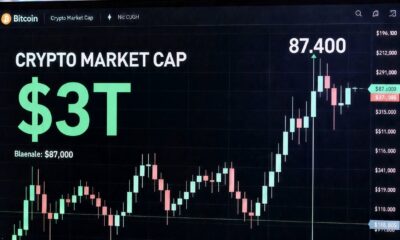
Bitcoin Surges Above $87,000 as Crypto Market Cap Reclaims $3 Trillion
-

 DeFi1 month ago
CFTC Submits Crypto Market Rules to White House Amid Congressional Stall
-

 Crypto2 weeks ago
Treasury and FinCEN drop unhosted-wallet and mixer surveillance proposals
-
DeFi1 month ago
Bitcoin Surges Above $87,000 on ETF Inflows and Massive Short Squeeze
-

 Bitcoin4 weeks ago
X Partners With Coinbase, Kraken, Gemini and Brokers to Trade From the Timeline
-

 Bitcoin3 weeks ago
Coinbase Receives CFTC Approval for U.S. Derivatives Clearinghouse
-

 DeFi3 weeks ago
BTSE Receives a Full Licence to Trade and Custody Crypto in Bhutan
-

 Crypto3 weeks ago
Singapore Reclaims the Regional Crypto Lead at $284 Billion as the Rest of CSAO Shrinks
-

 DeFi1 week ago
Bitcoin Holds Above $84,000, Shrugging Off Heavy ETF Outflows as Oil Declines
-

 DeFi2 weeks ago
Government-linked wallets move seized coins
-

 Bitcoin4 weeks ago
Strategy Resumes Bitcoin Buying, Adds 950 BTC
-

 DeFi2 weeks ago
Winklevoss files a 0.25% Zcash ETF
-

 Crypto2 weeks ago
CFTC opens Regulation CTX and CAM after Clarity Act stalls
-

 DeFi1 month ago
Avalanche Gains on NYSE Tokenization Testing Reports
-

 Bitcoin2 weeks ago
Bitcoin loses $84,000 as Hormuz attacks lift oil and yields
-

 Bitcoin2 weeks ago
Spot bitcoin ETFs flip to a ~$487 million outflow
-

 DeFi1 week ago
U.S. Spot Bitcoin and Ethereum ETFs See Significant Weekly Outflows
-

 DeFi3 weeks ago
Quant Surges After Selection for U.S. Bank On-Chain Payments Initiative
-
 DeFi4 weeks ago
Bitcoin Pulls Back Below $84,000 After Hitting Multi-Month Highs Near $87,000
-

 Bitcoin3 weeks ago
Spot Bitcoin ETFs Record Strongest Weekly Inflows of 2026, Flipping Year-to-Date Flows Positive