Crypto
The XRP Flywheel Effect: Why Price Discovery May Become Inevitable as Corridors Flip


The post The XRP Flywheel Effect: Why Price Discovery May Become Inevitable as Corridors Flip appeared first on Coinpedia Fintech News
XRP is once again at the center of market discussions after new commentary from analysts highlighted how the long-term expansion of Ripple’s global payment network could eventually translate into higher public ledger activity and stronger price momentum for the token.
According to Jesse from Apex Crypto Insights, a factor investors often misunderstand is that most current payment activity on Ripple’s network does not yet use XRP directly. Instead, many banks and financial institutions rely on fiat-based settlement rails within RippleNet because they provide faster processing, lower costs than traditional systems like SWIFT, and eliminate cryptocurrency volatility risks. As a result, a large portion of institutional payment flows remains invisible to the public XRP Ledger today.
Three-stage adoption model shaping XRP’s long-term outlook
He describes Ripple’s expansion strategy as a multi-stage adoption cycle designed to gradually integrate XRP into global payment infrastructure.
Stage one (2017–2023): Institutional onboarding: During the early phase, Ripple focused on convincing banks and payment providers to adopt its technology using fiat-only settlement systems. This approach allowed institutions to benefit from faster and cheaper cross-border payments without needing to hold crypto assets. While this helped grow RippleNet’s global footprint, it meant that most transaction volume did not yet contribute to demand on the public XRP ledger, keeping direct price impact limited.
Stage two (2023–2026): On-demand liquidity expansion: The second phase, now underway, involves introducing On-Demand Liquidity (ODL) solutions that use XRP as a bridge asset between currencies. In an ODL transaction, funds are converted into XRP on one exchange, transferred across the ledger within seconds, and converted back into the destination currency. Each activation of a new payment corridor—such as U.S. dollar to peso or yen—turns previously private fiat-only volume into public XRP transaction activity.
Several corridors are already using this system at scale, including the Mexico corridor through Bitso since 2019 and expanding adoption across regions such as Asia-Pacific and parts of Latin America. Analysts note that as more corridors adopt ODL, daily XRP transaction flows could grow significantly, tightening spreads and increasing liquidity across exchanges.
Stage three: Network effects and liquidity flywheel: As more institutions shift to XRP-based settlement, liquidity is expected to deepen further, lowering transaction costs and encouraging additional corridors to adopt the technology. Over time, this “flywheel effect” could create sustained demand growth, particularly if major G20 currency corridors—such as U.S. dollar to euro or yen—move toward full ODL usage.
Why current private payment volume still matters for XRP
Although most RippleNet transactions today do not directly use XRP, analysts argue that the existing private payment volume effectively acts as potential future demand. Once institutions become comfortable with Ripple’s infrastructure and regulatory clarity improves, the economic incentive to reduce settlement costs—often estimated at 60% to 90% savings—could drive a gradual shift toward XRP-based liquidity solutions.
The expansion of automated market makers (AMMs), decentralized exchange liquidity, and institutional participation in providing XRP liquidity pools could further amplify transaction activity. In such a scenario, rising payment flows, increased trading activity, and growing speculative interest could collectively contribute to stronger price discovery over time.

The content on CoinReporter.io is for informational purposes only and is not financial or investment advice. Cryptocurrency investments are highly volatile and risky. Always conduct your own research and consult a qualified financial advisor before making any investment decisions. CoinReporter.io and its authors are not liable for any losses resulting from actions based on this website’s content.

MoonPay has applied for a US national trust bank charter that would let it issue and redeem stablecoins, manage their reserves and hold digital assets for clients under federal supervision, according to filings with the Office of the Comptroller of the Currency (OCC).
The crypto payments company submitted the application on Nov. 17, and the OCC recorded its receipt the following day. The proposed MoonPay National Trust Bank would be a wholly owned subsidiary of MoonPay Inc., headquartered in Miami Beach, Florida.
No deposits, no loans
The bank would be a non-depository institution. It would not take traditional deposits or make loans, and its services would not carry Federal Deposit Insurance Corp. coverage. Instead, it would focus on custody, stablecoin issuance and redemption, reserve management and conversion services for clients.
MoonPay co-founder and chief executive Ivan Soto-Wright would chair the five-member board and serve as interim president and CEO. Other organizers include co-founder Victor Faramond and chief financial officer Anne Giviskos. The application describes a digital-first model, with no public offices or branches planned for the first three years.
The company says it serves more than 30 million customers in 180 countries and supports over 500 enterprise clients. It already holds a New York BitLicense and, since November 2025, a limited-purpose trust charter from the state’s Department of Financial Services.
A crowded charter queue
MoonPay joins a growing line of crypto firms seeking federal oversight. Coinbase’s national trust bank received final approval this month, Circle won final OCC approval in July, and Ripple secured its own charter in October. Stripe-owned Bridge received conditional approval in February.
Other applicants include Rain, Modern Treasury and Block, as well as Zerohash, EDX Markets and Morgan Stanley. The rush comes ahead of the GENIUS Act, which takes effect on Jan. 18, 2027, and sets federal standards for stablecoin reserves and redemptions.
Not everyone welcomes the trend. In October, the Independent Community Bankers of America sued the OCC, arguing the regulator overstepped its authority by letting non-depository trust banks carry out activities traditionally reserved for commercial banks.
For MoonPay, the charter would underpin a broader push beyond helping users buy crypto. The company has agreed to acquire North Capital Investment Technology for brokerage and trading capabilities, partnered with WisdomTree on tokenized Treasury products and launched a South Korean unit working with local banks on stablecoin payments.
The application now goes through OCC review, and approval is not guaranteed.
References: Cointelegraph, Bitcoin.com News


Bitcoin Hits Four-Month Low Near $61,300 as $700 Million in Liquidations Follow Anthropic IPO
Bitcoin fell to a four-month low near $61,300 late Thursday, its weakest level since early July, as a sell-off in...


MoonPay Files for National Trust Bank Charter to Issue Stablecoins in the US
MoonPay has applied for a US national trust bank charter that would let it issue and redeem stablecoins, manage their...


BlackRock’s IBIT Posts Record $541 Million Outflow as Bitcoin ETFs Lose $582 Million
US spot Bitcoin ETFs lost $582.3 million on Thursday, Nov. 19, nearly double the previous day’s outflow, as BlackRock’s iShares...


Bitcoin Slips to $63,600 as Fed Minutes Show October Hold Was a ‘Close Call’
Bitcoin fell to about $63,600 on Thursday after minutes of the Federal Reserve’s October meeting showed some officials viewed their...


Tokenized Anthropic Stock Heads to BNB Chain on Day of Record $81.3 Billion IPO
Tokens tracking Anthropic’s stock will go live on BNB Chain on the artificial intelligence company’s first day of public trading,...


Six Senators Urge Treasury to Give State Stablecoin Issuers GENIUS Act Safe Harbor
Six bipartisan U.S. senators have urged Treasury Secretary Scott Bessent to give state-supervised stablecoin issuers the same safe harbor that...


Bitcoin ETFs Extend Outflow Streak to Eight Days as Traders Brace for Nvidia Earnings
U.S. spot bitcoin exchange-traded funds recorded net outflows of $68.6 million on Monday, according to data from Farside Investors, extending...


Aster CEO Blames Likely Malicious Liquidations as ASTER Token Plunges 32% in Minutes
Key takeaways Aster chief executive Leonard Leung said the team is investigating after the ASTER token jumped above $0.71 and...


Coinone Warns of Phishing After Breach at Support Contractor Exposes 11 Data Types
Key takeaways South Korean crypto exchange Coinone has warned customers about phishing and identity theft after an attacker breached MetaM,...


Bitcoin Tests $75,200 Support
Total crypto market capitalization hovered near $2.50–2.54 trillion on November 9, 2026. Bitcoin dominance remained elevated at roughly 59–60%. The...
-

 DeFi3 weeks ago
LUNC Hits 462B Burned After v4.1.1 Upgrade
-
 DeFi1 month ago
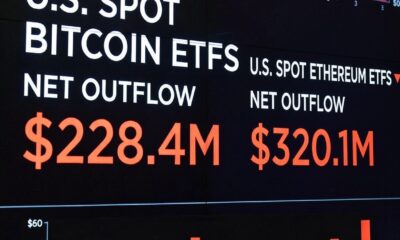
Bitcoin and Ethereum Spot ETFs Record Substantial Weekly Outflows
-

 DeFi1 month ago
Arbitrum Rallies on Stablecoin Growth Program as DeFi Tokens Outperform
-

 Crypto4 days ago
Ether ETFs Lose $399 Million for Seventh Straight Week, Nearing Record Outflow Streak
-

 DeFi4 weeks ago
BNB Standard Corporation
-

 Crypto3 weeks ago
DTCC Launches Tokenization Service Covering Approximately $30 Trillion in Securities
-

 DeFi1 month ago
Nine Crypto Firms Launch Quantum Alliance to Set Post-Quantum Standards
-

 DeFi4 weeks ago
Binance-Linked Transfer Triggers 347 Million LUNC Burn
-
 DeFi1 month ago
Swiss FINMA Approves First Retail Bitcoin ETF Holding BTC Directly
-

 DeFi1 month ago
U.S. Spot Bitcoin ETFs Post Best Inflow Day in Nearly a Month
-

 DeFi1 month ago
World Liberty Financial’s USD1 Stablecoin Sheds Over $400 Million in Market Cap Amid Redemptions
-

 Crypto3 weeks ago
Memecoin PEPE Rallies on Reported Large Holdings Linked to Justin Sun; Broader Tokenization Debate Continues
-

 DeFi1 month ago
Strive Discloses Additional Bitcoin Purchases, Holdings Reach 36,818 BTC
-

 DeFi3 weeks ago
Ripple Secures Final OCC Approval for National Trust Bank to Oversee RLUSD
-

 Crypto2 days ago
Zelle Picks Solana for ZelleUSD Stablecoin After $1.2 Trillion Year of US Payments
-

 Bitcoin3 weeks ago
Federal Reserve Holds Rates Steady as Bitcoin Trades Near $80,000; December Hike Odds Rise
-

 DeFi1 month ago
Crypto Hacks and Losses Reach $1.18 Billion in Q3 2026 Across 107 Incidents
-

 DeFi4 weeks ago
Crypto Liquidations Surge Past $400 Million in Hours as Bitcoin Briefly Dips Below $80,000
-

 Bitcoin2 days ago
Crypto Market Analysis: Bitcoin Slips Below $63,000 as Fear Grips Traders
-

 DeFi4 weeks ago
Bitcoin Slides Below $81,500 as Tech Sell-Off and Elevated Oil Prices Hit Risk Assets
-

 Bitcoin1 day ago
Bitcoin ETFs Lose $306.5 Million as Citi Cuts Its 12-Month Target to $99,532
-

 Bitcoin5 days ago
Bitcoin Falls to Three-Month Low Below $63,000 as Liquidations Top $1.9 Billion
-
DeFi1 week ago
Bitcoin Tests $75,200 Support
-
Bitcoin3 days ago
Bitcoin ETFs Extend Outflow Streak to Eight Days as Traders Brace for Nvidia Earnings
-

 DeFi1 month ago
JPMorgan Expands JPM Coin Deposit Token to Ethereum Mainnet for Institutional Clients
-

 DeFi1 month ago
Mt. Gox Extends Creditor Repayment Deadline to October 2027
-

 Crypto3 weeks ago
Hyperliquid Permanently Burns Nearly 5% of Maximum HYPE Supply Amid Broader Token Burn Trends
-

 DeFi4 weeks ago
Strive Adds $335 Million in Bitcoin to Corporate Treasury
-

 Crypto1 week ago
DTCC Adds Solana to Tokenization Service, Targeting Second Half of 2027
-

 DeFi3 weeks ago
Stablecoin Issuers and Partners Freeze Billions Linked to Binance Incident
-

 DeFi1 month ago
Circle Targets 40 Emerging Markets
-

 DeFi2 weeks ago
Bitcoin Crashes Toward $75K
-

 DeFi2 weeks ago
Bitcoin Rebounds Past $80,000 as Midterms Conclude and Markets Digest Binance Hack Details
-

 DeFi1 month ago
Strategy Adds 267 Bitcoin for $22.1 Million, Bringing Holdings to 848,517 BTC
-

 DeFi3 weeks ago
Moody’s Assigns Investment-Grade A2 Rating to Ripple’s RLUSD; Coinbase Lists the Stablecoin
-

 Bitcoin6 days ago
Bitcoin Slides Toward Sixth Weekly Loss as $1.23 Billion in Liquidations Hit Longs