DeFi
Chainlink Partners with Bottomline to Enable Cross-Chain Payments for 600+ Banks


Chainlink just plugged itself into a pipe most people have never heard of — and that pipe already moves more money than most blockchains will see in a decade.
On September 3 the oracle network said it had entered a strategic partnership with Bottomline, a top-three Swift service provider, to open cross-chain and cross-border payment rails for Bottomline’s 600-plus bank customers. Bottomline’s platforms handle more than $16 trillion in payments a year. The firm also counts about 1,200 financial institutions and 10,000 businesses. One compilation put daily traffic near 10 million payments and estimated that roughly 15% of international Swift cross-border traffic already touches Bottomline’s stack. The banks keep sending ISO 20022 messages. Chainlink sits underneath and talks to chains.
That is the whole pitch. Do not rip out Swift. Add a settlement option.
What actually gets built
Two Chainlink products do the work.
CCIP, the Cross-Chain Interoperability Protocol, moves messages and tokenized value across supported public and private networks. It has been live since July 2023 and now spans more than 60 chains. CRE, the Chainlink Runtime Environment, orchestrates the workflow from the bank’s existing instruction through on-chain settlement and back — compliance checks, routing, confirmations — so the core banking system does not have to learn a new chain every quarter. Access is supposed to be a single, network-agnostic connection rather than a custom integration per ledger.
In practice a treasury desk can keep typing the same Swift message it types today. If the receiving side, or the bank’s own policy, wants the value to land as a token on a permissioned chain or a public one, CCIP and CRE handle the hop. Correspondent accounts, weekend gaps, and T+2 FX still exist until someone actually settles on-chain. The partnership is the adapter, not a replacement for the correspondent system.
Neither firm disclosed how many of the 600 banks will turn the feature on first, what volumes will run, or when production traffic starts. Several reports framed the work as still at proof-of-concept. Treat “600 banks” as the addressable base, not a live user count.
Why Bottomline is the interesting logo
Swift itself connects more than 11,500 institutions. It does not settle. It messages. The bureaus that sit between those messages and bank back offices are where integration actually happens. Bottomline, owned by Thoma Bravo, is one of the three largest of those bureaus. Wiring Chainlink there is different from signing a memorandum with a single money-center bank. It is a distribution deal: one integration, hundreds of potential endpoints, without asking each bank to stand up its own oracle stack.
That is also why the $16 trillion figure is easy to misuse. It is Bottomline’s existing payments book, almost all of it still fiat rails. None of that volume automatically becomes CCIP volume. The option is what changed. Banks that already trust Bottomline for Swift connectivity now have a vendor-supported path to public and permissioned chains that does not require a second operations team.
Where this sits on Chainlink’s bank map
The Bottomline announcement is not Chainlink’s first institutional payment story. It is the widest distribution story.
Project Pangea already groups more than 50 banks in Europe and South Korea — including the Qivalis euro-stablecoin cohort and Korea’s UniKA alliance — targeting near-real-time, stablecoin-based FX settlement in a corridor of about $150 billion in trade, with banks still speaking Swift and ISO 20022. Chainlink has also put CCIP in front of names such as JPMorgan, ANZ, UBS Asset Management, and the Hong Kong Monetary Authority. Data products — including U.S. official economic releases delivered on-chain — and state-level stablecoin work sit on the same enterprise calendar. Swift’s own head of strategy, Jonathan Ehrenfeld Solé, is slated to speak on digital-asset adoption at Chainlink’s Link:NYC event on October 29. The bureau deal and the Swift conference circuit are the same campaign: meet the bank where the message already lives.
LINK traded up about 6–7% on the news, around the low $12 area in some prints. Token reaction is not implementation. Fees from a live payments workflow would be the fundamental. Those have not been published.
What still has to be true
Three gaps sit between a press release and a cheaper wire.
First, production. A path for 600 banks is not 600 banks sending value on CCIP. Watch for a named pilot, a corridor, and a first live settlement date. Second, compliance. Cross-chain does not erase sanctions screening, travel-rule data, or the fact that a public-chain hop is a different risk committee conversation from a private one. CRE can orchestrate that. Banks still have to approve it. Third, the Swift question. Swift is running its own digital-asset experiments. A top bureau plugging in Chainlink is complementary until it is competitive. How those two interoperability stories coexist will matter more than which logo won Thursday.
If the integration ships, the efficiency case is straightforward: fewer nostro balances, fewer cut-off times, programmable settlement next to the same ISO 20022 instruction the bank already files. That is the RWA-and-payments thesis in a sentence — tokenized value moving on the message the industry already standardized. ICE–tZERO, LSEG–Payward, and DTCC’s Stellar hook are the securities version of the same idea. Bottomline–Chainlink is the payments version.
Until a bank posts a hash next to a Swift MT or pacs.008, call it infrastructure optionality. For an oracle network that has spent years trying to become the default middleware between those two worlds, optionality at $16 trillion of existing flow is the point of the announcement. The next update that matters is not another logo. It is a volume number.

The content on CoinReporter.io is for informational purposes only and is not financial or investment advice. Cryptocurrency investments are highly volatile and risky. Always conduct your own research and consult a qualified financial advisor before making any investment decisions. CoinReporter.io and its authors are not liable for any losses resulting from actions based on this website’s content.




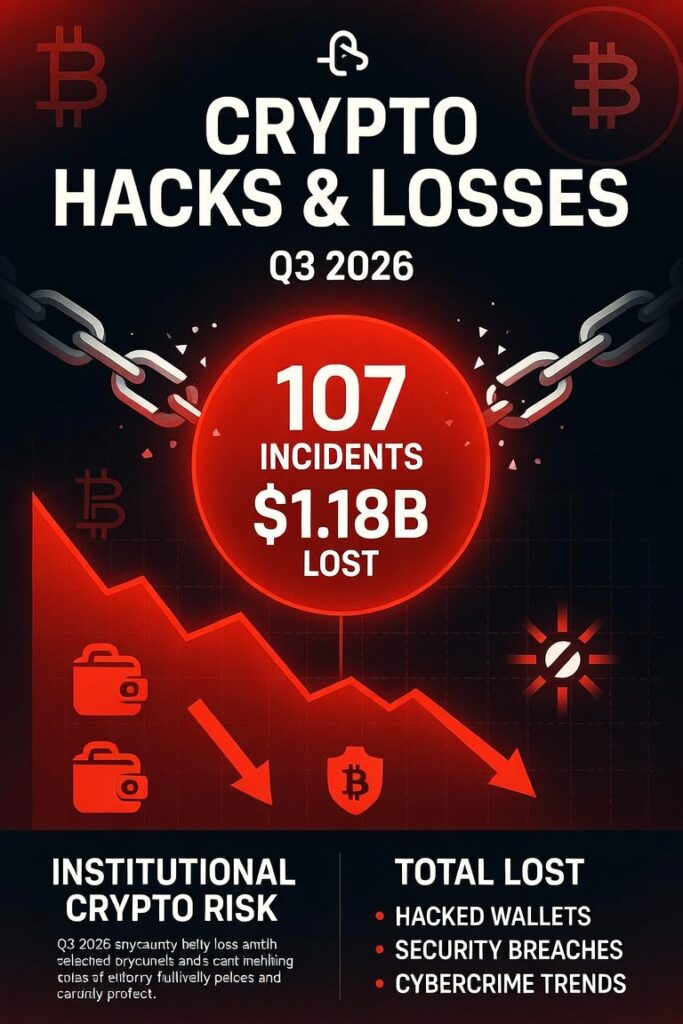
Security firm Hacken reported that crypto hacks and related losses totaled $1.18 billion across 107 incidents in the third quarter of 2026. The figure was 55% higher than the previous quarter and underscored persistent security challenges even as overall market capitalization recovered toward the $2.7–3 trillion range earlier in the year. Audit badges and conventional security signals did not fully mitigate the risks in several high-profile cases, according to the analysis.
Approximately $906–907 million (about 77% of the total) stemmed from compromised suppliers or developer tools, publicly available security fixes that were not installed, or components excluded from the most recent security reviews. Major incidents included a Bitget exchange breach involving third-party security infrastructure (reported between roughly $352–387 million) and an exploit affecting the Liquid Network (around $320 million). Smart contract issues accounted for a large share of the number of incidents, while access-control and operational failures drove significant value losses. About one-third of the gross losses were later returned, reversed, or covered by operators.
The data serves as a reminder of operational and smart-contract risks amid growing institutional participation and on-chain activity. Hacken noted that many attacks targeted systems outside the typical scope of standard audits, such as signing infrastructure, third-party tools, and supplier components. The concentration of losses in a relatively small number of large incidents further highlighted how single points of failure can drive the majority of quarterly damage even as the broader market expands.

Crypto Hacks and Losses Reach $1.18 Billion in Q3 2026 Across 107 Incidents
Security firm Hacken reported that crypto hacks and related losses totaled $1.18 billion across 107 incidents in the third quarter...


Strive Discloses Additional Bitcoin Purchases, Holdings Reach 36,818 BTC
Strive reported acquiring approximately 1,223 BTC for roughly $100 million between October 14 and 16, 2026, at an average price...


Arbitrum Rallies on Stablecoin Growth Program as DeFi Tokens Outperform
Arbitrum (ARB) led major altcoin gains on October 19, 2026, rising 6–9% toward the $0.20 level, driven by the Arbitrum...


World Liberty Financial’s USD1 Stablecoin Sheds Over $400 Million in Market Cap Amid Redemptions
World Liberty Financial’s USD1 stablecoin saw its market capitalization decline by more than $400 million over roughly two weeks, falling...


Strategy Adds 267 Bitcoin for $22.1 Million, Bringing Holdings to 848,517 BTC
Strategy (formerly MicroStrategy) disclosed in a Monday SEC filing that it purchased 267 BTC for approximately $22.1 million between October...


JPMorgan Expands JPM Coin Deposit Token to Ethereum Mainnet for Institutional Clients
JPMorgan Chase announced on October 19, 2026, that its dollar-denominated deposit token, JPM Coin (JPMD), is now available on Ethereum...


Bitcoin Rebounds Above $82,000 as China GDP Beats Estimates and Nasdaq Futures Recover; DeFi Leads Altcoin Gains
Bitcoin extended a rebound above the $82,000 level on October 19, 2026, recovering from a weekend dip near $80,700, as...

Bitcoin and Ethereum Spot ETFs Record Substantial Weekly Outflows
U.S. spot Bitcoin ETFs recorded roughly $228.4 million in net outflows over the five sessions ending October 16, 2026, while...


Stablecoin Remittances Shown 84% Cheaper Than Traditional Bank Transfers
Analysis published around October 17, 2026, indicated that stablecoin-based remittances can be approximately 84% cheaper than traditional bank transfers in...


Circle Targets 40 Emerging Markets
Circle Targets 40 Emerging Markets for USDC as Visa Direct Moves Stablecoin Prefunding into Production Circle is preparing a significant...
-

 DeFi4 weeks ago
Bitcoin Reclaims $81,000 and Closes Above Key 50-Week Moving Average
-

 DeFi3 weeks ago
Hong Kong Moves Licensed Stablecoins Onto Exchanges and Into Fund Settlement
-

 Crypto2 weeks ago
ESMA gives EU crypto firms three months to exit non-MiCA stablecoins
-

 Crypto2 weeks ago
Binance Burns 334.88 Million LUNC in October Fee Batch as Second Transaction Lifts the Day’s Total
-

 DeFi4 weeks ago
Coinbase Adds Fixed-Rate Bitcoin-Backed Loans via Morpho Midnight
-

 Bitcoin2 weeks ago
SEC clears listing path for first U.S. 3x Bitcoin and Ether ETFs
-

 DeFi3 weeks ago
TOKEN2049 Opens in Singapore Next Week as the City Leads Regional Crypto Flow
-

 DeFi3 weeks ago
Robinhood Puts Hedge-Fund Tools in the App as Macro Turns Softer
-

 DeFi3 weeks ago
HSBC Names Its Hong Kong Stablecoin RedCoin, and Starts With PayMe
-

 Bitcoin1 week ago
Strategy (MicroStrategy) Adds 250 Bitcoin, Holdings Reach 848,250 BTC
-

 DeFi4 weeks ago
Solana Advances Alpenglow Upgrade to Public Testnet
-

 Bitcoin3 weeks ago
Strategy Adds Another 1,665 BTC, Lifting Holdings to 847,666
-

 Bitcoin2 weeks ago
Bitcoin breaks under $84,000 as oil spikes on Hormuz tanker attacks
-

 DeFi1 week ago
Bitcoin Drops Below $82,000 Amid $770M+ in Liquidations as Volatility Spikes
-

 Bitcoin4 weeks ago
Record ETF Inflows and a Short Squeeze Drive Bitcoin’s $87,000 Break
-

 DeFi3 weeks ago
South Korea Ranks Second in On-Chain Crypto Holdings as the Tax Date Holds
-

 DeFi4 weeks ago
CFTC Submits Crypto Market Rules to White House Amid Congressional Stall
-
 DeFi4 weeks ago
Bitcoin Surges Above $87,000 as Crypto Market Cap Reclaims $3 Trillion
-
DeFi4 weeks ago
Bitcoin Surges Above $87,000 on ETF Inflows and Massive Short Squeeze
-

 Bitcoin3 weeks ago
Coinbase Receives CFTC Approval for U.S. Derivatives Clearinghouse
-

 Bitcoin4 weeks ago
X Partners With Coinbase, Kraken, Gemini and Brokers to Trade From the Timeline
-

 Crypto2 weeks ago
Treasury and FinCEN drop unhosted-wallet and mixer surveillance proposals
-

 DeFi3 weeks ago
BTSE Receives a Full Licence to Trade and Custody Crypto in Bhutan
-

 DeFi1 month ago
SEC Opens Pathway for Tokenized U.S. Equities After Legislative Setback
-

 DeFi1 month ago
Circle Launches Arc Mainnet with Institutional Validators Including BlackRock and Visa
-

 Bitcoin4 weeks ago
Strategy Resumes Bitcoin Buying, Adds 950 BTC
-

 DeFi2 weeks ago
Government-linked wallets move seized coins
-

 DeFi1 week ago
Bitcoin Holds Above $84,000, Shrugging Off Heavy ETF Outflows as Oil Declines
-

 Crypto3 weeks ago
Singapore Reclaims the Regional Crypto Lead at $284 Billion as the Rest of CSAO Shrinks
-

 DeFi4 weeks ago
Avalanche Gains on NYSE Tokenization Testing Reports
-

 Crypto2 weeks ago
CFTC opens Regulation CTX and CAM after Clarity Act stalls
-

 DeFi2 weeks ago
Winklevoss files a 0.25% Zcash ETF
-

 Bitcoin1 month ago
Institutional Crypto Infrastructure Advances: Deutsche Bank Custody and Related Moves
-

 Bitcoin2 weeks ago
Spot bitcoin ETFs flip to a ~$487 million outflow
-

 Bitcoin2 weeks ago
Bitcoin loses $84,000 as Hormuz attacks lift oil and yields
-
 DeFi4 weeks ago
Bitcoin Pulls Back Below $84,000 After Hitting Multi-Month Highs Near $87,000