Crypto
SEI price prediction 2026-2032: Time to buy SEI?

Key takeaways:
- Our SEI price prediction anticipates a high of $0.14 by the end of 2026.
- In 2028, it will range between $0.35 and $0.43, with an average price of $0.36.
- In 2030, it will range between $0.78 and $0.91, with an average price of $0.81.
Our SEI price prediction sees SEI reaching as high as $0.14 by the end of 2026, potentially climbing to $1.37 by 2031 and into a 1.66-2.02 range by 2032. For crypto investors, traders, and enthusiasts evaluating SEI’s upside and risk, that outlook matters because the project remains active on both the development and market fronts.
The Parallel Stack, a robust, open-source framework for building rollups and Layer 2s that leverage parallel processing, is now on SEI V2. The stack enhances Ethereum’s performance by addressing the most common bottlenecks Layer 2 blockchains face, and such developments could support SEI’s long-term value.
Regarding price performance, SEI shows signs of trading higher; however, it remains influenced by broader market sentiment. Below, we break down SEI’s current market position, technical analysis, price predictions from 2026 to 2032, recent developments, investment potential, and how this forecast compares with other expert outlooks so you can judge how high SEI could go and whether it fits your strategy.
Overview
| Cryptocurrency | Sei |
| Ticker | SEI |
| Current price | $0.07339 |
| Crypto market cap | $556.35M |
| Trading volume | $66.31M |
| Circulating supply | 7.57B |
| All-time high | $1.14 on Mar 16, 2024 |
| All-time low | $0.007989 on Aug 15, 2023 |
| 24-hour high | $0.07546 |
| 24-hour low | $0.07168 |
SEI price prediction: Technical analysis
| Metric | Value |
| Volatility (30-day variation) | 21.57% (Extremely high) |
| 50-day SMA | $0.05259 |
| 200-day EMA | $0.05362 |
| Sentiment | Bullish |
| Green days | 19/30 (63%) |
| Fear and Greed Index | 70 (Greed) |
Traders use moving averages built from historical data and recent price data to identify trends and bullish or bearish setups in Sei, and Sei’s 200-day SMA is projected to reach $0.05346 by November 2026.
SEI price analysis
On October 6, SEI’s price fell 0.87% over 24 hours and 51.90% over 30 days. Analysts assessing the current move use technical analysis on historical price action and chart patterns, and the short-term Sei price outlook remains highly volatile. Its 24-hour trading volume rose 13.95% to $67 million, signaling strong conviction in the market trend, though SEI remains highly volatile today.
Sei’s price is shaped by supply and demand, shifts in market capitalization, and whale activity.
SEI 1-day chart analysis
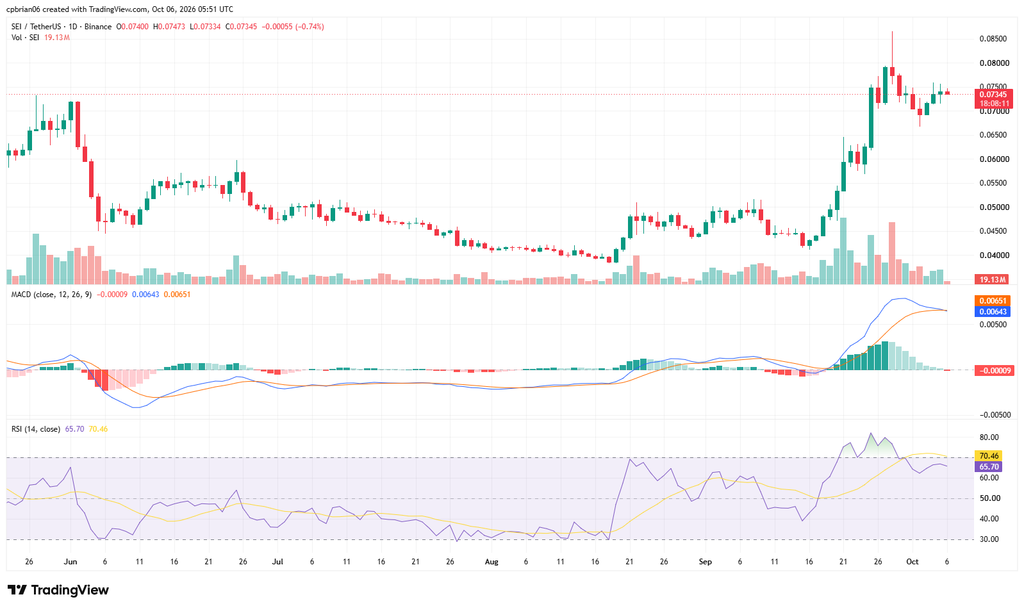
The 1-day chart’s price action shows SEI has broken above major moving averages after bouncing off support at $0.06. Its MACD histogram shows that momentum is rising, while rising trading volumes signal conviction in the trend. The RSI is at 65.56, suggestive of a neutral market.
SEI price 4-hour chart analysis
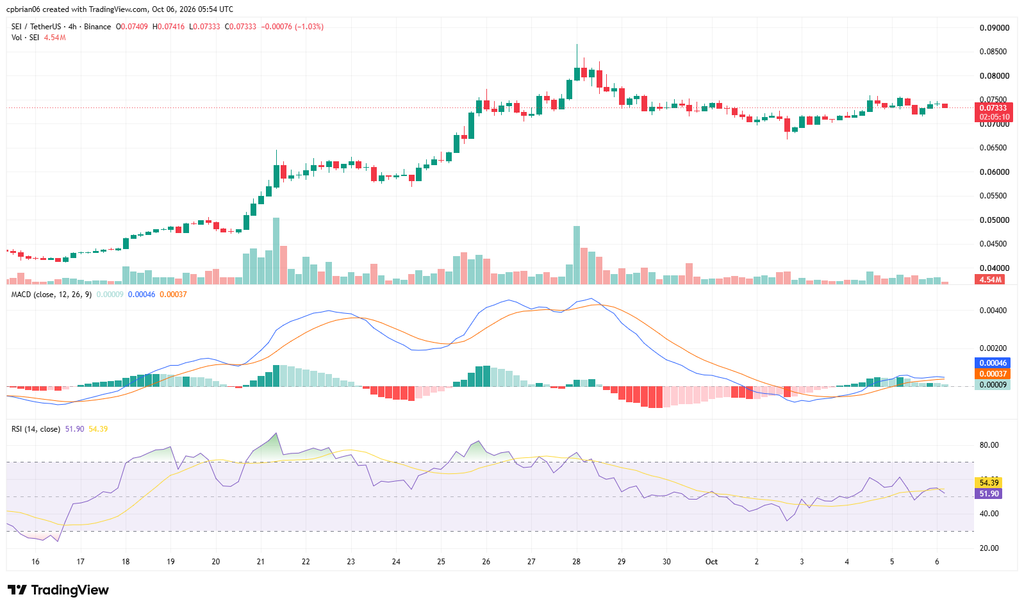
The 4-hour chart highlights SEI’s run this month. The trend is characterized by low price volatility. SEI’s momentum is positive in this timeframe, with the RSI at 51.86. The candles are short, suggestive of an undecided market.
SEI technical indicators: Levels and action
Daily simple moving average (SMA)
| Period | Value ($) | Action |
| SMA 3 | 0.07160 | BUY |
| SMA 5 | 0.07176 | BUY |
| SMA 10 | 007350 | BUY |
| SMA 21 | 0.06199 | BUY |
| SMA 50 | 0.05259 | BUY |
| SMA 100 | 0.04888 | BUY |
| SMA 200 | 0.05362 | BUY |
Daily exponential moving average (EMA)
| Period | Value ($) | Action |
| EMA 3 | 0.07251 | BUY |
| EMA 5 | 0.07221 | BUY |
| EMA 10 | 0.07036 | BUY |
| EMA 21 | 0.06459 | BUY |
| EMA 50 | 0.05649 | BUY |
| EMA 100 | 0.05391 | BUY |
| EMA 200 | 0.06742 | BUY |
Analysts also use a wide array of tools, including SMA, EMA, RSI, and MACD, to build SEI forecasts.
What to expect from the SEI price analysis next?
SEI is neutral, with short-term market conditions shaped by rising trading volumes and little momentum. Technical indicators now place key support levels at $0.06340, with the 0.06-0.07 zone still important for near-term valuation. Sei’s resistance sits at $0.08363, marking the main level to watch next.
Why is SEI up?
The entire crypto market cap rose 2.93%, with Bitcoin gaining 0.87%. Sector-wide altcoin pressure, with multiple low-cap tokens posting profits, indicates a risk-on rotation into speculative assets.
Will SEI reach $1?
According to the Cryptopolitan price prediction, SEI will rise above $1 in 2031, reaching a high of $1.37.
Can Sei Coin reach $10?
According to Cryptopolitan’s price prediction, SEI is unlikely to reach $10 before 2031. With a maximum token supply of 10 billion, SEI would need enormous market cap growth to support a $10 price.
Will SEI reach $100?
According to Cryptopolitan’s price prediction, SEI is unlikely to reach $100 before 2031.
Does SEI have a good long-term future?
According to Cryptopolitan price predictions, SEI will trade higher in the years to come. Analysts track on-chain metrics to gauge the Sei network’s health and utilization. They monitor both network activity and broader fundamental developments when building price predictions.
Better scalability and developer tooling could attract more projects and liquidity to this layer 1. Technical upgrades like the Sei Giga upgrade can also materially affect market sentiment and are aimed at optimizing Ethereum Virtual Machine execution.
SEI also faces competition from high-speed networks such as Solana and Aptos, while token unlocks can create selling pressure if demand does not keep pace. Long-term projections also depend heavily on ecosystem growth and adoption.
Recent news
Ondo Finance has launched its flagship USDY fund on Sei Network, marking the first tokenized Treasury product on the layer-1 blockchain. The move strengthens ties between Ondo and World Liberty Financial, which holds ONDO tokens as its 12th-largest position.
Is SEI a good investment?
SEI is a purpose-built Layer 1 with growing utility, and its EVM compatibility helps it steal market share from Ethereum. While the technical analysis is bearish, price predictions paint a different picture. The outlook for this asset also depends on overall market sentiment, institutional crypto adoption, and macroeconomic trends.
Potential ETF developments could improve institutional interest in SEI, and broader institutional adoption can improve market dynamics by expanding access. Improved scalability and developer tooling could bring more projects and liquidity to the network, while ongoing developer adoption could also drive short-term price surges.
Token vesting schedules can also create short-term sell pressure through supply dilution. Momentum also relies on fundamental growth metrics such as developer activity, TVL, user growth, and ecosystem activity, so investors should conduct thorough research before making investment decisions in this asset.
SEI price prediction October 2026
SEI’s current value suggests it will average at $0.07 in October. The price will range between $0.04 and $0.08.
| Month | Potential low ($) | Potential average ($) | Potential high ($) |
| October | $0.039 | $0.068 | $0.081 |
SEI price prediction 2026
This year, SEI will trade between $0.04 and $0.14, with an average of $0.09. Late-2026 projections still vary widely, and this SEI crypto price prediction also reflects short-term swings in the coming days and next week. One prediction suggests that, under a bearish next-month outlook, Sei’s price is expected to decrease by 24.93% to $0.05497 by October 29, 2026. The average price target for October 2026 is $0.0738. Some models place SEI in a 2026 trading channel between $0.05128 and $0.07323, with an end-of-2026 forecast near $0.05589. The broader 2026 outlook implies roughly -15% ROI for the year despite expected volatility.
| Year | Potential low ($) | Potential average ($) | Potential high ($) |
| 2026 | 0.0381 | 0.0858 | 0.1378 |
SEI price prediction 2027 – 2032
External forecasts also note potential upside in profit, including a 169.78% gain to $1,697.76 by July 16, 2027, and a 2030 target of $0.1495.
| Year | Potential low ($) | Potential average ($) | Potential high ($) |
| 2027 | 0.1459 | 0.2529 | 0.2946 |
| 2028 | 0.3539 | 0.3640 | 0.4261 |
| 2029 | 0.5210 | 0.5392 | 0.6199 |
| 2030 | 0.7849 | 0.8065 | 0.9054 |
| 2031 | 1.1300 | 1.1700 | 1.3700 |
| 2032 | 1.6600 | 1.7200 | 2.0200 |
Cryptopolitan’s prediction 2027
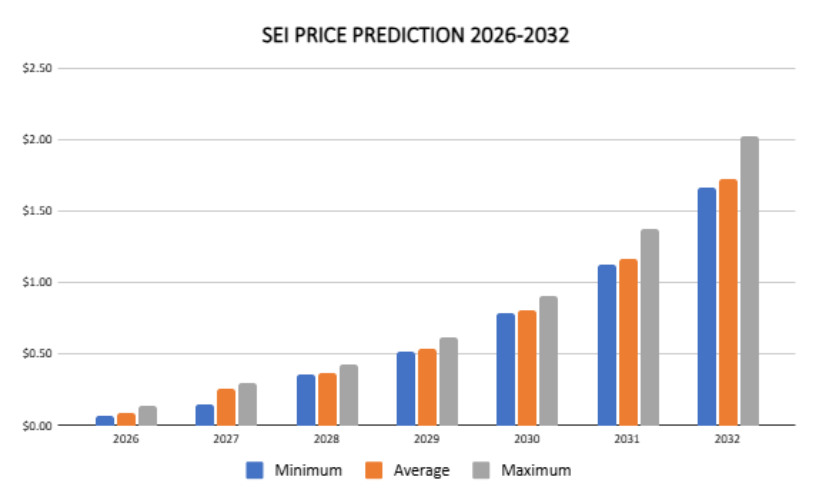
The SEI forecast climbs higher into 2027. It will range between $0.1459 and $0.2946, with an average price of $0.2529.
SEI coin price prediction 2028
The analysis suggests a further acceleration in SEI’s growth in 2028. According to the Cryptopolitan price forecast, it will trade between $0.3539 and $0.4261, with a year-round average of $0.3640.
SEI token price prediction 2029
Based on SEI’s price movements in 2029, the maximum price is $0.6199, the minimum is $0.5210, and the average is $0.5392.
SEI price prediction 2030
The SEI coin price prediction for 2030 suggests a price range of $0.7849 to $0.9054 and an expected average trading price of $0.8065. Some longer-term projections put the minimum SEI prices and recovery range at about $0.82 to $1.26 by 2030. The potential ROI by 2030 is also estimated at 320.7% for long-term investors. This long-term prediction also hinges on SEI’s rising global market recognition and adoption.
SEI prediction 2031
SEI forecast for 2031 sets the high at $1.37. On the downside, it will drop to $1.13, with an average price of $1.17. Another Sei price prediction for 2031 puts the minimum price at $0.09036 and the upper bound at $0.2791, implying a potential gain of 314.51%.
SEI price prediction 2032
According to expert predictions, the price of SEI will range from $1.66 to $2.02, with an average of $1.72.
SEI market price prediction: Analysts’ SEI price forecast
| Firm | 2026 | 2027 | 2028 |
| Gate.com | $0.07376 | $0.09183 | $0.1042 |
| Coincodex | $0.05809 | $0.1012 | $0.1049 |
Cryptopolitan SEI price prediction
SEI key price levels are expected to evolve over the coming years, according to price prediction tools. The coin will reach a high of $0.1378 before the end of 2026. In 2028, it will range between $0.35 and $0.43, with an average of $0.36.
SEI is highly volatile. Negative market sentiment, such as market crashes, could derail the predictions. Always seek independent professional consultation for investment advice. The information provided is for general informational purposes only and should not be treated as financial advice.
SEI historic price sentiment
- The SEI network launched in August 2023, with SEI as its native token, following the public beta’s launch. A community airdrop accompanied the launch.
- The token also supports transaction fee payments.
- Sei was built as a layer 1 blockchain for decentralized finance applications in the broader crypto space.
- Decentralized exchanges are a core target use case, and the chain was designed to optimize trading on such platforms, including derivatives platforms.
- Sei emphasizes a secure, reliable, and robust infrastructure that provides a solid foundation and makes scalability a core design goal.
- Carbon neutrality is also among Sei Network’s stated ecosystem goals.
- Governance decisions can involve token holders through the network’s community processes.
- SEI news and broader ecosystem developments can also influence sentiment around the token over time as SEI aims to expand its DeFi ecosystem.
- As per CoinMarketCap data, it started trading at $0.1808.
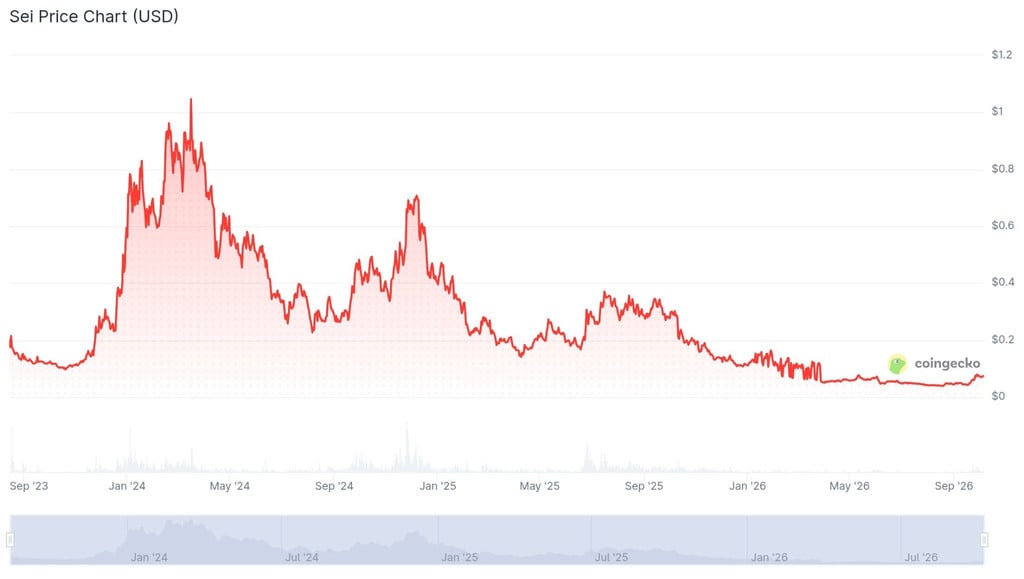
- Since listing, it has experienced significant fluctuations, reaching an all-time low of $0.007989 on August 15, 2023.
- The coin later reached an all-time high of $1.14 on March 16, 2024.
- Since March, it has been in a bear market, falling to $0.27 in September. It then began to recover, trading at $0.45 in October.
- It then began to recover in November; by December, it had risen above $0.68.
- It was later corrected and crossed into 2025, trading at $0.40, dropping to $0.32 in February. By March, it had fallen below $0.27.
- In June, it fell below $0.20. In December, it reached $0.13.
- External crypto correlations, including narratives around the artificial superintelligence alliance and other cryptocurrencies such as Immutable X, can also affect broader risk appetite and Sei price movements.
- Rapid changes in market capitalization have also contributed to sharp price swings in Sei over time, as with many crypto coins.
- In February 2026, it fell below the $0.10 support level. By April and May, it had fallen below the $0.06 support level. Between June and September, it traded at $0.05.
- In the third week of September, it broke higher, and by October, it had reached $0.07.

The content on CoinReporter.io is for informational purposes only and is not financial or investment advice. Cryptocurrency investments are highly volatile and risky. Always conduct your own research and consult a qualified financial advisor before making any investment decisions. CoinReporter.io and its authors are not liable for any losses resulting from actions based on this website’s content.

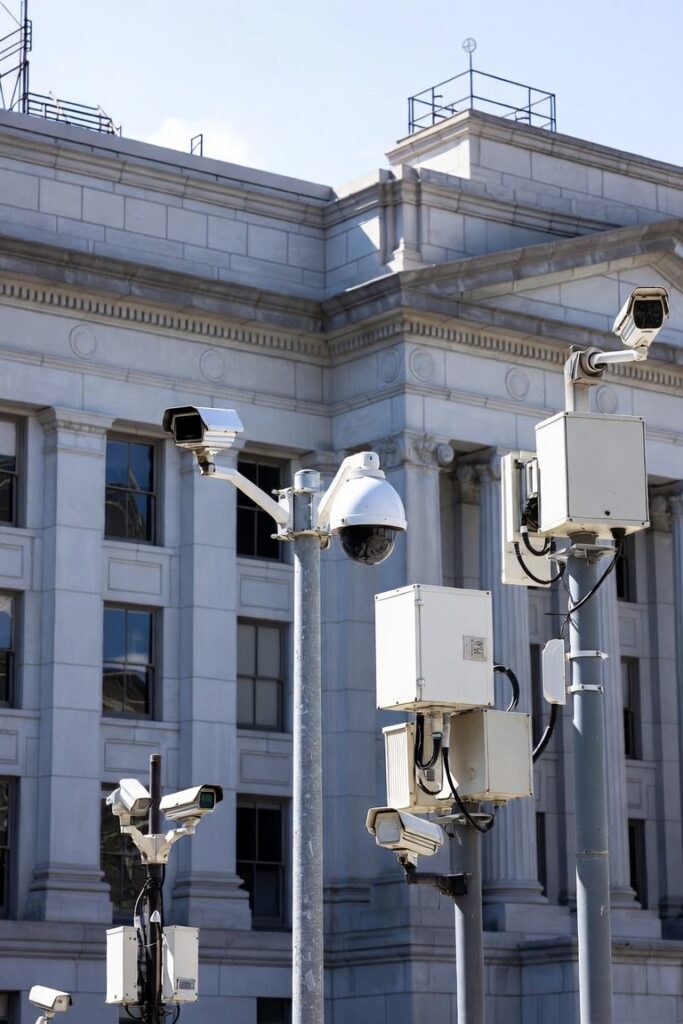
Washington’s other move on 5 October was a retreat. The Treasury and FinCEN withdrew two unfinished proposals: the 2020 rule that would have required identification and reporting on transfers to unhosted wallets, often discussed around a $3,000 threshold, and the 2023 crypto-mixing rule aimed at anonymity-enhancing services.
FinCEN cited the risk of sweeping up legitimate activity. The 2020 text would have treated a transfer from a regulated institution to a wallet the customer controls as a reporting event, not as a withdrawal. The 2023 mixer proposal would have put anonymity-enhancing services in a special surveillance category, on the theory that the tool itself was the risk. Neither rule was ever finalized. Both sat on the books as drafts the industry had to price in anyway.
Privacy advocates and wallet developers treated the withdrawals as the end of a five-year fight. Self-custody was the target of the first proposal: a wallet with no intermediary, no account, and no party FinCEN could already examine. Mixers were the target of the second: software or a service that breaks the link between sender and receiver. Pulling both drafts means the agency is no longer advancing a rule that makes either one a default reporting trigger.
Compliance teams should not read the withdrawals as a free pass. Existing Bank Secrecy Act duties still apply. Sanctions screening still applies. The GENIUS Act stablecoin regime still applies. A bank or a money transmitter that knows a customer is moving funds to evade a blockade, or that ignores a mixer it already flags as high risk, does not get a new defense because a proposed rule was pulled. What changed is the specific plan to treat self-custody transfers and mixers as reporting events in their own right, at a threshold, without a separate suspicion finding.
That distinction is the one that matters for product design. Wallet developers spent five years building around a rule that might have forced a counterparty identity onto every transfer above a few thousand dollars. Exchanges spent the same years deciding whether to block unhosted withdrawals or to collect the data in advance. The draft is gone. The internal controls built to survive it are not required to go with it, and many will stay, because sanctions and fraud filters do not depend on the withdrawn text.
The same week pointed the other way on custody. The SEC’s roughly 682-page crypto custody proposal moved toward the Federal Register, covering adviser self-custody, state trust-company custodians, and tokenized-fund reporting. Advisers who want to hold tokens themselves, or who want to use a state trust company rather than a qualified custodian from the old list, are getting a formal rule. Funds that issue shares as tokens are getting a reporting regime. That is plumbing, not surveillance of the open wallet.
The net picture is mixed. FinCEN stepped back from preemptive reporting on unhosted transfers and mixers. The SEC moved a custody proposal that would formalize how advisers and tokenized funds hold the same assets. Less default surveillance of the wallet. More paperwork once an adviser, a trust company, or a fund is in the chain. For a user who never touches a regulated intermediary, the withdrawn rules were the threat. For an allocator who does, the custody proposal is the one still moving.


Binance Burns 334.88 Million LUNC in October Fee Batch as Second Transaction Lifts the Day’s Total
Binance removed 334,879,422 Terra Luna Classic (LUNC) from circulation on October 1, the headline transaction in its monthly exchange burn...


TOKEN2049 Opens in Singapore Next Week as the City Leads Regional Crypto Flow
TOKEN2049 runs October 7–8 at Marina Bay Sands. Organisers expect more than 25,000 people, from more than 7,000 companies and...


BTSE Receives a Full Licence to Trade and Custody Crypto in Bhutan
BTSE has a full financial-services licence in Gelephu Mindfulness City. The company said on September 29 that the Gelephu Financial...


South Korea Ranks Second in On-Chain Crypto Holdings as the Tax Date Holds
South Korea is second only to the United States in cryptocurrency that can be measured sitting in wallets and on...


HSBC Names Its Hong Kong Stablecoin RedCoin, and Starts With PayMe
HSBC named the stablecoin it has not yet issued. On September 30 the bank said the Hong Kong-dollar token will...


Hong Kong Moves Licensed Stablecoins Onto Exchanges and Into Fund Settlement
Hong Kong’s stablecoin law is already in force. The September policy address is the next step: the tokens those licences...


Japan’s Licensed Yen Stablecoin Traded at Four Times Its Peg on Upbit
JPYC, the first yen stablecoin licensed in Japan, opened on Upbit on September 17 and briefly traded at about four...


South Korea Sets Capital and Ledger Rules for Tokenized Stocks and Bonds
The Financial Services Commission published the subordinate rules that would let tokenized securities start in Korea on February 4, 2027....


Singapore Reclaims the Regional Crypto Lead at $284 Billion as the Rest of CSAO Shrinks
Singapore is again the largest crypto economy in Central and Southeast Asia and Oceania. Chainalysis put activity there at $284...


UK FCA Opens Crypto Licensing Gateway, Giving Firms Until February 2027 to File
The Financial Conduct Authority opened its crypto authorisation gateway on September 30, the first time UK crypto firms can apply...
-

 DeFi2 weeks ago
Bitcoin Reclaims $81,000 and Closes Above Key 50-Week Moving Average
-

 DeFi4 weeks ago
Solana Sets Record with Over 263,000 New Tokens Minted in a Single Day
-

 DeFi2 weeks ago
Coinbase Adds Fixed-Rate Bitcoin-Backed Loans via Morpho Midnight
-

 DeFi4 weeks ago
Visa Stablecoin Settlement Volume Hits $20 Billion Annualized Run Rate
-

 DeFi1 month ago
Chainlink Partners with Bottomline to Enable Cross-Chain Payments for 600+ Banks
-

 DeFi1 month ago
Dash Leads Privacy Coin Rally with Massive Gains
-

 DeFi1 month ago
Zcash Breaks $1,000 for First Time in Nearly a Decade on ETF Momentum
-

 DeFi2 weeks ago
CFTC Submits Crypto Market Rules to White House Amid Congressional Stall
-

 Bitcoin2 weeks ago
X Partners With Coinbase, Kraken, Gemini and Brokers to Trade From the Timeline
-
 DeFi2 weeks ago
Bitcoin Surges Above $87,000 as Crypto Market Cap Reclaims $3 Trillion
-
DeFi4 days ago
Hong Kong Moves Licensed Stablecoins Onto Exchanges and Into Fund Settlement
-

 DeFi2 weeks ago
Bitcoin Surges Above $87,000 on ETF Inflows and Massive Short Squeeze
-

 Bitcoin4 weeks ago
Block (Jack Dorsey) Applies for U.S. Trust Bank Charter
-

 DeFi3 weeks ago
Senate Republicans Release “Final” CLARITY Act Draft Ahead of September 15 Cloture Vote
-

 DeFi4 weeks ago
First U.S. Staked TRX ETF (Canary TRXS) Debuts
-

 DeFi3 weeks ago
Senate Rejects CLARITY Act Cloture in 49-50 Vote, Dealing Major Blow to U.S. Crypto Market Structure
-

 Bitcoin1 month ago
Bitcoin Slips Below $80,000 After Strong U.S. Jobs Report Despite Record ETF Inflows
-

 DeFi4 weeks ago
Ethereum Advances Plans for Gas Payments Without Holding ETH
-

 DeFi3 weeks ago
SEC Opens Pathway for Tokenized U.S. Equities After Legislative Setback
-

 DeFi4 weeks ago
Bitmine Immersion Continues Aggressive ETH Accumulation
-

 Bitcoin4 weeks ago
Liquid Network Exploit: 4,000 BTC Drained, 3,400 Returned in White-Hat Negotiation
-

 Bitcoin2 weeks ago
Strategy Resumes Bitcoin Buying, Adds 950 BTC
-

 Bitcoin4 weeks ago
Crypto Market Faces Pressure as Bitcoin Tests Support Near $78K Amid Macro Headwinds
-

 DeFi3 weeks ago
Circle Launches Arc Mainnet with Institutional Validators Including BlackRock and Visa
-
DeFi4 days ago
TOKEN2049 Opens in Singapore Next Week as the City Leads Regional Crypto Flow
-

 Bitcoin3 weeks ago
Metaplanet Reverses Course, Erasing ~$220 Million in Warrant Value
-

 Bitcoin2 weeks ago
Record ETF Inflows and a Short Squeeze Drive Bitcoin’s $87,000 Break
-

 DeFi4 weeks ago
Circle to Acquire Tazapay for $400 Million
-

 DeFi3 weeks ago
Federal Reserve
-

 DeFi3 weeks ago
Crypto Markets Slide as Clarity Failure, Rising Yields and Oil Prices Weigh; Bitcoin Briefly Tests Below $75,000
-

 Bitcoin4 weeks ago
Bitcoin Slips Under $79,000 as Fed Rate-Hike Odds Hold Near 60%
-

 Bitcoin1 week ago
Strategy Adds Another 1,665 BTC, Lifting Holdings to 847,666
-

 Bitcoin3 weeks ago
Bitcoin Spot ETFs Record $463 Million in Outflows
-

 Bitcoin3 weeks ago
Institutional Crypto Infrastructure Advances: Deutsche Bank Custody and Related Moves
-

 Bitcoin1 week ago
Coinbase Receives CFTC Approval for U.S. Derivatives Clearinghouse
-

 DeFi2 weeks ago
Solana Advances Alpenglow Upgrade to Public Testnet