Crypto
Pi Network Price Prediction 2026–2032: Will PI Recover Further?

Key Takeaways:
- Pi is trading below $0.090.
- Our Pi Network price prediction anticipates the Pi price reaching a maximum of $0.3600 by 2026.
- In 2032, the Pi price prediction projects a maximum of $1.71.
Pi Network price prediction: our outlook sees PI reaching as high as $0.3600 by 2026 and up to $1.71 by 2032, with that long-term upside tied to adoption, ecosystem growth, and broader crypto market conditions. For crypto investors, traders, and PI followers weighing the token’s investment potential, that makes current network developments especially relevant.
Pi Network has expanded its ecosystem in 2026 through major infrastructure upgrades, new AI tools, and partnerships aimed at increasing PI’s real-world utility. The network completed Protocol 27 on September 25 and scheduled Protocol 28 for October 16. With PI recovering from its July low, this forecast examines historical price action, technical analysis, short- and long-term projections from 2026 to 2032, key valuation drivers such as upgrades and adoption, and analyst views to help readers assess both the opportunity and the risk.
Overview
| Cryptocurrency | Pi Network |
|---|---|
| Ticker Symbol | Pi |
| Price | $0.08168 |
| Price Change 24h | 1.62% (24h) |
| Market Cap | $918.51M |
| Circulating Supply | 11.24B PI |
| Trading Volume 24h | $8.04M |
| All-Time High | $2.98, Feb 26, 2025 |
| All-Time Low | Jul 14, 2026: $0.07072 |
Pi Network Price Prediction: Technical Analysis
| Current Price | $0.09013 |
|---|---|
| Price Prediction | $ 0.06889 (-24.93%) |
| Fear & Greed Index | 69 (Greed) |
| Sentiment | bearish |
| Volatility | 4.72% (Medium) |
| Green Days | 16/30 (53%) |
| 50-Day SMA | $0.09102 |
| 200-Day SMA | $0.1282 |
| 14-Day RSI | 54.45 (Neutral) |
Traders use moving averages in technical indicators to identify trends in recent price action, with the 50-day, 100-day, and 200-day averages commonly monitored.
Candlestick charts provide insight into market sentiment, while support and resistance levels help anticipate price movements.
Pi Network price analysis: Pi recovers to $0.08168 as bearish momentum continues.
TL;DR Breakdown:
- Today’s Pi Network price analysis shows Pi trading near $0.08168.
- RSI is at 36.68, while MACD remains in negative territory
- PI faces resistance near the $0.0850 area, and support is at $0.0800.
As of today, October 9th, PI network price analysis shows PI remains under pressure despite a moderate recovery after recent selling pressure pushed PI towards $0.08168. The token has declined by over 1% over the last 24 hours. However, technical indicators suggest buyers have not yet regained control. Trading activity is weak today, with trading volume down by almost 16% to $8.04M.
Pi Network price analysis on the daily chart
The daily PI chart shows that the token remains in a bearish structure after its recent decline. The candle opened at $0.08085 and hit a high of $0.08212. It also hit a day low of $0.08081 before recovering back towards $0.08168.
The recovery shows buyers’ interest at the lower levels. However, the price remains below the major daily moving averages. This shows a sustained weakness across short-term moving averages, rather than a confirmed reversal.
The RSI indicator also supports the bearish structure. The RSI 14 is at 37.96, below the neutral 50 level. This shows that sellers still have control over momentum. The RSI average is at 45.51, creating a notable gap from the current value of the RSI. This implies that downside momentum is still in effect.
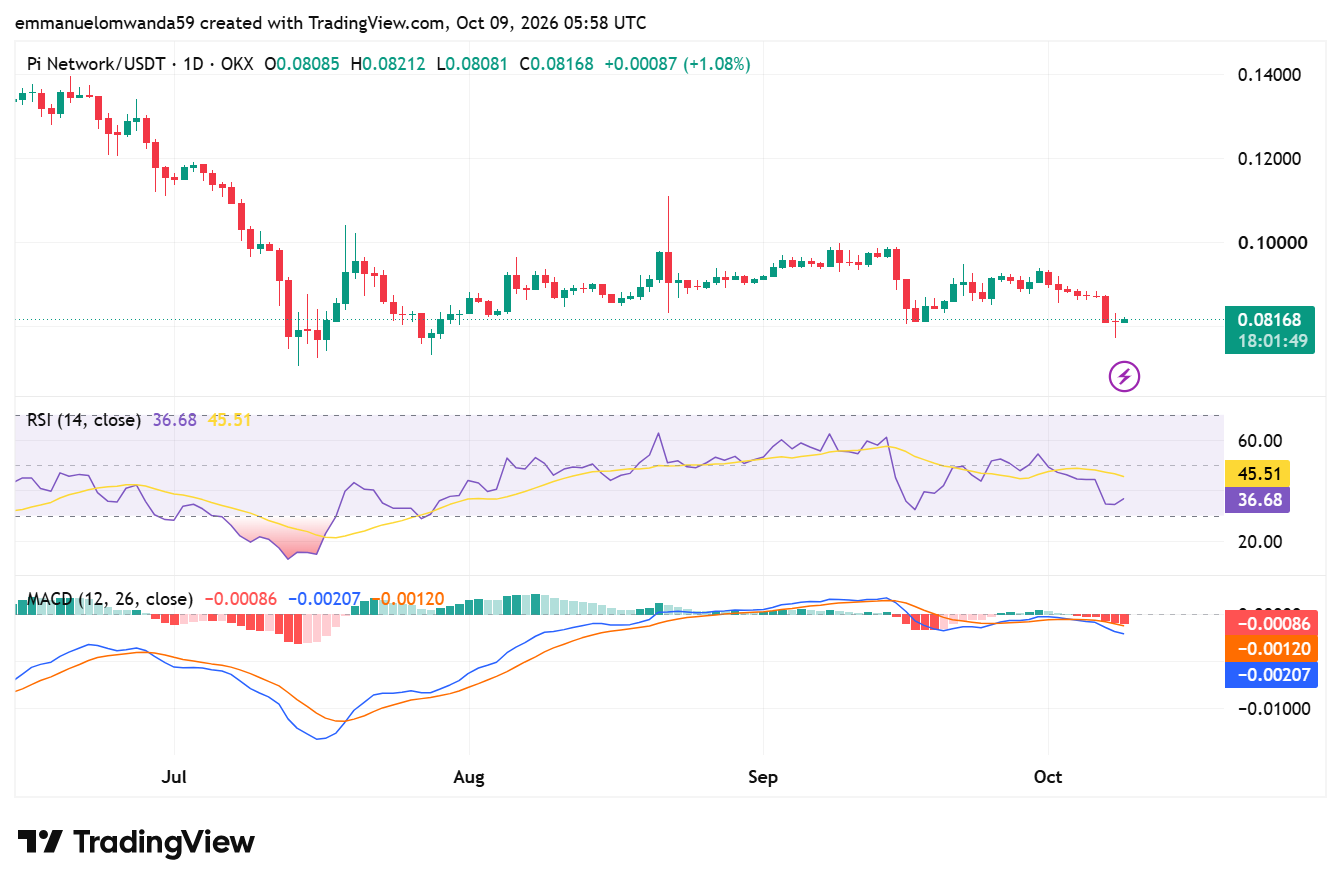
The MACD also points to weak momentum. The MACD line is at -0.00207, and the signal line is at -0.00120. The histogram continues to be negative at -0.00086. PI faces resistance near the $0.0850 and $0.0900 area, where several daily moving averages are positioned.
The $0.0800 area is still a key support level following today’s bounce off $0.07960. PI needs to reclaim the $0.0900 area to improve its short-term structure. A move above the clustered SMA levels could strengthen the recovery. If PI loses the $0.0800 support, selling pressure could increase further. Holding above this level could instead allow the token to attempt another recovery toward $0.0900.
PI price analysis on the 4-hour chart
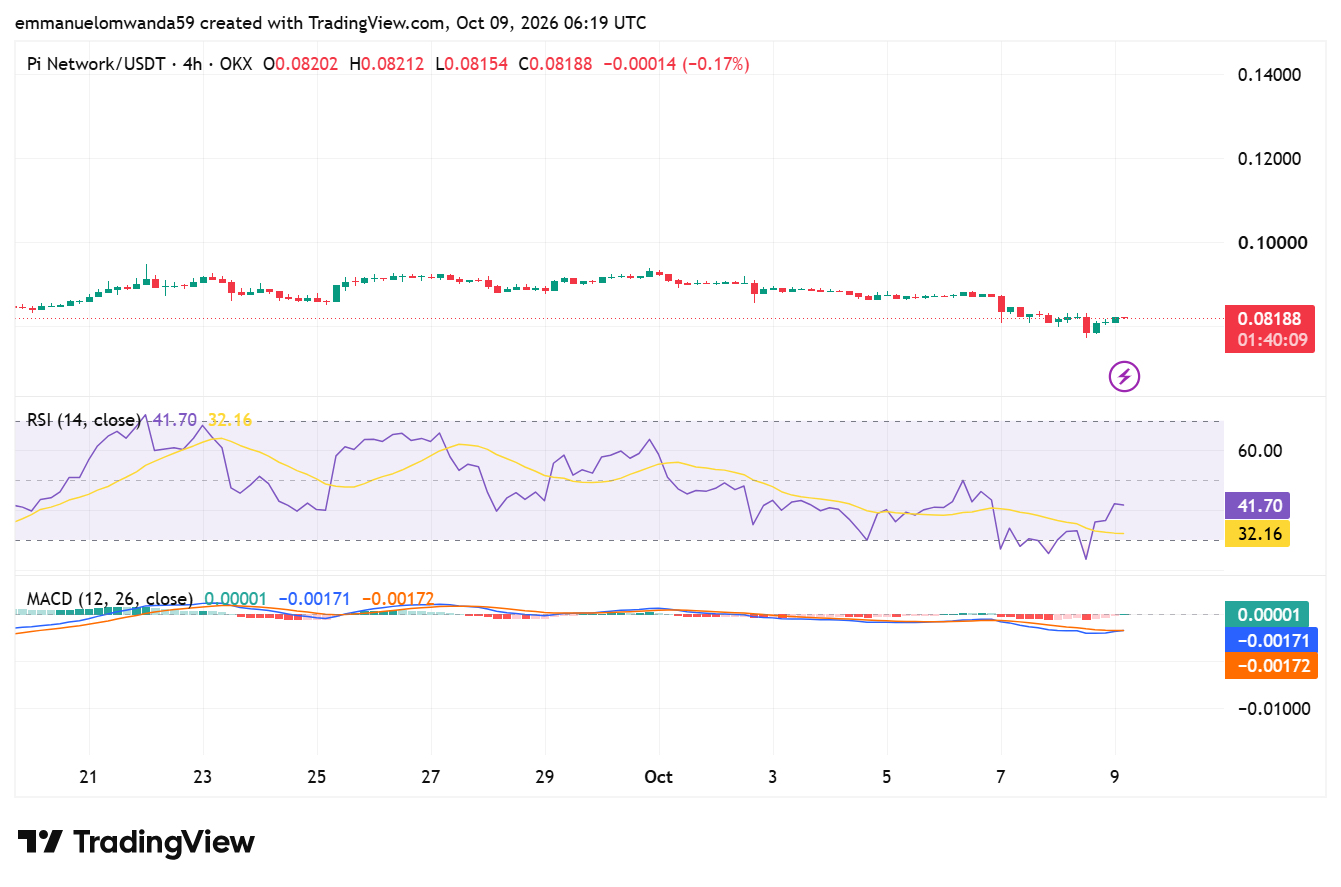
The 4-hour chart indicates that PI is trading at $0.08188 with a recent pullback towards the $0.0800 support zone. The RSI has recovered to 41.70 but remains below the neutral 50 level, showing continued bearish pressure. In the short term, the MACD histogram has moved slightly into positive territory, indicating that selling pressure might be easing. The MACD line remains below the signal line, though, suggesting a bearish trend. PI needs to hold above $0.0800 and break $0.0850 resistance to strengthen its recovery.
Pi Network Price Prediction: Levels and Action
Daily Simple Moving Average (SMA)
| Period | Value | Action |
|---|---|---|
| SMA 3 | $0.09074 | SELL |
| SMA 5 | $0.09095 | SELL |
| SMA 10 | $0.09025 | SELL |
| SMA 21 | $0.09041 | SELL |
| SMA 50 | $0.09102 | SELL |
| SMA 100 | $0.09391 | SELL |
| SMA 200 | $0.1282 | SELL |
Daily Exponential Moving Average (EMA)
| Period | Value | Action |
|---|---|---|
| EMA 3 | $0.09154 | SELL |
| EMA 5 | $0.09099 | SELL |
| EMA 10 | $0.09038 | SELL |
| EMA 21 | $0.09046 | SELL |
| EMA 50 | $0.09187 | SELL |
| EMA 100 | $0.1007 | SELL |
| EMA 200 | $0.1272 | SELL |
Is Pi a Good Investment?
Pi Network’s long-term success will depend on Mainnet adoption, developer activity, ecosystem utility, broader exchange listings that could significantly improve liquidity and accessibility, transaction activity, and the network’s ability to attract and retain active users. Since Pi entered its Open Network period in February 2025, external connectivity has allowed its ecosystem and applications to interact with the broader blockchain environment. Real-world adoption and transaction volume remain critical to PI’s long-term valuation. Greater merchant usage, decentralized applications, and transaction activity across the chain could strengthen demand, while weak liquidity, supply growth, broader market conditions, and regulatory uncertainty are among the factors that could continue to pressure the token and weigh on confidence in its long-term valuation.
Can Pi Network Reach $1?
At the current circulating supply of roughly 11.14 billion PI, a $1 price would correspond to approximately $11.14 billion in circulating market capitalization, assuming the supply remains unchanged.
Will Pi Price Reach $5?
Pi Network’s long-term value will depend on real-world utility, user adoption, and demand for PI as its ecosystem expands. Some analysts suggest Pi Coin’s price has the possibility of reaching $1.50 by 2025 under optimistic conditions. Protocol 26 is complete, while Protocol 27 is moving toward its September 15 mainnet target, alongside new tools such as SoloHost and AI-focused integrations.
However, PI still faces significant supply pressure, with a 100 billion maximum supply and ongoing token unlocks. A $5 target would require sustained adoption, stronger ecosystem activity, and much higher demand than the network currently has.
Will Pi Reach $10?
Analysts suggest that even optimistic forecasts place this milestone more than a decade away, if at all. Investors should treat such projections as forecasts with no guaranteed outcomes and conduct their own research before making investment decisions, as Pi remains a high-risk coin with uncertain long-term value; conversely, if adoption or demand weakens, it could stay far below that speculative target. In bearish scenarios, some analysts estimate a 50% chance Pi Coin could drop to $0 by 2026.
Does Pi Network Have a Good Long-Term Future?
Pi Network’s long-term prospects depend on its ability to convert the millions it has attracted, including its claimed base of over 60 million total users, into active, verified participants, while continuing to attract new members who later become active ecosystem participants, into a KYC-verified community the project puts at 11 million pioneers, though some reports cite 18.1 million KYC-verified users. Pi Network uses the Stellar Consensus Protocol for transactions, a design intended to support faster transactions than Bitcoin. If developer adoption, merchant integration, and real-world use cases continue to expand, the project’s progress could strengthen its position within the cryptocurrency market, but engagement and retention still matter because sentiment can influence long-term adoption.
However, investors should also consider risks related to token supply growth, market competition, regulatory developments, regulatory uncertainty, and overall crypto market conditions. As with any digital asset, future performance will
Recent Pi News/Opinions
The network is preparing for the Protocol 28 Mainnet activation, scheduled for October 16. Node operators must upgrade by October 13, according to the Core Team’s X account. This upgrade follows the completed Protocol 27 and is intended to improve the handling of transaction-data delays and allow safer updates to smart contract data within the network as a technical reference point.
Pi Network’s Core Team announced a partnership with Open Standard, the organization behind the new Open USD (OUSD) stablecoin. The collaboration will explore ways to bring OUSD-based rewards and broader utility to Pi’s Pioneer community, developments that may contribute to wider use if adoption follows. OUSD launched on September 30 with backing from founding partners like Visa, Coinbase, and Stripe, and a network of over 200 companies.
Pi Price Prediction October 2026
As a short-term network Pi price view for next month, in October 2026, Pi’s price may average around $0.0980, based on current market data reflecting recent momentum, as the token attempts to recover from recent weakness. For October, this sets up a short-term price action range in which buyers may try to push PI toward a monthly high of $0.1180, while sellers defend resistance, and renewed selling pressure may drive the price toward a low of $0.08150; any break above the projected range would need volume to confirm the move. Pi Network’s price could increase by 5% in 30 days.
| Pi Price Prediction | Potential Low | Potential Average | Potential High |
|---|---|---|---|
| Pi Price Prediction October 2026 | $0.08150 | $0.0980 | $0.1180 |
Pi Price Prediction 2026
In 2026, Pi Network (PI) is anticipated to trade between $0.0780 and $0.3600, leading to an average annualized price of around $0.2190. Based on Pi Network today, that estimated range from current market conditions implies both downside risk toward the low end and upside potential toward the high end from current levels if market sentiment and ecosystem growth improve during the year. In September 2026, Pi Coin trades around $0.08 to $0.09, while crypto assets remain sensitive to sentiment and liquidity conditions, and these factors shape the direction of the token through the rest of the year.
| Pi Price Prediction | Potential Low ($) | Potential Average ($) | Potential High ($) |
|---|---|---|---|
| Pi Price Prediction 2026 | $0.0780 | $0.2190 | $0.3600 |
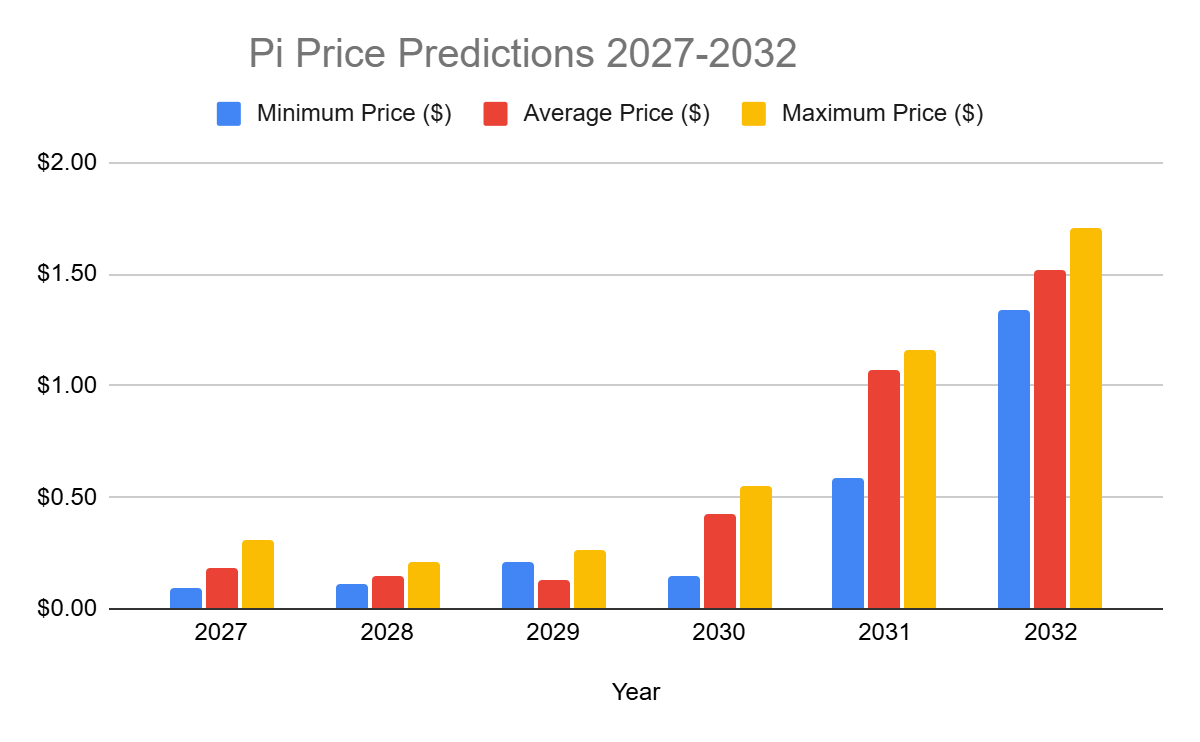
Pi Price Predictions 2027-2032
| Year | Minimum Price ($) | Average Price ($) | Maximum Price ($) |
|---|---|---|---|
| 2027 | $0.08973 | $0.1814 | $0.3127 |
| 2028 | $0.1078 | $0.1462 | $0.2074 |
| 2029 | $0.2124 | $0.1296 | $0.2656 |
| 2030 | $ 0.1490 | $0.4216 | $0.5547 |
| 2031 | $0.5825 | $1.07 | $1.16 |
| 2032 | $1.34 | $1.52 | $1.71 |
Pi Price Prediction 2027
In 2027, the price of Pi is expected to reach a minimum level of $0.0897. The PI price could climb to a maximum of $0.3127, with an average trading price of $0.1814 throughout the year.
Pi Price Prediction 2028
In 2028, Pi is forecast to trade at a minimum value of $0.1078. The PI price may reach a maximum of $0.2074, while the average trading price could settle around $0.1462.
Pi Price Prediction 2029
In 2029, Pi’s price is projected to reach a minimum of $0.1296. The PI price could rise to a maximum of $0.2656, with an average trading price of $0.2124 during the year.
Pi Price Prediction 2030
In 2030, Pi is expected to trade at a minimum price of $0.1490. The PI price may reach a maximum of $0.5547, with an average forecast price of $0.4216.
Pi Price Prediction 2031
In 2031, Pi’s price is forecast to hold a minimum value of $0.5825. The PI price could climb to a maximum of $1.16, with an average trading value of $1.07.
Pi Price Prediction 2032
In 2032, the long-range Pi Network forecast points to a minimum price of $1.34. The PI price could rise to a maximum of $1.71, with an average value of $1.52
Pi Network Price Prediction: Analysts’ Pi Price Forecast
| Firm Name | 2026 | 2027 |
|---|---|---|
| Coincodex | $0.1468 | $0.1468 |
| DigitalCoinPrice | $ 0.2310 | $ 0.2420 |
These figures reflect different assumptions rather than guaranteed outcomes, and how those conditions play out can vary.
Cryptopolitan’s Pi Price Prediction
At Cryptopolitan, we remain cautiously bullish on the long-term outlook for Pi Network despite recent volatility in the cryptocurrency market. Based on our Pi forecast, the current price could gradually recover as ecosystem adoption, trading volume, market capitalization, and utility continue to grow. Earlier pre-launch Pi values reflected derivatives-style trading rather than true price discovery.
Our forecast suggests Pi Network (PI) is anticipated to trade between $0.0780 and $0.3600, leading to an average annualized price of around $0.2190. Based on Pi Network today, that estimated range from current market conditions implies both downside risk toward the low end and upside potential toward the high end from current levels if market sentiment and ecosystem growth improve during the years, and investor confidence may strengthen or weaken at this moment depending on ecosystem progress. However, future price movements will depend on market sentiment, circulating supply growth, technical analysis indicators, and how Pi Network works in live market trading rather than enclosed-network conditions, while broader market trades and liquidity conditions can also influence its behavior in live trading, and user input should not replace independent analysis when interpreting forecast models; security circles support the network’s security model, and rewards are distributed based on participation, while the project also draws added credibility from Stanford University-linked founders, including Chengdiao Fan, whose backgrounds span distributed systems and anthropological sciences, as well as the network’s ability to attract users, developers, and real-world applications. Disclaimer: This forecast is for informational purposes only and should not be treated as financial advice.
Pi Historic Price Sentiment
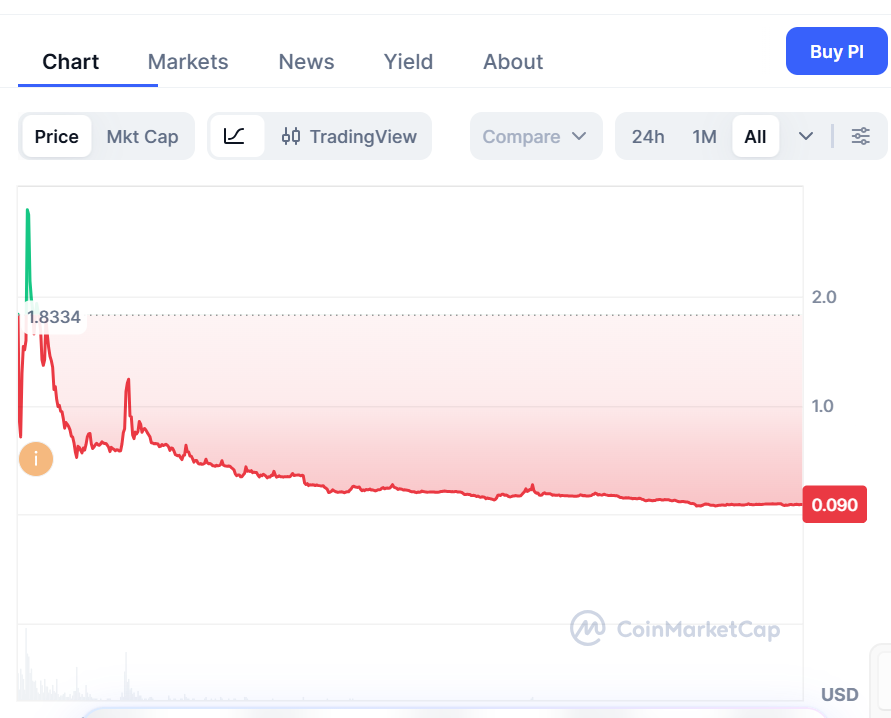
- Pi Network launched in 2019 as a mobile-first social cryptocurrency for everyday people, using mobile mining and operating on its own chain, though it was initially confined to a closed ecosystem with no official market price, as tokens couldn’t be traded externally.
- Its trust model and network life were designed around mobile accessibility rather than energy-intensive mining.
- Between 2023 and 2024, Pi remained unlisted, with speculative prices ranging between $0.60 and $1.00 in unofficial markets.
- In 2025, Pi Network surged to an all-time high of $2.98 in February before entering a prolonged decline, driving the price to $0.1585 by October. The token later stabilized between $0.20 and $0.26 toward the end of the year.
- From January to March 2026, Pi Network fell to a new all-time low of $0.1312 before recovering gradually toward the $0.17–$0.19 range as market stability improved.
- By May 2026, Pi Network declined from the $0.17–$0.18 range to around $0.1439, as weak market momentum and continued selling pressure weighed on the token throughout the month.
- By June 30, 2026, Pi Network hit a new all-time low of $0.1127.
- By July 2026, Pi Network plunged to a fresh all-time low of $0.1025, marking the period’s lowest price during the selloff as persistent selling pressure and weak market sentiment made it lose the key $0.11 support level.
- Pi Network launched in 2019 as a mobile-first social cryptocurrency for everyday people, using mobile mining and operating in a closed ecosystem with no official market price, as tokens couldn’t be traded externally.
- Between 2023 and 2024, Pi remained unlisted, with speculative prices ranging between $0.60 and $1.00 in unofficial markets.
- In 2025, Pi Network surged to an all-time high of $2.98 in February before entering a prolonged decline, pushing the price to $0.1585 by October. The token later stabilized between $0.20 and $0.26 toward the end of the year.
- From January to March 2026, Pi Network fell to a new all-time low of $0.1312 before recovering gradually toward the $0.17–$0.19 range as market stability improved.
- By May 2026, Pi Network declined from the $0.17–$0.18 range to around $0.1439, as weak market momentum and continued selling pressure weighed on the token throughout the month.
- By June 30, 2026, Pi Network hit a new all-time low of $0.1127.
- By July 2026, Pi Network plunged to a fresh all-time low of $0.1025, extending its prolonged downtrend as persistent selling pressure and weak market sentiment pushed the token below the key $0.11 support level.
- By the end of August 2026, Pi Network had recovered from its monthly low near $0.078 to around $0.0915, setting a baseline that traders may watch tomorrow for short-term momentum, though this is only one bit of evidence rather than a full trend reversal.
- By the end September 2026 neared its end, Pi Network traded around $0.0914, recovering from recent lows but remaining below May levels.

The content on CoinReporter.io is for informational purposes only and is not financial or investment advice. Cryptocurrency investments are highly volatile and risky. Always conduct your own research and consult a qualified financial advisor before making any investment decisions. CoinReporter.io and its authors are not liable for any losses resulting from actions based on this website’s content.


The European Securities and Markets Authority on 8 October told national supervisors that MiCA-authorised crypto firms should stop providing services in stablecoins that do not meet the EU rulebook. The opinion, ESMA75-113276571-1742, covers asset-referenced tokens and e-money tokens. It does not name a coin. It sets a clock.
National competent authorities should require firms to clear remaining client exposure as soon as possible, and no later than three months after publication. That outside date is 8 January 2027. Until then, a firm may keep only the services a client needs to get out: liquidation, conversion, withdrawal, transfer, or safekeeping. Those services have to be time-limited, risk-based, and closely supervised. They cannot be used for new purchases or promotion.
The scope is wider than a delisting. ESMA’s press notice lists trading platforms, exchange services, order execution, placement, reception and transmission of orders, investment advice, transfers, custody and administration, and portfolio management. The opinion says the problem does not turn on whether each service is itself a public offer or an admission to trading. An authorised firm that keeps a non-compliant token usable or liquid for EU clients is, in ESMA’s view, facilitating exposure the Titles III and IV safeguards were written to prevent.
That is the change from the earlier guidance. Custody and transfers had been the residual. The 8 October text pulls both inside the supervisory expectation. Firms are expected to put technical, contractual, and organisational controls in place so EU clients cannot acquire or increase exposure. ESMA will monitor how national regulators apply the opinion. It did not publish a common EU list of affected tokens, and it did not prescribe one technical implementation.
The opinion is addressed to supervisors. It is not a new statute, and it is not an EU-wide ban on holding a token in a private wallet. It is a direction to the firms that already hold a MiCA licence: stop offering the non-compliant stablecoin, and wind down what is already on the book by 8 January 2027.
ESMA does not name Tether’s USDT. Secondary tallies of the ESMA e-money token register, checked against the register this week, still do not list Tether as an authorised issuer. Circle’s USDC and EURC are on that register through Circle Internet Financial Europe, a French e-money institution. Paxos’s USDG and Société Générale’s EURCV are also among the notified tokens. The legal test in the opinion is the one that matters for a desk: if the conditions for a lawful EU public offer or admission to trading are not met, including exemptions and transitional arrangements, the token is in scope. USDT is the largest coin that fails that test. It is not the only one.
The same month has a second EU stablecoin file, and it cuts the other way. On 22 September the European System of Central Banks — the ECB and the 27 national central banks — told the Commission that MiCA’s bank-deposit reserve rule should be dropped. Issuers must currently hold 30% of reserves as bank deposits, or 60% if the token is significant. The central banks said that requirement can leave lenders exposed to a stablecoin run. They want a minimum share in assets that mature within one to five working days instead. They also want the ban on paying yield on stablecoins extended to lending, borrowing, and staking, on the argument that e-money is for payments, not savings. And they repeated the European Systemic Risk Board’s line that multi-issuance models — a global firm treating an EU token as interchangeable with a non-EU token — are not allowed under the current rules.
Read together, the two documents are not a single policy. ESMA is closing the service layer around tokens that never got a MiCA authorisation. The central banks are trying to rewrite the reserve and yield rules for the tokens that did. One is an opinion with a January deadline. The other is a consultation response, not a rule change. Neither legalises a non-EU stablecoin, and neither confiscates coins already in self-custody.
For EU clients the practical line is the authorised platform. Buying, trading, and — under this opinion — custody and transfers of a non-compliant stablecoin through a MiCA firm are what supervisors are being told to stop. Selling, converting, and withdrawing during a supervised wind-down are what the three months are for. After 8 January 2027, the residual book is the thing national regulators were told not to leave in place.
Sources:
ESMA press release, 8 October 2026: https://www.esma.europa.eu/press-news/esma-news/esma-sets-out-supervisory-expectations-services-related-unauthorised
ESMA opinion ESMA75-113276571-1742 (PDF): https://www.esma.europa.eu/sites/default/files/2026-10/ESMA75-113276571-1742_Opinion_on_the_provision_of_crypto_asset_services_in_relation_to_non-MiCA-compliant_asset-referenced_tokens_and_e-money_tokens.pdf
Reuters, 22 September 2026, ECB and EU central banks on the deposit rule: https://www.reuters.com/business/finance/ecb-eu-central-banks-oppose-stablecoin-bank-deposit-rule-2026-09-22/


ESMA gives EU crypto firms three months to exit non-MiCA stablecoins
The European Securities and Markets Authority on 8 October told national supervisors that MiCA-authorised crypto firms should stop providing services...


Uptober stalls ahead of the Fed minutes
Seasonality lost to bonds. October has been positive for bitcoin in 10 of the past 13 years, and 21Shares had...


Government-linked wallets move seized coins
Early on-chain reads put about $103 million in motion: 833.6 BTC, roughly $71.6 million, to Coinbase Prime, and 40,285 BNB,...


Winklevoss files a 0.25% Zcash ETF
Winklevoss Asset Services filed for a spot Zcash ETF, proposed Nasdaq ticker WINK, with Gemini as custodian and a 0.25%...


Spot bitcoin ETFs flip to a ~$487 million outflow
Tuesday’s US spot bitcoin ETFs took in about $119 million, the fourth inflow in five sessions. Wednesday reversed that. SoSoValue-linked...


Bitcoin loses $84,000 as Hormuz attacks lift oil and yields
Bitcoin closed at $83,275.93, down 2.67%, after Iran stepped up attacks on tankers in the Strait of Hormuz. Brent rose...


Binance Burns 334.88 Million LUNC in October Fee Batch as Second Transaction Lifts the Day’s Total
Binance removed 334,879,422 Terra Luna Classic (LUNC) from circulation on October 1, the headline transaction in its monthly exchange burn...


TOKEN2049 Opens in Singapore Next Week as the City Leads Regional Crypto Flow
TOKEN2049 runs October 7–8 at Marina Bay Sands. Organisers expect more than 25,000 people, from more than 7,000 companies and...


BTSE Receives a Full Licence to Trade and Custody Crypto in Bhutan
BTSE has a full financial-services licence in Gelephu Mindfulness City. The company said on September 29 that the Gelephu Financial...


South Korea Ranks Second in On-Chain Crypto Holdings as the Tax Date Holds
South Korea is second only to the United States in cryptocurrency that can be measured sitting in wallets and on...
-

 DeFi3 weeks ago
Bitcoin Reclaims $81,000 and Closes Above Key 50-Week Moving Average
-

 DeFi4 weeks ago
Solana Sets Record with Over 263,000 New Tokens Minted in a Single Day
-

 DeFi2 weeks ago
Coinbase Adds Fixed-Rate Bitcoin-Backed Loans via Morpho Midnight
-

 DeFi4 weeks ago
Visa Stablecoin Settlement Volume Hits $20 Billion Annualized Run Rate
-

 DeFi1 week ago
Hong Kong Moves Licensed Stablecoins Onto Exchanges and Into Fund Settlement
-
DeFi1 week ago
TOKEN2049 Opens in Singapore Next Week as the City Leads Regional Crypto Flow
-

 DeFi3 weeks ago
CFTC Submits Crypto Market Rules to White House Amid Congressional Stall
-
 DeFi2 weeks ago
Bitcoin Surges Above $87,000 as Crypto Market Cap Reclaims $3 Trillion
-

 DeFi3 weeks ago
Senate Rejects CLARITY Act Cloture in 49-50 Vote, Dealing Major Blow to U.S. Crypto Market Structure
-

 DeFi3 weeks ago
Bitcoin Surges Above $87,000 on ETF Inflows and Massive Short Squeeze
-

 Bitcoin2 weeks ago
X Partners With Coinbase, Kraken, Gemini and Brokers to Trade From the Timeline
-

 DeFi4 weeks ago
Bitmine Immersion Continues Aggressive ETH Accumulation
-

 Bitcoin4 weeks ago
Block (Jack Dorsey) Applies for U.S. Trust Bank Charter
-

 DeFi4 weeks ago
Senate Republicans Release “Final” CLARITY Act Draft Ahead of September 15 Cloture Vote
-

 DeFi4 weeks ago
First U.S. Staked TRX ETF (Canary TRXS) Debuts
-

 DeFi3 weeks ago
SEC Opens Pathway for Tokenized U.S. Equities After Legislative Setback
-

 Bitcoin2 weeks ago
Record ETF Inflows and a Short Squeeze Drive Bitcoin’s $87,000 Break
-

 DeFi1 month ago
Ethereum Advances Plans for Gas Payments Without Holding ETH
-

 Bitcoin3 weeks ago
Strategy Resumes Bitcoin Buying, Adds 950 BTC
-

 Bitcoin4 weeks ago
Crypto Market Faces Pressure as Bitcoin Tests Support Near $78K Amid Macro Headwinds
-

 DeFi3 weeks ago
Circle Launches Arc Mainnet with Institutional Validators Including BlackRock and Visa
-

 Bitcoin1 month ago
Liquid Network Exploit: 4,000 BTC Drained, 3,400 Returned in White-Hat Negotiation
-

 Bitcoin4 weeks ago
Metaplanet Reverses Course, Erasing ~$220 Million in Warrant Value
-

 DeFi3 weeks ago
Federal Reserve
-

 Bitcoin2 weeks ago
Strategy Adds Another 1,665 BTC, Lifting Holdings to 847,666
-

 DeFi4 weeks ago
Circle to Acquire Tazapay for $400 Million
-

 Bitcoin2 weeks ago
Coinbase Receives CFTC Approval for U.S. Derivatives Clearinghouse
-

 DeFi3 weeks ago
Crypto Markets Slide as Clarity Failure, Rising Yields and Oil Prices Weigh; Bitcoin Briefly Tests Below $75,000
-

 Bitcoin3 weeks ago
Institutional Crypto Infrastructure Advances: Deutsche Bank Custody and Related Moves
-

 DeFi2 weeks ago
Solana Advances Alpenglow Upgrade to Public Testnet
-

 Bitcoin4 weeks ago
Bitcoin Spot ETFs Record $463 Million in Outflows
-

 DeFi3 weeks ago
Crypto Market Suffers Broad Decline; Bitcoin Briefly Drops Below $75,000 Before Stabilizing
-

 DeFi3 weeks ago
Avalanche Gains on NYSE Tokenization Testing Reports
-

 Bitcoin1 month ago
Bitcoin Slips Under $79,000 as Fed Rate-Hike Odds Hold Near 60%
-

 DeFi1 week ago
Robinhood Puts Hedge-Fund Tools in the App as Macro Turns Softer
-

 DeFi1 month ago
Solana Set to Triple Maximum Transaction Size