Crypto
Fairshake backs 32 House races as crypto industry presses for regulation

As it endeavors to push crypto rulemaking forward in Washington, the crypto industry is connecting campaign financing with voter mobilization activities.
Through its political campaign, Fairshake, which is the largest super political action committee (PAC) in the industry, is supporting various House campaigns. Moreover, another group supported by Coinbase called Stand With Crypto, indicates that they have established a network of 3 million advocates for cryptocurrencies.
The two groups are working together to use monetary resources, as well as voter influence pressure, to ensure the passage of crypto regulations after a primary bill submitted by the crypto industry received no progress in Congress.
For investors, the issue goes beyond elections. Regulation remains the biggest concern among fund managers already invested in digital assets, according to an August CoinShares survey.
Six lawmakers, a million dollars each
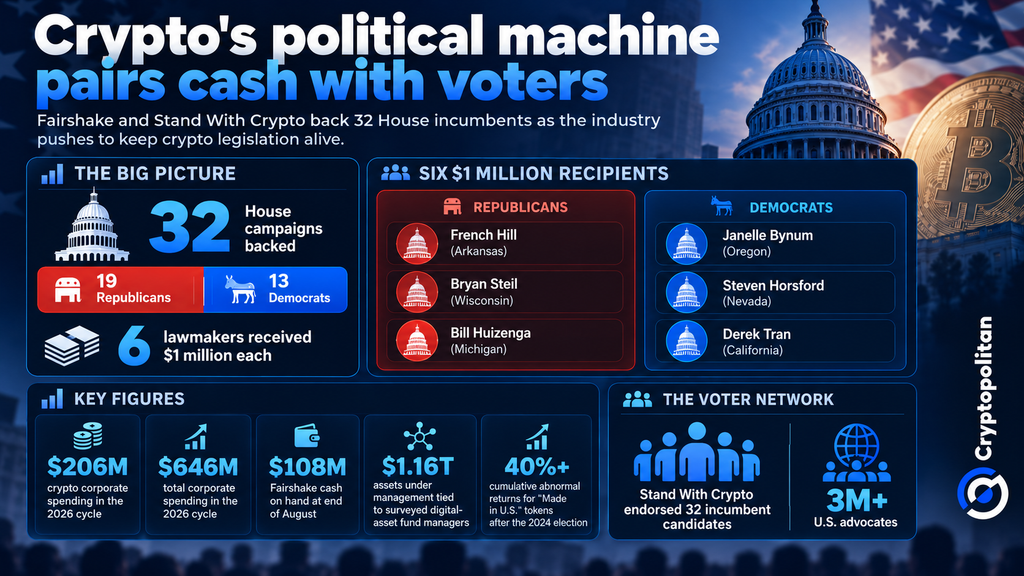
Fairshake will give $1 million each to six House members as part of its wider 32-race effort, according to Roll Call.
The Republicans are Financial Services Committee Chair French Hill of Arkansas, digital-assets subcommittee Chair Bryan Steil of Wisconsin, and committee Vice Chair Bill Huizenga of Michigan.
The Democrats are Janelle Bynum of Oregon, Steven Horsford of Nevada, and Derek Tran of California.
Fairshake’s broader list includes 19 Republicans and 13 Democrats. The PAC had $108 million in cash on hand at the end of August. Spokesperson Geoff Vetter said it had won 53 of the 57 races it entered this cycle.
The spending follows the Clarity Act’s failure in the Senate. The House passed the crypto market-structure bill in July 2025, but lawmakers later failed to resolve issues including ethics safeguards.
Fairshake is also targeting opponents. The group plans to spend $30 million against former Senator Sherrod Brown in Ohio, as Cryptopolitan previously reported.
The voter network behind the money
Stand With Crypto provides the industry with something that donations cannot achieve: a coherent base of voters.
The Coinbase-backed organization supported 32 members of Congress who approved the Clarity Act and claims to have over 3 million registered U.S. advocates. According to the executive director of the organization, Mason Lynaugh, the organization aims to convey that crypto supporters are “a true voting bloc that can move the needle.”
That voter network provides powerful backing for the industry’s money. Cryptocurrency companies are spending lots of money for the 2026 elections, and advocacy groups are looking at turning supporters into voters. According to Public Citizen, companies spent $646 million this election cycle, of which $206 million came from crypto.
Crypto is not acting alone. AI and online-betting companies are also spending heavily, making the three sectors increasingly influential in midterm financing, according to Reuters.
What it means for the market
The political push matters because regulatory uncertainty is still shaping investor sentiment.
CoinShares’ survey covered 30 investors overseeing about $1.16 trillion in assets. Regulation remained their top concern, while the firm linked weaker sentiment toward Ether partly to falling expectations that the Clarity Act would pass this year.
Research also suggests elections can move crypto prices quickly. An Economics Letters study found that “Made in U.S.” crypto assets posted cumulative abnormal returns above 40% after the 2024 election. Fairshake is spending on politics, but the outcome it wants is much broader: clearer rules for the crypto market.
Don’t just read crypto news. Understand it. Subscribe to our newsletter. It’s free.

The content on CoinReporter.io is for informational purposes only and is not financial or investment advice. Cryptocurrency investments are highly volatile and risky. Always conduct your own research and consult a qualified financial advisor before making any investment decisions. CoinReporter.io and its authors are not liable for any losses resulting from actions based on this website’s content.

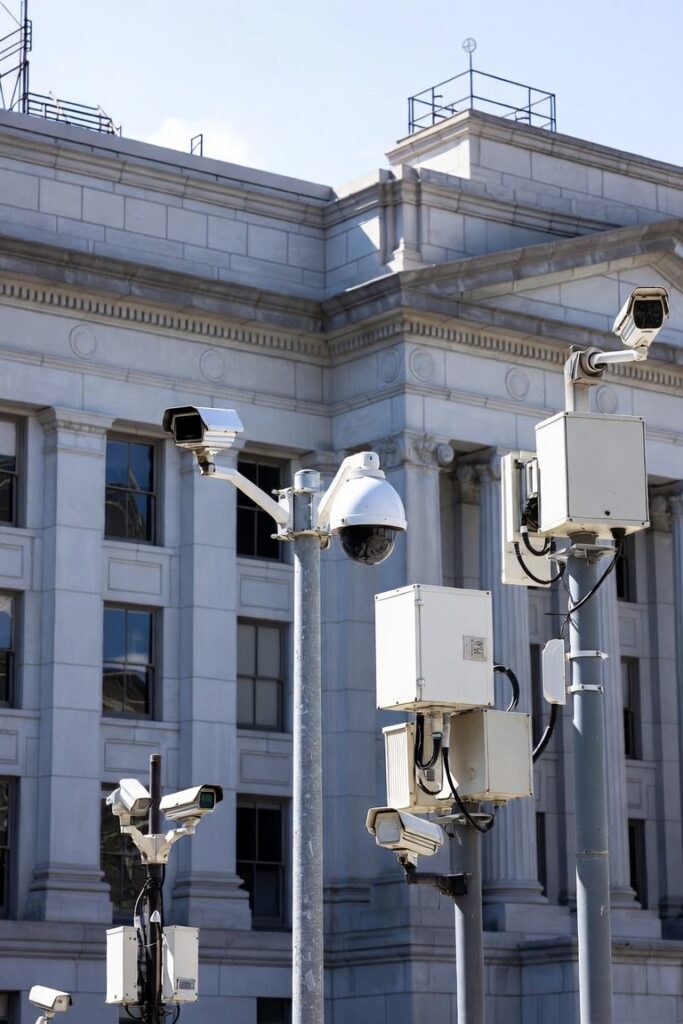
Washington’s other move on 5 October was a retreat. The Treasury and FinCEN withdrew two unfinished proposals: the 2020 rule that would have required identification and reporting on transfers to unhosted wallets, often discussed around a $3,000 threshold, and the 2023 crypto-mixing rule aimed at anonymity-enhancing services.
FinCEN cited the risk of sweeping up legitimate activity. The 2020 text would have treated a transfer from a regulated institution to a wallet the customer controls as a reporting event, not as a withdrawal. The 2023 mixer proposal would have put anonymity-enhancing services in a special surveillance category, on the theory that the tool itself was the risk. Neither rule was ever finalized. Both sat on the books as drafts the industry had to price in anyway.
Privacy advocates and wallet developers treated the withdrawals as the end of a five-year fight. Self-custody was the target of the first proposal: a wallet with no intermediary, no account, and no party FinCEN could already examine. Mixers were the target of the second: software or a service that breaks the link between sender and receiver. Pulling both drafts means the agency is no longer advancing a rule that makes either one a default reporting trigger.
Compliance teams should not read the withdrawals as a free pass. Existing Bank Secrecy Act duties still apply. Sanctions screening still applies. The GENIUS Act stablecoin regime still applies. A bank or a money transmitter that knows a customer is moving funds to evade a blockade, or that ignores a mixer it already flags as high risk, does not get a new defense because a proposed rule was pulled. What changed is the specific plan to treat self-custody transfers and mixers as reporting events in their own right, at a threshold, without a separate suspicion finding.
That distinction is the one that matters for product design. Wallet developers spent five years building around a rule that might have forced a counterparty identity onto every transfer above a few thousand dollars. Exchanges spent the same years deciding whether to block unhosted withdrawals or to collect the data in advance. The draft is gone. The internal controls built to survive it are not required to go with it, and many will stay, because sanctions and fraud filters do not depend on the withdrawn text.
The same week pointed the other way on custody. The SEC’s roughly 682-page crypto custody proposal moved toward the Federal Register, covering adviser self-custody, state trust-company custodians, and tokenized-fund reporting. Advisers who want to hold tokens themselves, or who want to use a state trust company rather than a qualified custodian from the old list, are getting a formal rule. Funds that issue shares as tokens are getting a reporting regime. That is plumbing, not surveillance of the open wallet.
The net picture is mixed. FinCEN stepped back from preemptive reporting on unhosted transfers and mixers. The SEC moved a custody proposal that would formalize how advisers and tokenized funds hold the same assets. Less default surveillance of the wallet. More paperwork once an adviser, a trust company, or a fund is in the chain. For a user who never touches a regulated intermediary, the withdrawn rules were the threat. For an allocator who does, the custody proposal is the one still moving.


Binance Burns 334.88 Million LUNC in October Fee Batch as Second Transaction Lifts the Day’s Total
Binance removed 334,879,422 Terra Luna Classic (LUNC) from circulation on October 1, the headline transaction in its monthly exchange burn...


TOKEN2049 Opens in Singapore Next Week as the City Leads Regional Crypto Flow
TOKEN2049 runs October 7–8 at Marina Bay Sands. Organisers expect more than 25,000 people, from more than 7,000 companies and...


BTSE Receives a Full Licence to Trade and Custody Crypto in Bhutan
BTSE has a full financial-services licence in Gelephu Mindfulness City. The company said on September 29 that the Gelephu Financial...


South Korea Ranks Second in On-Chain Crypto Holdings as the Tax Date Holds
South Korea is second only to the United States in cryptocurrency that can be measured sitting in wallets and on...


HSBC Names Its Hong Kong Stablecoin RedCoin, and Starts With PayMe
HSBC named the stablecoin it has not yet issued. On September 30 the bank said the Hong Kong-dollar token will...


Hong Kong Moves Licensed Stablecoins Onto Exchanges and Into Fund Settlement
Hong Kong’s stablecoin law is already in force. The September policy address is the next step: the tokens those licences...


Japan’s Licensed Yen Stablecoin Traded at Four Times Its Peg on Upbit
JPYC, the first yen stablecoin licensed in Japan, opened on Upbit on September 17 and briefly traded at about four...


South Korea Sets Capital and Ledger Rules for Tokenized Stocks and Bonds
The Financial Services Commission published the subordinate rules that would let tokenized securities start in Korea on February 4, 2027....


Singapore Reclaims the Regional Crypto Lead at $284 Billion as the Rest of CSAO Shrinks
Singapore is again the largest crypto economy in Central and Southeast Asia and Oceania. Chainalysis put activity there at $284...


UK FCA Opens Crypto Licensing Gateway, Giving Firms Until February 2027 to File
The Financial Conduct Authority opened its crypto authorisation gateway on September 30, the first time UK crypto firms can apply...
-

 DeFi2 weeks ago
Bitcoin Reclaims $81,000 and Closes Above Key 50-Week Moving Average
-

 DeFi4 weeks ago
Solana Sets Record with Over 263,000 New Tokens Minted in a Single Day
-

 DeFi2 weeks ago
Coinbase Adds Fixed-Rate Bitcoin-Backed Loans via Morpho Midnight
-

 DeFi4 weeks ago
Visa Stablecoin Settlement Volume Hits $20 Billion Annualized Run Rate
-

 DeFi1 month ago
Chainlink Partners with Bottomline to Enable Cross-Chain Payments for 600+ Banks
-

 DeFi1 month ago
Dash Leads Privacy Coin Rally with Massive Gains
-

 DeFi1 month ago
Zcash Breaks $1,000 for First Time in Nearly a Decade on ETF Momentum
-
 DeFi2 weeks ago
CFTC Submits Crypto Market Rules to White House Amid Congressional Stall
-

 Bitcoin2 weeks ago
X Partners With Coinbase, Kraken, Gemini and Brokers to Trade From the Timeline
-
 DeFi2 weeks ago
Bitcoin Surges Above $87,000 as Crypto Market Cap Reclaims $3 Trillion
-
DeFi4 days ago
Hong Kong Moves Licensed Stablecoins Onto Exchanges and Into Fund Settlement
-

 DeFi2 weeks ago
Bitcoin Surges Above $87,000 on ETF Inflows and Massive Short Squeeze
-

 Bitcoin4 weeks ago
Block (Jack Dorsey) Applies for U.S. Trust Bank Charter
-

 DeFi3 weeks ago
Senate Republicans Release “Final” CLARITY Act Draft Ahead of September 15 Cloture Vote
-

 DeFi4 weeks ago
First U.S. Staked TRX ETF (Canary TRXS) Debuts
-

 DeFi3 weeks ago
Senate Rejects CLARITY Act Cloture in 49-50 Vote, Dealing Major Blow to U.S. Crypto Market Structure
-

 Bitcoin1 month ago
Bitcoin Slips Below $80,000 After Strong U.S. Jobs Report Despite Record ETF Inflows
-

 DeFi4 weeks ago
Ethereum Advances Plans for Gas Payments Without Holding ETH
-

 DeFi3 weeks ago
SEC Opens Pathway for Tokenized U.S. Equities After Legislative Setback
-

 DeFi4 weeks ago
Bitmine Immersion Continues Aggressive ETH Accumulation
-

 Bitcoin4 weeks ago
Liquid Network Exploit: 4,000 BTC Drained, 3,400 Returned in White-Hat Negotiation
-

 Bitcoin2 weeks ago
Strategy Resumes Bitcoin Buying, Adds 950 BTC
-

 Bitcoin4 weeks ago
Crypto Market Faces Pressure as Bitcoin Tests Support Near $78K Amid Macro Headwinds
-

 DeFi3 weeks ago
Circle Launches Arc Mainnet with Institutional Validators Including BlackRock and Visa
-
DeFi4 days ago
TOKEN2049 Opens in Singapore Next Week as the City Leads Regional Crypto Flow
-

 Bitcoin3 weeks ago
Metaplanet Reverses Course, Erasing ~$220 Million in Warrant Value
-

 Bitcoin2 weeks ago
Record ETF Inflows and a Short Squeeze Drive Bitcoin’s $87,000 Break
-

 DeFi4 weeks ago
Circle to Acquire Tazapay for $400 Million
-

 DeFi3 weeks ago
Federal Reserve
-

 DeFi3 weeks ago
Crypto Markets Slide as Clarity Failure, Rising Yields and Oil Prices Weigh; Bitcoin Briefly Tests Below $75,000
-

 Bitcoin4 weeks ago
Bitcoin Slips Under $79,000 as Fed Rate-Hike Odds Hold Near 60%
-

 Bitcoin1 week ago
Strategy Adds Another 1,665 BTC, Lifting Holdings to 847,666
-

 Bitcoin3 weeks ago
Bitcoin Spot ETFs Record $463 Million in Outflows
-

 Bitcoin3 weeks ago
Institutional Crypto Infrastructure Advances: Deutsche Bank Custody and Related Moves
-

 DeFi2 weeks ago
Solana Advances Alpenglow Upgrade to Public Testnet
-

 DeFi2 weeks ago
Avalanche Gains on NYSE Tokenization Testing Reports