Crypto
Accenture puts its $1.5 billion China unit under review after unsolicited approaches

Accenture has reportedly hired JPMorgan to run a strategic review of its Greater China business after it has received unsolicited approaches for the unit over the past year.
According to the Financial Times, people familiar with the matter said the business could be valued at as much as $1.5 billion.
Accenture didn’t reply to a request sent outside of business hours. JPMorgan declined to comment.
Hong Kong and Taiwan sit inside the unit up for review
Accenture’s website lists mainland China, Hong Kong and Taiwan under the Greater China unit. Private equity groups and a few strategic buyers are the expected suitors.
If the deal is done, Accenture may retain a significant minority stake in the business.
The $1.5 billion price tag is for the China unit alone. Accenture has a presence in 120 territories, and in fiscal 2026, its Asia Pacific market generated $10.68 billion in revenue.
For the year ended August 31, revenue in the Asia Pacific region rose 8% in local currency. Group revenues climbed to $74.2 billion.
Accenture has a record of “exiting businesses, offerings, countries, contracts that no longer meet our strategic or return thresholds,” chief financial officer Angie Park said at a recent investor event.
The review lands weeks after a 15.8% one-day share jump
The review comes weeks after a sharp rally in Accenture shares. The stock jumped as much as 24% on October 1 and closed up 15.8%.
Fourth-quarter results had beaten the company’s own revenue targets and allayed fears of an AI-driven slowdown in consulting.
The jump came after a year when billions were wiped off Accenture’s market value amid fears that AI would hollow out consulting.
Quarterly revenue was $18.7 billion, higher than the guided range of $17.75 billion to $18.40 billion. Accenture returned a record $11.5 billion to shareholders in fiscal year 2026.
Accenture guided for 3% to 6% revenue growth for fiscal 2027, above analysts’ expectations. It also expects to return at least $9.5 billion in cash to shareholders.
China’s economy grew 4.5% in the third quarter, up from 4.3% in the second, official data showed on October 19. Growth for the first nine months reached 4.6%, inside Beijing’s annual target of 4.5% to 5%.
Retail sales growth slowed to 0.4% in August, below a consensus forecast of 0.8%, Cryptopolitan reported. Investment in property and infrastructure fell 7.2% through August.
Real estate has been in a slump for five years and consumer spending is sluggish, crimping growth.
Cryptopolitan reports that the US and China agreed in late September to cut tariffs on $30 billion of each other’s goods after Xi Jinping’s three-day visit to Washington.
The two governments also agreed to extend a trade truce by two months and set up a trade council to implement commitments from previous talks in Kuala Lumpur.
There is another round of talks on artificial intelligence scheduled for November.
Don’t just read crypto news. Understand it. Subscribe to our newsletter. It’s free.

The content on CoinReporter.io is for informational purposes only and is not financial or investment advice. Cryptocurrency investments are highly volatile and risky. Always conduct your own research and consult a qualified financial advisor before making any investment decisions. CoinReporter.io and its authors are not liable for any losses resulting from actions based on this website’s content.
On October 17, a forged mint message forced 10 million unauthorized CYS tokens out of Cysic’s cross-chain bridge.
The attacker’s wallet dumped 7.2 million of them and moved about $727,000 into Ethereum before the project locked it up.
Two selling rounds fetched 588,315 USDT and 220 BNB
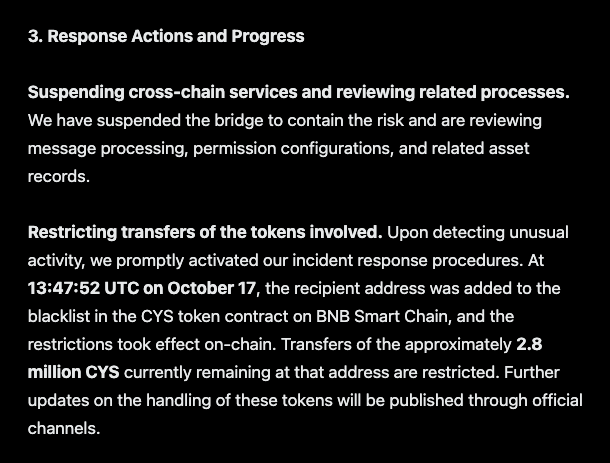
On-chain data reveals a fraudulent mint hit BNB Smart Chain at 12:31 UTC on October 17. But the foundation’s incident report says that Cysic did not blacklist the receiving wallet in the CYS contract until 13:47 UTC.
The gap was 76 minutes long. The address had stopped sending tokens 48 minutes before the freeze and had moved its proceeds from BNB Chain by the time the freeze struck.
Blacklist took the remains: ~2.8 million CYS that can no longer be transferred. About 160.8 million CYS circulate.
As per BscScan records, the dumping was in two rounds. The first 5.65 million CYS sold for 588,315 USDT in five minutes from 12:36 UTC, at about 10 cents each.
A second, smaller round ran from 12:57 to 12:59 UTC. It garnered about 220 BNB for the last 1.55 million tokens.
Twelve of the 15 sales were completed using OKX’s DEX aggregator. The orders were divided between several venues, including PancakeSwap.
Mayan, deBridge and SWFT carried 306.6 ETH to Ethereum
SWFT’s Bridgers service took the first 100,000 USDT at 12:44 UTC. About a minute later, 40.88 ETH landed on Ethereum.
Another 488,315 USDT was moved to the cross-chain protocol Mayan in six transfers by 12:53 UTC.
After the second sell-off, BNB followed. Mayan carried 80 of those BNB at 13:05 UTC, and deBridge handled 139 more at 13:06.
According to Etherscan data, Mayan paid out around 224.66 ETH and deBridge 41.05 ETH, with the last arriving at 13:06 UTC. The total was ~306.6 ETH or ~$727,000 at the price of ETH on October 18 of ~$2,372.
By 13:11 UTC, a second wallet had received 306.52 ETH through five transfers. Its first deposit was made about two hours before the mint.
The CYS contract’s blacklist does not reach ETH.
The attacker “gained unauthorized access to a database used by services supporting the bridge and exploited a vulnerability in the relevant processing logic to submit a fraudulent mint message,” the Cysic Foundation said in an X incident report on October 18.
The foundation said the incident was isolated to bridge message handling and minting and did not affect consensus, block production and EVM execution on the Cysic mainnet. “Existing user assets were not stolen,” it said.
Cysic dates to 2022 and generates zero-knowledge proofs on dedicated hardware and its own Layer 1 chain. Polychain Capital led its $6 million seed round in 2023.
The foundation said that the final dollar figure is not determined by the 10 million minted tokens alone.
Cross-chain transfers through the bridge stay offline until Cysic finishes a security review. A second report is due on verified losses and fund tracing.
Cryptopolitan reported that Symbiosis suspended its Bitcoin bridge in September when an attacker minted an immense synthetic balance, but walked away with about $336,000.
In June, a validation flaw permitted an attacker to mint around 5 billion unauthorized SYS. Syscoin froze its bridge.
The smartest crypto minds already read our newsletter. Want in? Join them.

Bitcoin and Ethereum Spot ETFs Record Substantial Weekly Outflows
U.S. spot Bitcoin ETFs recorded roughly $228.4 million in net outflows over the five sessions ending October 16, 2026, while...


Stablecoin Remittances Shown 84% Cheaper Than Traditional Bank Transfers
Analysis published around October 17, 2026, indicated that stablecoin-based remittances can be approximately 84% cheaper than traditional bank transfers in...


Circle Targets 40 Emerging Markets
Circle Targets 40 Emerging Markets for USDC as Visa Direct Moves Stablecoin Prefunding into Production Circle is preparing a significant...


Nine Crypto Firms Launch Quantum Alliance to Set Post-Quantum Standards
Nine blockchain organizations—including Hacken, Midnight Foundation, Quantus, Postquant Labs, Keystone, American Fortress, Intmax, Abelian, and The Vault—formed the Quantum Alliance...


Inflation Shock Triggers Nearly $1 Billion in Liquidations as Bitcoin Tests $80,000
Hotter-than-expected U.S. inflation data rattled risk assets on October 15, 2026. September CPI rose 3.7% year-over-year, above the 3.6% forecast...


Bitcoin Drops Below $81,000 as Hotter U.S. CPI Revives Rate-Hike Fears and Asian Equities Tumble
Bitcoin fell sharply below $81,000 in early Asian trading on October 15, 2026, extending losses after a hotter-than-expected U.S. September...


U.S. Spot Bitcoin and Ethereum ETFs See Significant Weekly Outflows
U.S.-listed spot Bitcoin ETFs recorded roughly $681 million in net outflows over the trading week of October 5–9, 2026—the largest...


Binance Rolls Out AI Trading Interface Globally After 150,000-User Beta
Binance launched its free Binance AI personalized trading interface to all English-language users on October 12, 2026, following a beta...


Ethereum Foundation-Linked Wallets Transfer 4,393 ETH (~$11 Million) to Kraken
On October 12, 2026, two wallets historically linked to the Ethereum Foundation transferred a combined 4,393 ETH—valued at approximately $11.13...

TRON Q3 2026 Report: $2.21 Trillion in Stablecoin Settlement Volume
TRON’s State of TRON Q3 2026 report, released in mid-October, highlighted $2.21 trillion (precisely $2.2126 trillion) in stablecoin settlement volume...
-

 DeFi4 weeks ago
Bitcoin Reclaims $81,000 and Closes Above Key 50-Week Moving Average
-

 DeFi2 weeks ago
Hong Kong Moves Licensed Stablecoins Onto Exchanges and Into Fund Settlement
-

 Crypto1 week ago
ESMA gives EU crypto firms three months to exit non-MiCA stablecoins
-

 Crypto2 weeks ago
Binance Burns 334.88 Million LUNC in October Fee Batch as Second Transaction Lifts the Day’s Total
-

 DeFi4 weeks ago
Coinbase Adds Fixed-Rate Bitcoin-Backed Loans via Morpho Midnight
-

 Bitcoin2 weeks ago
SEC clears listing path for first U.S. 3x Bitcoin and Ether ETFs
-

 DeFi2 weeks ago
TOKEN2049 Opens in Singapore Next Week as the City Leads Regional Crypto Flow
-

 DeFi3 weeks ago
Robinhood Puts Hedge-Fund Tools in the App as Macro Turns Softer
-

 DeFi2 weeks ago
HSBC Names Its Hong Kong Stablecoin RedCoin, and Starts With PayMe
-

 DeFi3 weeks ago
Solana Advances Alpenglow Upgrade to Public Testnet
-

 Bitcoin3 weeks ago
Strategy Adds Another 1,665 BTC, Lifting Holdings to 847,666
-

 Bitcoin2 weeks ago
Bitcoin breaks under $84,000 as oil spikes on Hormuz tanker attacks
-

 DeFi2 weeks ago
South Korea Ranks Second in On-Chain Crypto Holdings as the Tax Date Holds
-

 DeFi7 days ago
Bitcoin Drops Below $82,000 Amid $770M+ in Liquidations as Volatility Spikes
-

 DeFi4 weeks ago
CFTC Submits Crypto Market Rules to White House Amid Congressional Stall
-

 DeFi4 weeks ago
Bitcoin Surges Above $87,000 as Crypto Market Cap Reclaims $3 Trillion
-

 Bitcoin4 weeks ago
Record ETF Inflows and a Short Squeeze Drive Bitcoin’s $87,000 Break
-

 DeFi4 weeks ago
Bitcoin Surges Above $87,000 on ETF Inflows and Massive Short Squeeze
-

 Bitcoin3 weeks ago
Coinbase Receives CFTC Approval for U.S. Derivatives Clearinghouse
-

 Bitcoin4 weeks ago
X Partners With Coinbase, Kraken, Gemini and Brokers to Trade From the Timeline
-
Bitcoin7 days ago
Strategy (MicroStrategy) Adds 250 Bitcoin, Holdings Reach 848,250 BTC
-

 Crypto2 weeks ago
Treasury and FinCEN drop unhosted-wallet and mixer surveillance proposals
-

 DeFi2 weeks ago
BTSE Receives a Full Licence to Trade and Custody Crypto in Bhutan
-

 DeFi1 month ago
SEC Opens Pathway for Tokenized U.S. Equities After Legislative Setback
-

 Bitcoin4 weeks ago
Strategy Resumes Bitcoin Buying, Adds 950 BTC
-

 DeFi1 month ago
Circle Launches Arc Mainnet with Institutional Validators Including BlackRock and Visa
-

 DeFi2 weeks ago
Government-linked wallets move seized coins
-

 DeFi1 week ago
Bitcoin Holds Above $84,000, Shrugging Off Heavy ETF Outflows as Oil Declines
-

 DeFi1 month ago
Crypto Market Suffers Broad Decline; Bitcoin Briefly Drops Below $75,000 Before Stabilizing
-

 Crypto2 weeks ago
Singapore Reclaims the Regional Crypto Lead at $284 Billion as the Rest of CSAO Shrinks
-

 Crypto2 weeks ago
CFTC opens Regulation CTX and CAM after Clarity Act stalls
-

 DeFi4 weeks ago
Avalanche Gains on NYSE Tokenization Testing Reports
-

 DeFi1 month ago
Federal Reserve
-

 Bitcoin1 month ago
Institutional Crypto Infrastructure Advances: Deutsche Bank Custody and Related Moves
-

 DeFi2 weeks ago
Winklevoss files a 0.25% Zcash ETF
-

 Bitcoin2 weeks ago
Spot bitcoin ETFs flip to a ~$487 million outflow