DeFi
U.S. House Passes Stablecoin Regulatory Bill with Bipartisan Support


In a landmark development for the cryptocurrency industry, the U.S. House of Representatives has approved a comprehensive stablecoin regulatory framework with strong bipartisan backing. The bill establishes clear federal standards for licensing, reserve requirements, redemption rights, and oversight of dollar-pegged stablecoins, addressing long-standing calls for regulatory clarity in the rapidly growing sector.
The legislation—building on prior efforts like the Guiding and Establishing National Innovation for U.S. Stablecoins (GENIUS) Act and related discussions—requires issuers to maintain 1:1 reserves in high-quality liquid assets such as U.S. dollars, short-term Treasuries, or equivalent instruments. It mandates monthly public disclosures of reserve composition, strict anti-money laundering (AML) and counter-terrorism financing (CFT) compliance, and prompt redemption at par value for holders. Nonbank issuers must obtain federal or state-level approvals, while banks can issue through subsidiaries under existing prudential rules.
The House vote passed with significant cross-aisle support, reflecting growing consensus on the need to balance innovation with consumer protection and financial stability. Lawmakers from both parties highlighted the bill’s potential to foster a safe, competitive environment for stablecoins, which now exceed $200 billion in market capitalization and serve as critical infrastructure for trading, remittances, and payments.
Major stablecoin issuers, including Circle (USDC) and Tether (USDT), welcomed the clarity, stating it would reduce uncertainty and encourage responsible growth. “This framework provides the guardrails needed for mainstream adoption while preserving the benefits of dollar-pegged digital assets,” a Circle spokesperson noted. The bill’s redemption and reserve standards align closely with industry best practices already implemented by leading issuers.
Market participants anticipate accelerated institutional inflows into regulated stablecoins as the legislation moves forward. With clearer rules, banks, asset managers, and corporates may increase allocations to compliant tokens for treasury management, settlements, and yield-generating products. Analysts suggest this could boost overall stablecoin supply and liquidity, particularly in cross-border corridors where speed and cost advantages over traditional rails are pronounced.
The bill now heads to the Senate, where negotiations on broader crypto market structure legislation (including digital asset classifications and DeFi provisions) continue. Bipartisan momentum from the House vote positions stablecoin regulation as a likely near-term priority, potentially paving the way for final passage and enactment later in 2026.
This milestone marks a shift from “regulation by enforcement” toward proactive, tailored rules—potentially positioning the U.S. as a leader in responsible digital asset innovation while mitigating risks like illicit finance and systemic instability.
Cryptocurrency markets remain sensitive to regulatory developments—stablecoin volumes, prices, and adoption can shift rapidly. Always verify the latest bill status from official sources like Congress.gov, committee announcements, or major news outlets before acting on investment decisions.

The content on CoinReporter.io is for informational purposes only and is not financial or investment advice. Cryptocurrency investments are highly volatile and risky. Always conduct your own research and consult a qualified financial advisor before making any investment decisions. CoinReporter.io and its authors are not liable for any losses resulting from actions based on this website’s content.


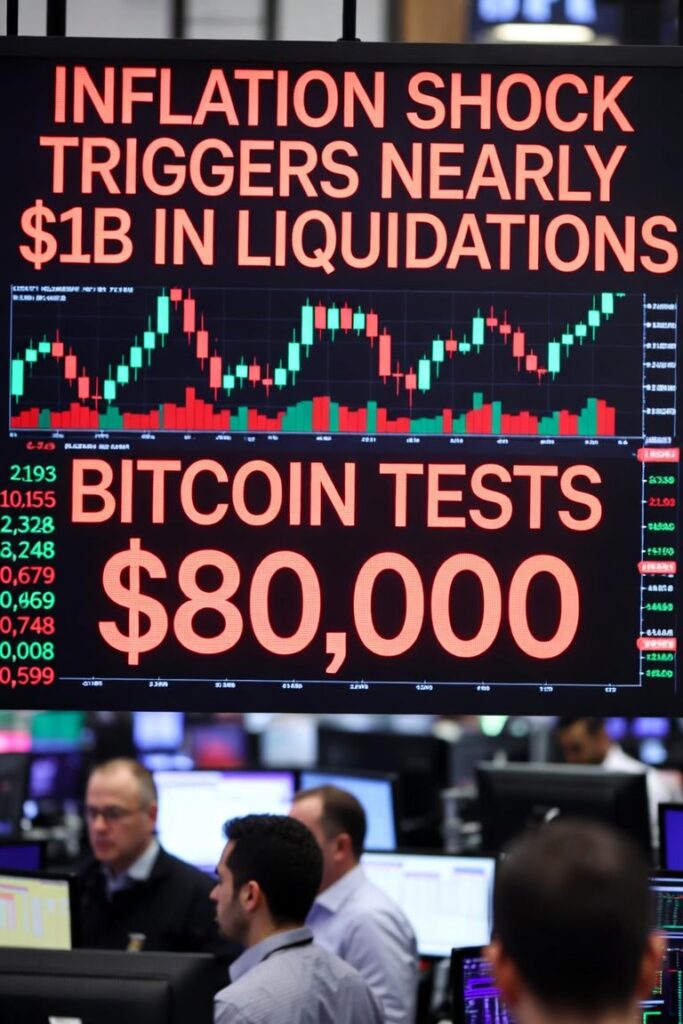
Hotter-than-expected U.S. inflation data rattled risk assets on October 15, 2026. September CPI rose 3.7% year-over-year, above the 3.6% forecast and up from 3.4% in August, while core CPI firmed to 2.6%. The following day’s Producer Price Index for final demand jumped 1.3% month-over-month—the largest monthly advance since March 2022—and 6.3% annually, well above expectations near 0.5% monthly and roughly 5.4% yearly. Energy costs drove much of the PPI spike.
Bitcoin briefly fell near or below $80,000 during Asian trading hours, with lows reported around $80,210–$80,500 in various snapshots, before buyers stepped in. It recovered to trade near $82,000–$82,400 later in the session. On the CoinMarketCap October 15 snapshot, BTC printed around $82,141 with a modest daily gain after the dip, and a market capitalization near $1.65 trillion. Ethereum underperformed, dipping below $2,400 before recovering toward $2,440. Broader altcoins and indices such as the CoinDesk 80 fell harder amid the risk-off move.
Nearly $1 billion in leveraged crypto positions were liquidated over 24 hours, with figures ranging from roughly $937 million to $977 million across reports. Long positions accounted for the vast majority (around 85–91%), and Ethereum led the wipeout with roughly $280–$290 million in liquidations, followed by Bitcoin near $200 million. More than 170,000 traders were affected. The cascade reflected crowded long positioning into the data releases and correlated selling in equities, including declines in the Nasdaq and S&P 500, while Asian markets such as South Korea’s Kospi saw sharp drops.
Analysts noted that the inflation prints revived “higher-for-longer” rate concerns and increased odds of a Federal Reserve hike at the late-October meeting. Bitcoin’s correlation with risk assets remained elevated, and the move pushed the cryptocurrency briefly below the approximate average cost basis of U.S. spot ETF holders near $81,500–$82,300. By the evening of October 15 and into October 16, majors stabilized or edged higher as yields eased and dip-buying emerged, with trading volume rising significantly.
The episode underscores crypto’s ongoing sensitivity to macro data even as institutional adoption advances. Support near the early-October lows held for Bitcoin, but further inflation or labor-market surprises remain key risks ahead of the Fed’s October 27–28 decision window.


Inflation Shock Triggers Nearly $1 Billion in Liquidations as Bitcoin Tests $80,000
Hotter-than-expected U.S. inflation data rattled risk assets on October 15, 2026. September CPI rose 3.7% year-over-year, above the 3.6% forecast...


Bitcoin Drops Below $81,000 as Hotter U.S. CPI Revives Rate-Hike Fears and Asian Equities Tumble
Bitcoin fell sharply below $81,000 in early Asian trading on October 15, 2026, extending losses after a hotter-than-expected U.S. September...


U.S. Spot Bitcoin and Ethereum ETFs See Significant Weekly Outflows
U.S.-listed spot Bitcoin ETFs recorded roughly $681 million in net outflows over the trading week of October 5–9, 2026—the largest...


Binance Rolls Out AI Trading Interface Globally After 150,000-User Beta
Binance launched its free Binance AI personalized trading interface to all English-language users on October 12, 2026, following a beta...


Ethereum Foundation-Linked Wallets Transfer 4,393 ETH (~$11 Million) to Kraken
On October 12, 2026, two wallets historically linked to the Ethereum Foundation transferred a combined 4,393 ETH—valued at approximately $11.13...

TRON Q3 2026 Report: $2.21 Trillion in Stablecoin Settlement Volume
TRON’s State of TRON Q3 2026 report, released in mid-October, highlighted $2.21 trillion (precisely $2.2126 trillion) in stablecoin settlement volume...


South Korea Blocks Domestic Access to 27 Unregistered Crypto Exchange Websites, Including KuCoin and MEXC
South Korea’s Financial Intelligence Unit (FIU), under the Financial Services Commission, announced on October 13, 2026, that domestic access would...


Bitcoin Drops Below $82,000 Amid $770M+ in Liquidations as Volatility Spikes
Bitcoin fell sharply on October 12, 2026, sliding below $82,000 and triggering more than $770 million in cryptocurrency liquidations, the...


Bitcoin Holds Above $84,000, Shrugging Off Heavy ETF Outflows as Oil Declines
Bitcoin rebounded to trade near or above $84,000 on Monday, October 12, 2026, recovering from earlier dips toward the low...


ESMA gives EU crypto firms three months to exit non-MiCA stablecoins
The European Securities and Markets Authority on 8 October told national supervisors that MiCA-authorised crypto firms should stop providing services...
-

 DeFi4 weeks ago
Bitcoin Reclaims $81,000 and Closes Above Key 50-Week Moving Average
-

 DeFi2 weeks ago
Hong Kong Moves Licensed Stablecoins Onto Exchanges and Into Fund Settlement
-
Crypto1 week ago
ESMA gives EU crypto firms three months to exit non-MiCA stablecoins
-

 Crypto2 weeks ago
Binance Burns 334.88 Million LUNC in October Fee Batch as Second Transaction Lifts the Day’s Total
-

 DeFi4 weeks ago
Coinbase Adds Fixed-Rate Bitcoin-Backed Loans via Morpho Midnight
-

 Bitcoin2 weeks ago
SEC clears listing path for first U.S. 3x Bitcoin and Ether ETFs
-

 DeFi2 weeks ago
Robinhood Puts Hedge-Fund Tools in the App as Macro Turns Softer
-

 DeFi2 weeks ago
TOKEN2049 Opens in Singapore Next Week as the City Leads Regional Crypto Flow
-

 DeFi1 month ago
Senate Rejects CLARITY Act Cloture in 49-50 Vote, Dealing Major Blow to U.S. Crypto Market Structure
-

 DeFi2 weeks ago
HSBC Names Its Hong Kong Stablecoin RedCoin, and Starts With PayMe
-

 DeFi3 weeks ago
Solana Advances Alpenglow Upgrade to Public Testnet
-

 Bitcoin3 weeks ago
Strategy Adds Another 1,665 BTC, Lifting Holdings to 847,666
-

 DeFi4 weeks ago
CFTC Submits Crypto Market Rules to White House Amid Congressional Stall
-

 DeFi2 weeks ago
South Korea Ranks Second in On-Chain Crypto Holdings as the Tax Date Holds
-
 DeFi4 weeks ago
Bitcoin Surges Above $87,000 as Crypto Market Cap Reclaims $3 Trillion
-

 Bitcoin2 weeks ago
Bitcoin breaks under $84,000 as oil spikes on Hormuz tanker attacks
-

 Bitcoin4 weeks ago
Record ETF Inflows and a Short Squeeze Drive Bitcoin’s $87,000 Break
-

 DeFi4 weeks ago
Bitcoin Surges Above $87,000 on ETF Inflows and Massive Short Squeeze
-

 Bitcoin3 weeks ago
Coinbase Receives CFTC Approval for U.S. Derivatives Clearinghouse
-

 Bitcoin4 weeks ago
X Partners With Coinbase, Kraken, Gemini and Brokers to Trade From the Timeline
-

 Crypto2 weeks ago
Treasury and FinCEN drop unhosted-wallet and mixer surveillance proposals
-
DeFi5 days ago
Bitcoin Drops Below $82,000 Amid $770M+ in Liquidations as Volatility Spikes
-

 DeFi2 weeks ago
BTSE Receives a Full Licence to Trade and Custody Crypto in Bhutan
-

 DeFi4 weeks ago
SEC Opens Pathway for Tokenized U.S. Equities After Legislative Setback
-

 Bitcoin4 weeks ago
Strategy Resumes Bitcoin Buying, Adds 950 BTC
-

 DeFi4 weeks ago
Circle Launches Arc Mainnet with Institutional Validators Including BlackRock and Visa
-

 DeFi1 week ago
Government-linked wallets move seized coins
-

 DeFi1 month ago
Crypto Market Suffers Broad Decline; Bitcoin Briefly Drops Below $75,000 Before Stabilizing
-
DeFi6 days ago
Bitcoin Holds Above $84,000, Shrugging Off Heavy ETF Outflows as Oil Declines
-

 DeFi4 weeks ago
Avalanche Gains on NYSE Tokenization Testing Reports
-

 Crypto2 weeks ago
Singapore Reclaims the Regional Crypto Lead at $284 Billion as the Rest of CSAO Shrinks
-

 Crypto2 weeks ago
CFTC opens Regulation CTX and CAM after Clarity Act stalls
-

 DeFi1 month ago
Federal Reserve
-

 Bitcoin4 weeks ago
Institutional Crypto Infrastructure Advances: Deutsche Bank Custody and Related Moves
-

 Bitcoin1 month ago
Bitcoin Spot ETFs Record $463 Million in Outflows
-

 DeFi1 month ago
Crypto Markets Slide as Clarity Failure, Rising Yields and Oil Prices Weigh; Bitcoin Briefly Tests Below $75,000