Bitcoin
Panama City Council Pioneers Crypto Payments for Public Services in Historic Vote

On April 15, 2025, Panama City made history as its city council voted to become the first government institution in the country to accept payments in Bitcoin (BTC) and other cryptocurrencies for public services. The decision, announced by Mayor Mayer Mizrachi, allows residents to pay taxes, fees, permits, and fines using Bitcoin, Ethereum (ETH), USD Coin (USDC), and Tether (USDT), marking a significant step toward integrating digital currencies into municipal governance. This move positions Panama City as a regional leader in crypto adoption, reflecting a growing global trend of municipalities embracing blockchain technology.
The initiative bypasses previous legislative hurdles by partnering with a local bank to convert cryptocurrency payments into U.S. dollars on the spot, ensuring compliance with Panama’s legal requirement for public institutions to receive funds in USD. “Legally public institutions must receive funds in $, so we partner with a bank who will take care of the transaction receiving in crypto and convert on spot to $,” Mizrachi stated on X. He added that this model “allows for the free flow of crypto in the entire economy and entire government,” offering a practical solution without the need for new legislation—a challenge that had stalled prior efforts under previous administrations.
Panama City’s approach contrasts with El Salvador’s 2021 decision to make Bitcoin legal tender, which mandated its use and faced challenges due to price volatility. Instead, Panama’s model is optional, focusing on compatibility with existing financial systems while encouraging crypto adoption. The city joins a growing list of jurisdictions exploring crypto payments, such as Colorado in the U.S., which began accepting crypto for taxes in 2022, and Lugano, Switzerland, where Bitcoin payments for public services were approved in 2023. However, Panama’s national stance on crypto remains cautious—President Laurentino Cortizo vetoed a 2022 bill to regulate Bitcoin, citing financial regulation concerns, indicating that broader adoption may face challenges.
The decision comes amid a global surge in corporate and institutional interest in Bitcoin, with companies purchasing a record 95,431 BTC in Q1 2025, as reported by Bitwise. Panama’s move could further stimulate its local crypto economy, allowing residents to use digital assets for everyday transactions with the government without requiring institutions to directly manage them. The city has not yet disclosed which payment providers or wallets will be supported, but local authorities promised further guidance before the program’s full rollout later this year.
While this step is a milestone for crypto adoption in Latin America, its impact may be limited by the immediate conversion to USD, which some argue restricts true integration of digital currencies into the economy. For Panama to fully embrace crypto, structural changes might be needed to allow digital assets to circulate more freely without constant liquidation. Nonetheless, Panama City’s initiative could serve as a model for other municipalities, potentially pressuring national policymakers to revisit crypto legislation. As the world watches, this pioneering vote may inspire a broader shift in how governments interact with digital finance.

The content on CoinReporter.io is for informational purposes only and is not financial or investment advice. Cryptocurrency investments are highly volatile and risky. Always conduct your own research and consult a qualified financial advisor before making any investment decisions. CoinReporter.io and its authors are not liable for any losses resulting from actions based on this website’s content.




Strategy, Inc. (Nasdaq: MSTR), the company led by Executive Chairman Michael Saylor, acquired an additional 250 bitcoin for approximately $21.5 million between October 5 and October 11, 2026, at an average price of $86,194 per coin (including fees and expenses). The purchase brings the firm’s total holdings to 848,250 BTC.
The company funded the acquisition primarily through net proceeds of about $21 million from at-the-market sales of 125,183 shares of its Class A common stock (MSTR), with the remaining roughly $0.5 million drawn from its USD cash balance. No preferred stock was sold during the period. Strategy’s cumulative bitcoin investment now stands at roughly $64 billion, acquired at an average cost basis of approximately $75,444 per coin. At recent market prices, the holdings represent more than 4% of Bitcoin’s fixed 21 million supply cap and carry substantial unrealized gains.
In the same weekly update, Strategy reported repurchasing 1,932,145 shares of its STRC preferred stock (Variable Rate Series A Perpetual Stretch Preferred Stock) for an aggregate of about $192.4 million. The company maintains a large USD reserve—previously reported near $4.88–$5.5 billion—to support preferred stock dividends and interest payments on outstanding debt. Additional cash balances remain available for treasury activities, including further bitcoin purchases.
Saylor highlighted the latest acquisition on X with the familiar phrase “There’s always room for more orange,” continuing his long-running pattern of signaling accumulation. Strategy remains the largest publicly traded corporate holder of bitcoin. The move occurred against a backdrop of elevated volatility, with bitcoin trading in the roughly $81,000–$84,000 range around October 12 after earlier strength above $84,000.
The latest purchase marks continued, if more modest, weekly accumulation following larger buys in prior weeks. Strategy has paired ongoing bitcoin treasury expansion with active capital management, including preferred-stock repurchases, while relying on equity issuance and existing cash reserves to fund purchases.


Inflation Shock Triggers Nearly $1 Billion in Liquidations as Bitcoin Tests $80,000
Hotter-than-expected U.S. inflation data rattled risk assets on October 15, 2026. September CPI rose 3.7% year-over-year, above the 3.6% forecast...


Bitcoin Drops Below $81,000 as Hotter U.S. CPI Revives Rate-Hike Fears and Asian Equities Tumble
Bitcoin fell sharply below $81,000 in early Asian trading on October 15, 2026, extending losses after a hotter-than-expected U.S. September...


U.S. Spot Bitcoin and Ethereum ETFs See Significant Weekly Outflows
U.S.-listed spot Bitcoin ETFs recorded roughly $681 million in net outflows over the trading week of October 5–9, 2026—the largest...


Binance Rolls Out AI Trading Interface Globally After 150,000-User Beta
Binance launched its free Binance AI personalized trading interface to all English-language users on October 12, 2026, following a beta...


Ethereum Foundation-Linked Wallets Transfer 4,393 ETH (~$11 Million) to Kraken
On October 12, 2026, two wallets historically linked to the Ethereum Foundation transferred a combined 4,393 ETH—valued at approximately $11.13...
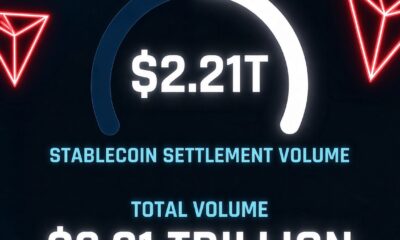

TRON Q3 2026 Report: $2.21 Trillion in Stablecoin Settlement Volume
TRON’s State of TRON Q3 2026 report, released in mid-October, highlighted $2.21 trillion (precisely $2.2126 trillion) in stablecoin settlement volume...


South Korea Blocks Domestic Access to 27 Unregistered Crypto Exchange Websites, Including KuCoin and MEXC
South Korea’s Financial Intelligence Unit (FIU), under the Financial Services Commission, announced on October 13, 2026, that domestic access would...


Bitcoin Drops Below $82,000 Amid $770M+ in Liquidations as Volatility Spikes
Bitcoin fell sharply on October 12, 2026, sliding below $82,000 and triggering more than $770 million in cryptocurrency liquidations, the...


Bitcoin Holds Above $84,000, Shrugging Off Heavy ETF Outflows as Oil Declines
Bitcoin rebounded to trade near or above $84,000 on Monday, October 12, 2026, recovering from earlier dips toward the low...


ESMA gives EU crypto firms three months to exit non-MiCA stablecoins
The European Securities and Markets Authority on 8 October told national supervisors that MiCA-authorised crypto firms should stop providing services...
-

 DeFi4 weeks ago
Bitcoin Reclaims $81,000 and Closes Above Key 50-Week Moving Average
-

 DeFi2 weeks ago
Hong Kong Moves Licensed Stablecoins Onto Exchanges and Into Fund Settlement
-
Crypto1 week ago
ESMA gives EU crypto firms three months to exit non-MiCA stablecoins
-

 DeFi3 weeks ago
Coinbase Adds Fixed-Rate Bitcoin-Backed Loans via Morpho Midnight
-

 Crypto2 weeks ago
Binance Burns 334.88 Million LUNC in October Fee Batch as Second Transaction Lifts the Day’s Total
-

 DeFi2 weeks ago
Robinhood Puts Hedge-Fund Tools in the App as Macro Turns Softer
-

 Bitcoin1 week ago
SEC clears listing path for first U.S. 3x Bitcoin and Ether ETFs
-

 DeFi2 weeks ago
TOKEN2049 Opens in Singapore Next Week as the City Leads Regional Crypto Flow
-

 DeFi1 month ago
Senate Rejects CLARITY Act Cloture in 49-50 Vote, Dealing Major Blow to U.S. Crypto Market Structure
-

 DeFi2 weeks ago
HSBC Names Its Hong Kong Stablecoin RedCoin, and Starts With PayMe
-

 Bitcoin2 weeks ago
Strategy Adds Another 1,665 BTC, Lifting Holdings to 847,666
-

 DeFi3 weeks ago
Solana Advances Alpenglow Upgrade to Public Testnet
-
 DeFi4 weeks ago
CFTC Submits Crypto Market Rules to White House Amid Congressional Stall
-
 DeFi3 weeks ago
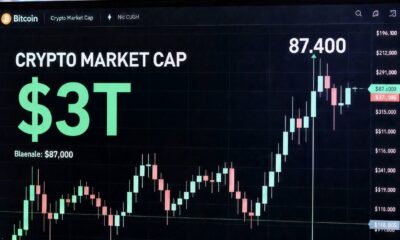
Bitcoin Surges Above $87,000 as Crypto Market Cap Reclaims $3 Trillion
-

 DeFi2 weeks ago
South Korea Ranks Second in On-Chain Crypto Holdings as the Tax Date Holds
-

 DeFi3 weeks ago
Bitcoin Surges Above $87,000 on ETF Inflows and Massive Short Squeeze
-

 Bitcoin1 week ago
Bitcoin breaks under $84,000 as oil spikes on Hormuz tanker attacks
-

 Bitcoin3 weeks ago
Record ETF Inflows and a Short Squeeze Drive Bitcoin’s $87,000 Break
-

 Bitcoin2 weeks ago
Coinbase Receives CFTC Approval for U.S. Derivatives Clearinghouse
-

 Bitcoin3 weeks ago
X Partners With Coinbase, Kraken, Gemini and Brokers to Trade From the Timeline
-

 Crypto1 week ago
Treasury and FinCEN drop unhosted-wallet and mixer surveillance proposals
-

 DeFi1 month ago
Senate Republicans Release “Final” CLARITY Act Draft Ahead of September 15 Cloture Vote
-

 DeFi2 weeks ago
BTSE Receives a Full Licence to Trade and Custody Crypto in Bhutan
-

 DeFi4 weeks ago
SEC Opens Pathway for Tokenized U.S. Equities After Legislative Setback
-
DeFi3 days ago
Bitcoin Drops Below $82,000 Amid $770M+ in Liquidations as Volatility Spikes
-

 Bitcoin3 weeks ago
Strategy Resumes Bitcoin Buying, Adds 950 BTC
-

 DeFi4 weeks ago
Circle Launches Arc Mainnet with Institutional Validators Including BlackRock and Visa
-

 Bitcoin1 month ago
Metaplanet Reverses Course, Erasing ~$220 Million in Warrant Value
-

 DeFi1 week ago
Government-linked wallets move seized coins
-

 DeFi4 weeks ago
Crypto Market Suffers Broad Decline; Bitcoin Briefly Drops Below $75,000 Before Stabilizing
-

 DeFi4 weeks ago
Avalanche Gains on NYSE Tokenization Testing Reports
-

 Crypto1 week ago
CFTC opens Regulation CTX and CAM after Clarity Act stalls
-

 DeFi4 weeks ago
Federal Reserve
-

 Bitcoin1 month ago
Bitcoin Spot ETFs Record $463 Million in Outflows
-

 Crypto2 weeks ago
Singapore Reclaims the Regional Crypto Lead at $284 Billion as the Rest of CSAO Shrinks
-

 Bitcoin4 weeks ago
Institutional Crypto Infrastructure Advances: Deutsche Bank Custody and Related Moves