Bitcoin
Prediction Markets Shatter Records with $18.8 Billion in December 2025 Trading Volume

Prediction markets capped off an explosive 2025 with a bang, recording an all-time high of $18.8 billion in trading volume during December alone. This milestone, driven primarily by platforms like Polymarket and Kalshi, marks a staggering surge from previous monthly highs and solidifies prediction markets as one of the fastest-growing sectors in both crypto and traditional finance.
The December figure represents a roughly 44% increase over November’s already impressive volumes and triples the peak seen during the 2024 U.S. election cycle. Industry-wide, the surge pushed 2025’s cumulative trading volume past $44 billion, with Polymarket contributing approximately $21.5 billion and Kalshi $17.1 billion for the year, according to data from Keyrock, Dune Analytics, and The Block.
What Drove the Record-Breaking Month?
Several factors converged to fuel this historic volume:
- Sports Dominance Takes Center Stage: While political betting grabbed headlines in 2024, sports contracts emerged as the clear winner in 2025. On Kalshi, sports accounted for 85% of volume, with high-profile markets like NFL Pro Football Champion outcomes drawing over $65 million in trades in a single week. Polymarket saw sports make up 39% of its activity, complemented by diversified bets on economics, tech, and culture.
- Regulatory Tailwinds and Mainstream Integration: A friendlier U.S. regulatory environment under the Commodity Futures Trading Commission (CFTC) played a key role. The agency shifted from enforcement to collaboration, hosting roundtables and dropping appeals against platforms. This paved the way for major partnerships: Kalshi secured exclusive data deals with CNN and CNBC, while Polymarket inked agreements with the NHL and UFC. Google Finance now displays Polymarket odds, and Bloomberg terminals are reportedly next.
- Institutional Inflows and Massive Funding: Intercontinental Exchange (parent of the NYSE) invested $2 billion in Polymarket at a $9 billion valuation, while Kalshi raised over $1 billion in fresh capital. These deals signaled Wall Street’s confidence, attracting institutional hedgers and boosting open interest to $13 billion across categories—quadrupling from early 2025 levels.
- New Entrants Amplify Liquidity: Traditional powerhouses entered the fray in December, including Fanatics Markets (in partnership with Crypto.com), DraftKings, and FanDuel. Robinhood’s prediction features also processed billions in volume, often routing through Kalshi markets. Decentralized challengers like Myriad, Limitless, and Opinion added hundreds of millions more, expanding access via chains like BNB and Solana.
Popular December markets included bets on Bitcoin reaching $100,000 before 2027 (heavily favored at over 70% probability on Polymarket), Federal Reserve rate decisions, and even quirky ones like Jerome Powell’s tie color or the highest-grossing 2025 movie (with A Minecraft Movie leading at 100% resolution in some contracts).
Why Prediction Markets Are Outpacing Traditional Betting
Unlike sportsbooks with a “house edge,” prediction markets operate peer-to-peer, allowing users to buy “Yes” or “No” shares in event outcomes priced between $0.01 and $0.99. This structure often yields sharper probabilities than polls—Polymarket famously outperformed traditional forecasters in the 2024 election.
Analysts highlight the sector’s maturation: “Prediction markets have evolved from niche crypto experiments to essential infrastructure for real-time analysis,” said Jimmy Xue, COO of Axis. A Certuity report projects 46.8% compound annual growth, potentially reaching $95.5 billion by 2035. Citizens Financial Group forecasts revenues exceeding $10 billion by 2030, with some bold predictions hitting $1 trillion in annual volume by decade’s end.
DeFi integration has been a boon too. Platforms saw $14 billion in deposits on protocols like Aave, with stablecoins like USDC facilitating seamless trades. On-chain transactions topped 95 million for Polymarket alone in 2025.
Outlook for 2026: Acceleration Ahead
Experts are bullish. “I absolutely expect traction to accelerate as prediction markets solidify their status as the ‘Dual Pillars’ of finance and media,” Xue added. With weekly volumes already exceeding $2 billion (Kalshi hit a record $2.3 billion in one week alone), 2026 could see sustained monthly figures north of $20 billion.
However, challenges remain. Double-counting concerns on some dashboards (e.g., Polymarket’s OrderFilled events) have led to inflated perceptions in the past, though corrected data confirms the growth is genuine. Regulatory scrutiny in states like California and Texas persists, and insider trading risks grow with higher stakes.
Key Takeaways for Investors and Traders
- Diversify Across Platforms: Use Polymarket for global/crypto events and Kalshi for U.S.-regulated sports/economics.
- Risk Management: High liquidity reduces slippage, but volatile news events can swing prices rapidly—employ limit orders and monitor open interest.
- Opportunities: Arbitrage between platforms remains profitable, with top traders extracting millions via information edges and speed trading.
- Watch for Airdrops: Polymarket hints at rewards for high-volume users, potentially valuing participation at billions.
December’s $18.8 billion record isn’t just a number—it’s proof that prediction markets have arrived as a mainstream asset class. As CEO Shayne Coplan of Polymarket told 60 Minutes, these platforms may be “the most accurate thing we have as mankind” for forecasting the future. With institutional backing and endless real-world applications, 2026 looks set to be even bigger.
Disclaimer
The content on CoinReporter.io is for informational purposes only and is not financial or investment advice. Cryptocurrency investments are highly volatile and risky. Always conduct your own research and consult a qualified financial advisor before making investment decisions. CoinReporter.io and its authors are not liable for any losses resulting from actions based on this website’s content.

The content on CoinReporter.io is for informational purposes only and is not financial or investment advice. Cryptocurrency investments are highly volatile and risky. Always conduct your own research and consult a qualified financial advisor before making any investment decisions. CoinReporter.io and its authors are not liable for any losses resulting from actions based on this website’s content.






The Financial Conduct Authority opened its crypto authorisation gateway on September 30, the first time UK crypto firms can apply for full permission under the new regime rather than sit on the anti-money-laundering register.
Applications go through the FCA’s Connect system. The window runs to 11:59 p.m. on February 28, 2027. The regime itself starts on October 25, 2027. Firms that want to keep operating in Britain are expected to file inside that window. Authorisation is not automatic.
Dominic Cashman, the FCA’s director of authorisation, said the regime gives consumers protections they have not had and firms a framework to work inside. The standards the press release names are consumer protection, safeguarding, market integrity and financial resilience. Final rules and guidance landed in June. Perimeter guidance, PS26/18, followed on September 16. The legal base is the Financial Services and Markets Act 2000 (Cryptoassets) Regulations 2026, made in February.
The filing date is the part that decides who stays open. A firm that applies between September 30 and February 28 can keep providing cryptoasset services, including taking new business, if the FCA has not ruled by commencement. That is the savings provision. A firm that files late does not get it. A firm that does not file has to leave the UK market when the regime starts. The FCA says it expects to decide applications submitted in the window before October 25, 2027, and is offering pre-application meetings and webinars. It is not offering legal advice.
This is a different object from the existing money-laundering registration. AML registration let a firm operate under a narrow compliance overlay. The gateway is a FSMA permission: exchanges, custodians and other in-scope businesses need authorisation, or a variation if they are already authorised, for the new cryptoasset activities. The asset can still go to zero. What changes is who is accountable for conduct, custody and market abuse once the firm is inside the perimeter.
Europe is the comparison the industry is already making. MiCA’s transitional cutoff on July 1 left a large share of applicants, including major offshore names, without a licence. The UK window is five months, then a further eight before commencement, and the savings rule is written so a timely application is not a stop-the-business event. That is more orderly than a hard cutoff. It is also a filter. Groups that cannot document safeguarding, capital and governance by February will not be in the October 2027 market.
For UK users the practical change is later, not this week. No new consumer redress appears on September 30. The date that matters is October 25 next year, and only for firms that filed, and only for the activities the permission actually covers.


TOKEN2049 Opens in Singapore Next Week as the City Leads Regional Crypto Flow
TOKEN2049 runs October 7–8 at Marina Bay Sands. Organisers expect more than 25,000 people, from more than 7,000 companies and...


BTSE Receives a Full Licence to Trade and Custody Crypto in Bhutan
BTSE has a full financial-services licence in Gelephu Mindfulness City. The company said on September 29 that the Gelephu Financial...


South Korea Ranks Second in On-Chain Crypto Holdings as the Tax Date Holds
South Korea is second only to the United States in cryptocurrency that can be measured sitting in wallets and on...


HSBC Names Its Hong Kong Stablecoin RedCoin, and Starts With PayMe
HSBC named the stablecoin it has not yet issued. On September 30 the bank said the Hong Kong-dollar token will...


Hong Kong Moves Licensed Stablecoins Onto Exchanges and Into Fund Settlement
Hong Kong’s stablecoin law is already in force. The September policy address is the next step: the tokens those licences...


Japan’s Licensed Yen Stablecoin Traded at Four Times Its Peg on Upbit
JPYC, the first yen stablecoin licensed in Japan, opened on Upbit on September 17 and briefly traded at about four...


South Korea Sets Capital and Ledger Rules for Tokenized Stocks and Bonds
The Financial Services Commission published the subordinate rules that would let tokenized securities start in Korea on February 4, 2027....


Singapore Reclaims the Regional Crypto Lead at $284 Billion as the Rest of CSAO Shrinks
Singapore is again the largest crypto economy in Central and Southeast Asia and Oceania. Chainalysis put activity there at $284...


UK FCA Opens Crypto Licensing Gateway, Giving Firms Until February 2027 to File
The Financial Conduct Authority opened its crypto authorisation gateway on September 30, the first time UK crypto firms can apply...


Robinhood Puts Hedge-Fund Tools in the App as Macro Turns Softer
Robinhood used HOOD Summit in Houston to do what the brokerage has been signaling all year: stop being only a...
-

 Crypto4 weeks ago
Binance Completes 48th Monthly LUNC Burn as BNB Chain Marks Six Years
-

 DeFi2 weeks ago
Bitcoin Reclaims $81,000 and Closes Above Key 50-Week Moving Average
-

 DeFi3 weeks ago
Solana Sets Record with Over 263,000 New Tokens Minted in a Single Day
-

 DeFi1 month ago
Tokenized Stock Volume Jumps 415% in a Month as Holder Base Explodes
-

 Bitcoin1 month ago
Strategy Ends 10-Week Pause, Buys 4,603 BTC for $369.7 Million
-

 Crypto4 weeks ago
Arbitrum (ARB) Surges Nearly 30% as Robinhood Chain Revenue Explodes
-

 Crypto1 month ago
Stellar’s Tokenized RWA Market Quadruples to Nearly $4 Billion
-

 Bitcoin1 month ago
Bitcoin Delivers Strongest August Since 2017 as Rally Digests Macro Signals
-

 Bitcoin1 month ago
Spot Crypto ETFs Attract Over $2 Billion in Weekly Net Inflows
-

 DeFi3 weeks ago
Visa Stablecoin Settlement Volume Hits $20 Billion Annualized Run Rate
-

 DeFi4 weeks ago
Chainlink Partners with Bottomline to Enable Cross-Chain Payments for 600+ Banks
-

 DeFi4 weeks ago
Dash Leads Privacy Coin Rally with Massive Gains
-

 DeFi4 weeks ago
Zcash Breaks $1,000 for First Time in Nearly a Decade on ETF Momentum
-

 DeFi1 week ago
Coinbase Adds Fixed-Rate Bitcoin-Backed Loans via Morpho Midnight
-

 DeFi4 weeks ago
NYSE Owner ICE Bets on tZERO to Advance Tokenized Securities Infrastructure
-

 DeFi4 weeks ago
CME Overtakes Other Venues to Become Leading XRP Futures Market
-

 DeFi4 weeks ago
Macro Pressure Intensifies: Rising Yields, Oil Spike, and Fed Hike Odds Weigh on Risk Assets
-

 Bitcoin3 weeks ago
Block (Jack Dorsey) Applies for U.S. Trust Bank Charter
-

 Crypto1 month ago
Bitwise Solana ETF (BSOL) Becomes First to Cross $1 Billion in Assets
-

 DeFi3 weeks ago
First U.S. Staked TRX ETF (Canary TRXS) Debuts
-

 Bitcoin1 month ago
Strive Acquires 1,800 BTC for $143 Million, Enters Top Five Corporate Holders
-

 Bitcoin4 weeks ago
Bitcoin Slips Below $80,000 After Strong U.S. Jobs Report Despite Record ETF Inflows
-

 DeFi3 weeks ago
Senate Republicans Release “Final” CLARITY Act Draft Ahead of September 15 Cloture Vote
-

 DeFi3 weeks ago
Ethereum Advances Plans for Gas Payments Without Holding ETH
-

 DeFi4 weeks ago
London Stock Exchange Partners with Kraken Parent to Tokenize Top UK Stocks
-

 Bitcoin1 week ago
X Partners With Coinbase, Kraken, Gemini and Brokers to Trade From the Timeline
-
DeFi1 week ago
Bitcoin Surges Above $87,000 on ETF Inflows and Massive Short Squeeze
-

 Bitcoin3 weeks ago
Liquid Network Exploit: 4,000 BTC Drained, 3,400 Returned in White-Hat Negotiation
-
 DeFi1 week ago
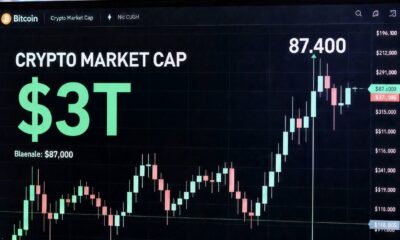
Bitcoin Surges Above $87,000 as Crypto Market Cap Reclaims $3 Trillion
-

 DeFi2 weeks ago
SEC Opens Pathway for Tokenized U.S. Equities After Legislative Setback
-
 DeFi2 weeks ago
CFTC Submits Crypto Market Rules to White House Amid Congressional Stall
-

 Bitcoin3 weeks ago
Crypto Market Faces Pressure as Bitcoin Tests Support Near $78K Amid Macro Headwinds
-

 DeFi2 weeks ago
Circle Launches Arc Mainnet with Institutional Validators Including BlackRock and Visa
-

 DeFi3 weeks ago
Bitmine Immersion Continues Aggressive ETH Accumulation
-

 Bitcoin1 month ago
Bitcoin ETF Inflow Streak Ends Amid Hawkish Fed Commentary
-

 DeFi3 weeks ago
Circle to Acquire Tazapay for $400 Million