Crypto
Best Bitcoin & Crypto-Backed Loan Platforms in 2026

The post Best Bitcoin & Crypto-Backed Loan Platforms in 2026 appeared first on Coinpedia Fintech News
Unlock liquidity from your crypto holdings without triggering a taxable sale; here’s how the top platforms compare.
Disclaimer: This article is for informational and educational purposes only and does not constitute financial or investment advice. Always consult a qualified professional before making financial decisions.
Why Borrow Instead of Sell?
For long-term Bitcoin holders, selling is often the worst option. It triggers capital gains tax, removes future upside exposure, and can be psychologically costly after years of conviction holding.
Crypto-backed lending solves this. You deposit Bitcoin or other crypto as collateral, receive cash or stablecoins, and keep your position intact. When you repay, your collateral comes back. The market now spans centralized platforms (CeFi) and smart contract protocols (DeFi), each with meaningfully different risk profiles.
Platform Types at a Glance
| Type | How It Works | Best For |
| CeFi | A company holds your crypto and manages the loan | Simplicity, fiat loans, customer support |
| DeFi | Smart contracts manage everything on-chain | Lower rates, no KYC, full transparency |
The 6 Best Crypto-Backed Loan Platforms
1. Ledn — Best for Bitcoin Holders Who Prioritise Security
Platform type: CeFi | Collateral: BTC | Borrow: USD, USDC, local fiat | Rate: From ~9.99% | Max LTV: 50%
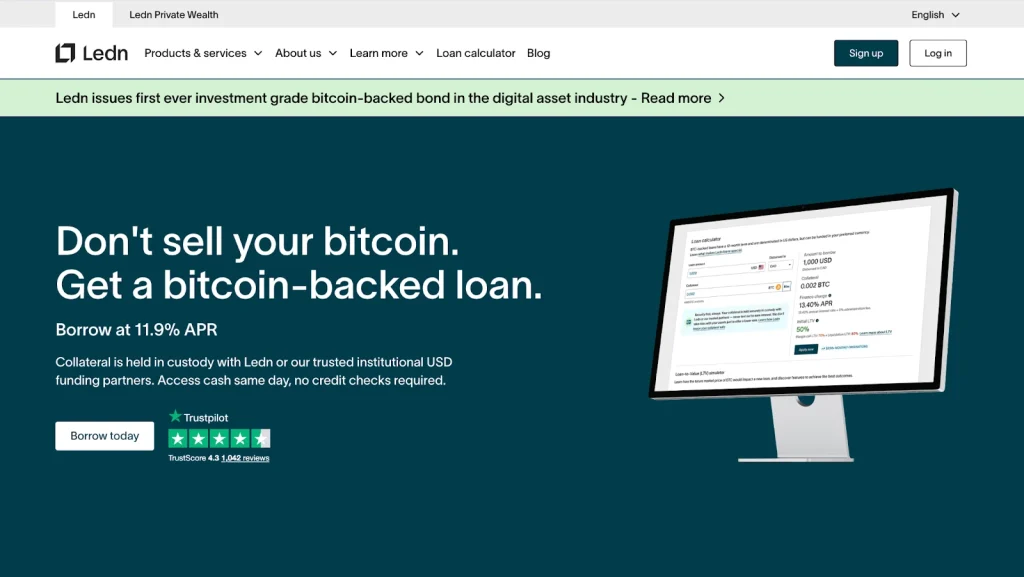
Founded in 2018, Ledn has processed over $10.5 billion in Bitcoin-backed loans without a single reported loss of client funds, a track record that survived the collapses of Celsius, BlockFi, and FTX.
Its Custodied Loan product holds collateral in segregated on-chain addresses, ring-fenced from the platform’s other activities. Neither Ledn nor its funding partners can lend out your collateral for interest, directly addressing rehypothecation concerns. A monthly Open Book Report and independent Proof of Reserves audits every six months add further transparency.
Ledn’s core borrowers tend to be financially sophisticated, long-term BTC holders managing significant Bitcoin wealth. For this profile, trust and track record outrank rate optimisation. Ledn’s 24/7 operations are also a genuine advantage: Bitcoin’s sharpest moves often happen on weekends, when traditional finance is unavailable.
The B2X product lets conviction holders borrow against BTC to buy more BTC instantly. Auto Top-Up automatically adds collateral when LTV hits 70%, reducing liquidation risk.
Trade-off: Rates are higher than DeFi, and the 12-month fixed term is less flexible than open-ended protocols.
Key stats: $10.5B+ loaned | Zero client losses | 6-hour funding | No monthly payments | 100+ countries
2. Aave — Best for DeFi-Native Users with Multi-Chain Portfolios
Platform type: DeFi | Collateral: 120+ ERC-20 tokens | Borrow: Any supported token | Rate: Variable | Max LTV: Up to 82%
Aave is the gold standard for decentralised lending, deployed across 18 blockchains with no KYC and no company holding your funds. Rates move based on pool utilisation, making it well-suited for short-term borrowing windows. Flash loan functionality attracts advanced traders, though it’s not relevant for most borrowers.
Key stats: Battle-tested across multiple market cycles | Ethereum, Arbitrum, Polygon, Base, and more | No origination fees
3. Nexo — Best for Borrowers with Diverse Crypto Holdings
Platform type: CeFi | Collateral: 100+ assets | Borrow: USD, USDC, USDT, fiat | Rate: 11–19% | Max LTV: 90%
Nexo accepts over 100 cryptocurrencies as collateral, including altcoins most lenders won’t touch, with instant approval and 24-hour funding. Tiered interest rates are available to NEXO token holders.
Risks and considerations: Accessing Nexo’s best rates requires holding significant NEXDC token exposure, adding market risk unrelated to your loan; token depreciation can outweigh any interest savings. In 2023, Nexo settled with the U.S. SEC and multiple state regulators for $45 million over unregistered securities allegations, subsequently exiting the U.S. market. New York imposed a five-year ban on Nexo in the securities industry. Nexo discontinued Proof of Reserves reporting after its U.S. exit, with no plans to reinstate it. The platform also accepts its own token as collateral, a structural conflict of interest worth considering.
Key stats: Widest collateral acceptance in CeFi | Unlimited loan duration | No current Proof of Reserves reporting
4. Compound — Best for Ethereum-Native Borrowers Who Prefer Governance Transparency
Platform type: DeFi | Collateral: Major ERC-20 tokens | Borrow: ETH, USDC, USDT | Rate: Variable | Max LTV: Asset-dependent
One of DeFi’s original protocols, Compound sets rates algorithmically and governs changes via COMP token holders, with all decisions visible on-chain. Rates can be competitive during low-utilisation periods but spike under high demand. A solid choice for Ethereum-native users who don’t need fiat output.
Key stats: Fully decentralised governance | Long track record | No origination fees
5. Arch Lending — Best for Institutional Borrowers
Platform type: CeFi | Collateral: BTC, ETH | Borrow: USD | Rate: Negotiated | Max LTV: ~50%
Arch operates at the institutional end of the market (minimum loan sizes from $75,000+), offering dedicated relationship managers and custom loan structuring for complex borrower situations, including trusts, LLCs, and family offices. Rates are negotiated rather than published upfront.
Key stats: Purpose-built for large borrowers | Accommodates investment structures | Relationship-managed service
6. Morpho — Best for Users Seeking Competitive DeFi Rates
Platform type: DeFi | Collateral: Any ERC-20 token | Borrow: Any supported token | Rate: Variable | Max LTV: Variable
Morpho matches lenders and borrowers directly where possible, allowing both sides to benefit from better rates than shared pool models. When no direct match exists, it falls back to standard mechanisms. Its Morpho Blue engine powers 190+ markets and underpins Coinbase’s borrowing product.
Risks and considerations: Borrowing against BTC on Morpho requires wrapping it into WBTC or cbBTC first, introducing custodial and bridge risk; depending on your jurisdiction, the wrapping itself may constitute a taxable event. Smart contract vulnerabilities are a genuine concern across DeFi: a rounding error combined with an access control flaw in Balancer V2 (November 2025) led to estimated losses of over $100 million. Morpho’s permissionless market creation broadens the potential attack surface. Liquidations are automated and instant, often liquidating more collateral than the minimum necessary, with no human review and no legal recourse in the event of failure.
Key stats: Peer-to-peer rate matching | 190+ markets | No origination fees | No regulatory oversight or Proof of Reserves
Platform Comparison
| Platform | Type | Collateral | Rate | Max LTV |
| Ledn | CeFi | BTC only | From ~9.99% | 50% |
| Aave | DeFi | 120+ ERC-20 | Variable | 82% |
| Nexo | CeFi | 100+ assets | 11–19% | 90% |
| Compound | DeFi | Major ERC-20 | Variable | Asset-dependent |
| Arch Lending | CeFi | BTC, ETH | Negotiated | ~50% |
| Morpho | DeFi | Any ERC-20 | Variable | Variable |
Key Risks to Understand
In CeFi: You’re trusting a company with your assets. Platform insolvency, rehypothecation, and regulatory risk are the main concerns. Ledn’s Custodied Loan explicitly prohibits collateral lending; most other CeFi lenders do not.
In DeFi: Smart contract exploits can cause irreversible losses with no recourse. Variable rates can spike. Wrapping BTC introduces additional custodial and potential tax risk. Liquidations are automated and aggressive compared to regulated CeFi models.
Frequently Asked Questions
Is a crypto-backed loan a taxable event? In most countries, no; borrowing against crypto is not a disposal. Local rules vary, and wrapping BTC for DeFi may be treated differently. Always confirm with a tax professional.
What happens if I can’t repay? The platform sells your collateral to recover the outstanding balance. You keep the original loan proceeds.
What’s a safe LTV to target? Below 35% is widely recommended. It provides a meaningful buffer against price declines before approaching liquidation thresholds.
This article is for general informational purposes only and does not constitute financial, legal, or tax advice. Past performance is not a guarantee of future results. Always conduct your own research and consult qualified professionals before making financial decisions.

The content on CoinReporter.io is for informational purposes only and is not financial or investment advice. Cryptocurrency investments are highly volatile and risky. Always conduct your own research and consult a qualified financial advisor before making any investment decisions. CoinReporter.io and its authors are not liable for any losses resulting from actions based on this website’s content.

The US Justice Department is seeking to permanently forfeit about $1.17 billion in USDC tied to the Oct. 29 Binance hack, according to a civil complaint filed on Monday in federal court in Washington, DC. US investigators attribute the theft to North Korean military hackers known as Lazarus Group, or APT38.
The complaint lists USDC balances across 36 addresses on 18 blockchains. Prosecutors also asked the judge for a new restraining order, saying it was unclear when or whether an earlier order obtained on Nov. 12 would expire, so that there would be “no lapse in the restraint” of the funds.
Circle to reissue the tokens
Circle has blocked access to the stolen USDC but cannot move the original tokens out of the frozen addresses. Instead, the stablecoin issuer “has agreed to voluntarily issue new USDC in an amount equivalent” to the funds and transfer it to the United States once a court orders forfeiture, the complaint says.
US authorities say they have helped freeze, seize or return more than $2.9 billion in crypto since the attack. Binance puts its losses at about $6.34 billion and says it covered them in full from its own funds. The exchange separately won a $6.5 billion worldwide freezing order from the Abu Dhabi Global Market Courts this month.
“Following the Binance theft, the FBI and our partners moved quickly to trace and freeze stolen assets and share critical information with virtual asset service providers,” said Brett Leatherman, operations director of the FBI’s Cyber Branch.
Laundering through Bitcoin mixers
The hackers are still moving money. Blockchain analytics firm Elliptic said on Monday that at least $247 million had been pushed through Bitcoin coinjoins, a mixing method that pools many users’ coins in one transaction to break the trail.
Almost all of it ran through Kruw, the most widely used coinjoin coordinator for Wasabi Wallet users. Its operator “refuses to block funds such as these,” Elliptic co-founder Tom Robinson said, which is why the firm expects the laundering to continue.
Mixing picked up after Nov. 17, when the attacker emptied five of the nine largest Ethereum addresses tied to the theft and moved about 488,000 ETH. Those coins are being swapped into Bitcoin through the THORChain bridge and then mixed, often within hours. Elliptic counts more than 27,000 wallets across at least 16 blockchains in the operation.
Little has been cashed out so far. About $2.85 billion has been frozen or seized, according to Elliptic, and the 18,270 BTC taken directly from Binance has not moved since the night of the record hack.
What comes next
The forfeiture still needs a court order before Circle can mint the replacement USDC. Elliptic expects the rest of the stolen funds to be converted to Bitcoin, mixed and cashed out through over-the-counter brokers over several months, the stage at which they can still be intercepted.
References: The Block, Decrypt, Cointelegraph


South Korea Crypto Tax Delay to 2029 Stalls Over Three- or Five-Year Loss Rule
South Korea’s plan to push its crypto tax back to 2029 has the support of both main parties, but it...


Binance Says Five New Asian Licences Are on Track After $6.3 Billion Hack
Binance says its plan to win five more licences in Asia is still on track, even after a $6.3 billion...


Bitcoin Sits 51% Below Its All-Time High as Crypto Market Loses $2.2 Trillion
Bitcoin is trading 51.4% below its all-time high, and the total crypto market has lost about $2.2 trillion, or roughly...


Stock Market Sell-Off Explained: Why Wall Street Tumbled and Crypto Fell With It
The stock market sell-off that pushed the S&P 500 into a correction on Friday came from a collapse in the...


Terra Classic (LUNC) Jumps 21% in a Week as Validators Vote on v4.2.0 Upgrade
Terra Classic’s LUNC token has climbed about 21% over the past week, even as the wider crypto market sits in...


Hong Kong Adds Hyperliquid to Suspicious Platforms List as CFTC Chair Outlines US Route
Hong Kong’s Securities and Futures Commission (SFC) has added Hyperliquid to its suspicious platforms list for virtual asset trading, flagging...


Sky’s USDS Stablecoin Shrinks More Than 30% as $1.5 Billion Leaves Its Reserve
The supply of Sky’s USDS stablecoin fell by more than 30% to about $3.2 billion after more than $1.5 billion...


Bitcoin Hits Four-Month Low Near $61,300 as $700 Million in Liquidations Follow Anthropic IPO
Bitcoin fell to a four-month low near $61,300 late Thursday, its weakest level since early July, as a sell-off in...


MoonPay Files for National Trust Bank Charter to Issue Stablecoins in the US
MoonPay has applied for a US national trust bank charter that would let it issue and redeem stablecoins, manage their...


BlackRock’s IBIT Posts Record $541 Million Outflow as Bitcoin ETFs Lose $582 Million
US spot Bitcoin ETFs lost $582.3 million on Thursday, Nov. 19, nearly double the previous day’s outflow, as BlackRock’s iShares...
-

 DeFi4 weeks ago
LUNC Hits 462B Burned After v4.1.1 Upgrade
-

 Crypto1 week ago
Zelle Picks Solana for ZelleUSD Stablecoin After $1.2 Trillion Year of US Payments
-

 Crypto1 week ago
Ether ETFs Lose $399 Million for Seventh Straight Week, Nearing Record Outflow Streak
-

 Crypto4 weeks ago
DTCC Launches Tokenization Service Covering Approximately $30 Trillion in Securities
-

 Bitcoin1 week ago
Crypto Market Analysis: Bitcoin Slips Below $63,000 as Fear Grips Traders
-

 Crypto4 weeks ago
Memecoin PEPE Rallies on Reported Large Holdings Linked to Justin Sun; Broader Tokenization Debate Continues
-
Bitcoin3 days ago
Terra Classic (LUNC) Jumps 21% in a Week as Validators Vote on v4.2.0 Upgrade
-

 DeFi4 weeks ago
Ripple Secures Final OCC Approval for National Trust Bank to Oversee RLUSD
-

 Bitcoin1 week ago
Bitcoin Falls to Three-Month Low Below $63,000 as Liquidations Top $1.9 Billion
-

 Crypto2 weeks ago
DTCC Adds Solana to Tokenization Service, Targeting Second Half of 2027
-

 Bitcoin4 weeks ago
Federal Reserve Holds Rates Steady as Bitcoin Trades Near $80,000; December Hike Odds Rise
-

 Bitcoin7 days ago
Bitcoin ETFs Lose $306.5 Million as Citi Cuts Its 12-Month Target to $99,532
-

 DeFi1 month ago
Crypto Liquidations Surge Past $400 Million in Hours as Bitcoin Briefly Dips Below $80,000
-

 Bitcoin1 week ago
Bitcoin ETFs Extend Outflow Streak to Eight Days as Traders Brace for Nvidia Earnings
-

 Crypto2 weeks ago
Nvidia Names Colette Kress Interim CEO After Jensen Huang Resigns
-

 Crypto4 weeks ago
Hyperliquid Permanently Burns Nearly 5% of Maximum HYPE Supply Amid Broader Token Burn Trends
-

 Bitcoin7 days ago
Bitcoin Slips to $63,600 as Fed Minutes Show October Hold Was a ‘Close Call’
-

 DeFi2 weeks ago
Bitcoin Tests $75,200 Support
-

 DeFi3 weeks ago
Bitcoin Crashes Toward $75K
-

 Bitcoin2 weeks ago
Bitcoin Slides Toward Sixth Weekly Loss as $1.23 Billion in Liquidations Hit Longs
-

 DeFi4 weeks ago
Stablecoin Issuers and Partners Freeze Billions Linked to Binance Incident
-

 DeFi3 weeks ago
Bitcoin Rebounds Past $80,000 as Midterms Conclude and Markets Digest Binance Hack Details
-

 DeFi3 weeks ago
Bitcoin Falls Below $77,000 as Chip Stocks Sell Off Ahead of U.S. Midterms
-

 DeFi4 weeks ago
Moody’s Assigns Investment-Grade A2 Rating to Ripple’s RLUSD; Coinbase Lists the Stablecoin
-

 Crypto7 days ago
Tokenized Anthropic Stock Heads to BNB Chain on Day of Record $81.3 Billion IPO
-
Bitcoin3 days ago
Bitcoin Sits 51% Below Its All-Time High as Crypto Market Loses $2.2 Trillion
-

 Crypto1 week ago
Top 10 Asia-Pacific Crypto News: South Korea Moves to Delay Crypto Tax to 2029 and More (Nov 11–17, 2026)
-

 DeFi3 weeks ago
Bitcoin Dips to Multi-Week Lows Near $75,200 Before Recovering Above $76,000
-

 Crypto1 week ago
Hong Kong Plans Year-End Bill to License Four More Types of Crypto Firms
-

 DeFi3 weeks ago
U.S. Spot Bitcoin ETFs See Multi-Hundred-Million Outflows as Post-Hack Caution Weighs
-

 DeFi3 weeks ago
Crypto Market Stabilizes After Sharp Dip
-

 Bitcoin4 weeks ago
Bitcoin Slides Below $78,000 as Risk-Off Sentiment Intensifies
-

 DeFi4 weeks ago
Binance Suffers Record $6.3 Billion Security Incident — Largest Crypto Heist in History
-

 Crypto2 weeks ago
Visa Adds Western Union’s USDPT as First Anchorage Stablecoin for VisaNet Settlement
-

 DeFi4 weeks ago
Google Cloud Unveils Multi-Party Computation Custody Service for Banks
-

 DeFi2 weeks ago
Bitcoin Slips Toward $74,600