Bitcoin
The Evolution of Crypto in 2025: From Hype to Real-World Integration

The year 2025 will be remembered as the period when cryptocurrency began its true transition from speculative asset class to foundational financial infrastructure. What started as a year of regulatory breakthroughs and institutional inflows ended with stablecoins, tokenized assets, and regulated access points becoming everyday tools for payments, remittances, and capital markets.
Regulatory Foundations Take Shape
The defining regulatory event of 2025 was the passage of the GENIUS Act in the United States (July 2025), which established a clear framework for dollar-pegged stablecoins and brought significant legitimacy to issuers like Circle (USDC) and Paxos (PYUSD). In Europe, MiCA Phase 2 enforcement matured, while the UAE’s ADGM and VARA regimes created the most crypto-friendly jurisdiction in the world. The UK’s FCA consultation (December 2025) laid groundwork for a 2027 regime, and even Japan introduced a 20% flat tax on crypto gains.
These frameworks did not suppress innovation—they channelled it. Stablecoin market cap crossed $310 billion by year-end, with USDC and PYUSD seeing 660%+ growth in usage.
Stablecoins: The Quiet Revolution
Mastercard’s December 2025 insights captured the moment perfectly: stablecoins have become the “digital dollar” for cross-border payments and remittances, especially in Asia-Pacific (APAC). Transaction volumes in the region exceeded $2.36 trillion, with stablecoins reducing costs from 6–7% (traditional wires) to under 1% in many corridors.
The Philippines, Vietnam, and Indonesia led adoption, with remittances (10–15% of GDP in some nations) increasingly routed through USDC and USDT. Banks and fintechs—Visa’s Stablecoins Advisory Practice, GoTyme Bank’s crypto wallets, Interactive Brokers’ stablecoin deposits—began integrating these assets directly, proving utility over speculation.
Tokenization and Institutional Flows
Real-world asset (RWA) tokenization crossed $24 billion in on-chain value by Q4, led by BlackRock’s BUIDL fund ($2.9B in tokenized Treasuries) and JPMorgan’s Onyx platform. Sovereign funds in the Middle East and Asia allocated 1–5% to Bitcoin and RWAs, while banks like PNC and National Bank of Canada added indirect exposure via MicroStrategy stock and direct Bitcoin trading.
ETFs continued their dominance: U.S. spot Bitcoin and Ethereum funds absorbed over $120 billion in 2025 inflows. Grayscale’s Bittensor Trust (GTAO) and Bitwise’s 10 Crypto Index Fund (BITW) on NYSE Arca broadened access to altcoins and AI-crypto narratives.
Retail Shifts and Market Maturation
Retail participation in speculative altcoins declined sharply—mid/small-cap tokens lost $200 billion in value—while institutional demand through regulated vehicles grew. Prediction markets (Polymarket, Kalshi) saw volumes exceed $5 billion, demonstrating superior information aggregation, as praised by Vitalik Buterin.
The year closed with Bitcoin trading around $88,700–$89,200 (down ~4–5% in late December), missing the traditional Santa rally. Yet institutional accumulation, stablecoin utility, and tokenization growth painted a picture of maturation: from hype to infrastructure.
As 2026 approaches, the message is clear: crypto is no longer a fringe asset class—it is becoming the backbone of modern finance.
Disclaimer
The content on CoinReporter.io is for informational purposes only and is not financial or investment advice. Cryptocurrency investments are highly volatile and risky. Always conduct your own research and consult a qualified financial advisor before making investment decisions. CoinReporter.io and its authors are not liable for any losses resulting from actions based on this website’s content.

The content on CoinReporter.io is for informational purposes only and is not financial or investment advice. Cryptocurrency investments are highly volatile and risky. Always conduct your own research and consult a qualified financial advisor before making any investment decisions. CoinReporter.io and its authors are not liable for any losses resulting from actions based on this website’s content.






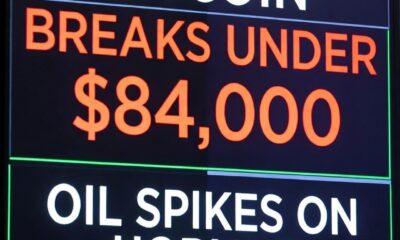





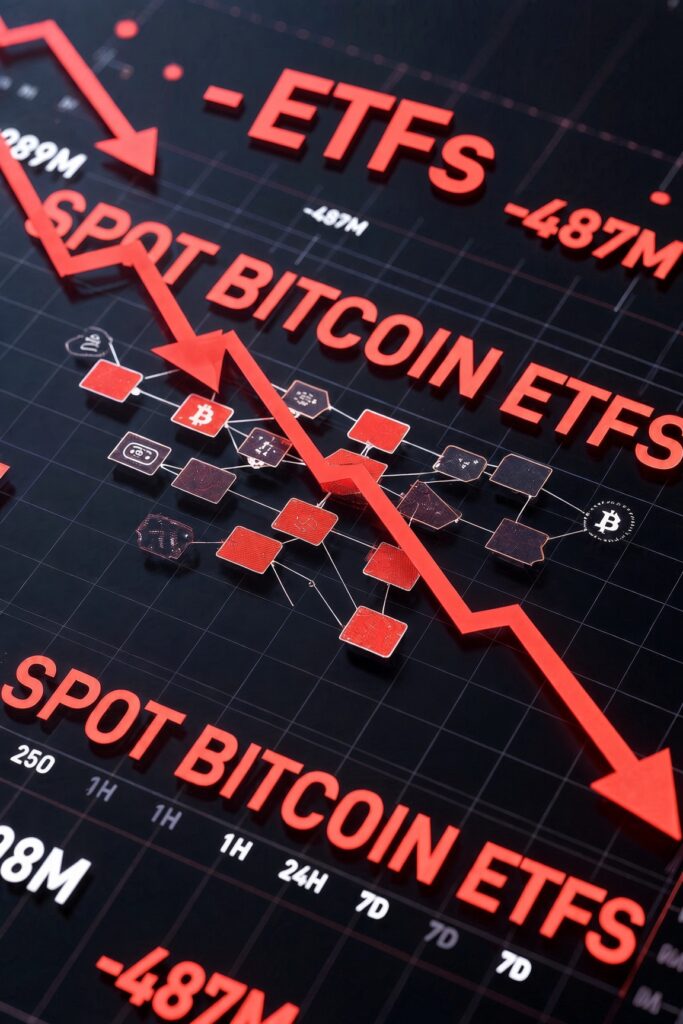
Tuesday’s US spot bitcoin ETFs took in about $119 million, the fourth inflow in five sessions. Wednesday reversed that. SoSoValue-linked reports put net outflows at $487 million, the largest day since 25 June on one compilation, at $484.9 million. BlackRock’s IBIT led with about $208 million, Fidelity’s FBTC with about $105 million, then ARKB at about $102 million, GBTC at about $39 million, BITB at about $28 million and HODL at about $3.5 million.
The day before had looked like the thin bid was stabilizing. Creations in the week ended 2 October had already fallen to the low hundreds of millions, with IBIT the main buyer and FBTC the fund seeing outflows. Tuesday’s $119 million fit that pattern. Wednesday did not. IBIT, the fund that had been absorbing shares while others leaked, led the redemption. That is a different tape from a rotation inside the complex. It is the complex selling.
The stock is still large: about $107.4 billion in net assets, roughly 6.41% of bitcoin’s market cap, and $57.3 billion of cumulative net inflows. A one-day redemption does not unwind that base. It does remove the marginal buyer on the day the range broke. Bitcoin closed at $83,275.93, down 2.67%, after trading near $86,600 a day earlier and printing a Bloomberg low near $82,759. The post-breakout band of roughly $83,000–$87,000 was tested from underneath on the same session the creations flipped.
Ether funds had already been bleeding. US spot ether ETFs logged about $202 million of outflows on Tuesday, a six-session streak near $408 million, while bitcoin funds were still taking in cash. Wednesday closed that gap from the other side. Ether finished at $2,573.53, down 4.60%. The base asset and the beta asset redeemed together into a Hormuz shock that had Brent above $101 and the 10-year near a 24-year high.
For the range, the flow number is the one that matters more than the oil headline. A reclaim of $85,500 was the resistance that would restore the band. That reclaim needs a buyer. A $487 million outflow is the opposite print, and it landed on the day $84,000 failed. If Thursday’s creations do not flip back, $81,000 is the figure CoinMarketCap’s desk already flagged, and the cumulative $57.3 billion does not trade against it. The stock is the base. The daily creation is the bid. Wednesday took the bid off.


ESMA gives EU crypto firms three months to exit non-MiCA stablecoins
The European Securities and Markets Authority on 8 October told national supervisors that MiCA-authorised crypto firms should stop providing services...


Uptober stalls ahead of the Fed minutes
Seasonality lost to bonds. October has been positive for bitcoin in 10 of the past 13 years, and 21Shares had...


Government-linked wallets move seized coins
Early on-chain reads put about $103 million in motion: 833.6 BTC, roughly $71.6 million, to Coinbase Prime, and 40,285 BNB,...


Winklevoss files a 0.25% Zcash ETF
Winklevoss Asset Services filed for a spot Zcash ETF, proposed Nasdaq ticker WINK, with Gemini as custodian and a 0.25%...


Spot bitcoin ETFs flip to a ~$487 million outflow
Tuesday’s US spot bitcoin ETFs took in about $119 million, the fourth inflow in five sessions. Wednesday reversed that. SoSoValue-linked...


Bitcoin loses $84,000 as Hormuz attacks lift oil and yields
Bitcoin closed at $83,275.93, down 2.67%, after Iran stepped up attacks on tankers in the Strait of Hormuz. Brent rose...


Binance Burns 334.88 Million LUNC in October Fee Batch as Second Transaction Lifts the Day’s Total
Binance removed 334,879,422 Terra Luna Classic (LUNC) from circulation on October 1, the headline transaction in its monthly exchange burn...


TOKEN2049 Opens in Singapore Next Week as the City Leads Regional Crypto Flow
TOKEN2049 runs October 7–8 at Marina Bay Sands. Organisers expect more than 25,000 people, from more than 7,000 companies and...


BTSE Receives a Full Licence to Trade and Custody Crypto in Bhutan
BTSE has a full financial-services licence in Gelephu Mindfulness City. The company said on September 29 that the Gelephu Financial...


South Korea Ranks Second in On-Chain Crypto Holdings as the Tax Date Holds
South Korea is second only to the United States in cryptocurrency that can be measured sitting in wallets and on...
-

 DeFi3 weeks ago
Bitcoin Reclaims $81,000 and Closes Above Key 50-Week Moving Average
-

 DeFi1 month ago
Solana Sets Record with Over 263,000 New Tokens Minted in a Single Day
-

 DeFi3 weeks ago
Coinbase Adds Fixed-Rate Bitcoin-Backed Loans via Morpho Midnight
-

 DeFi1 month ago
Visa Stablecoin Settlement Volume Hits $20 Billion Annualized Run Rate
-

 DeFi1 week ago
Hong Kong Moves Licensed Stablecoins Onto Exchanges and Into Fund Settlement
-
DeFi1 week ago
TOKEN2049 Opens in Singapore Next Week as the City Leads Regional Crypto Flow
-
Crypto2 days ago
ESMA gives EU crypto firms three months to exit non-MiCA stablecoins
-
 DeFi3 weeks ago
CFTC Submits Crypto Market Rules to White House Amid Congressional Stall
-

 DeFi4 weeks ago
Senate Rejects CLARITY Act Cloture in 49-50 Vote, Dealing Major Blow to U.S. Crypto Market Structure
-
 DeFi3 weeks ago
Bitcoin Surges Above $87,000 as Crypto Market Cap Reclaims $3 Trillion
-

 DeFi3 weeks ago
Bitcoin Surges Above $87,000 on ETF Inflows and Massive Short Squeeze
-

 Bitcoin3 weeks ago
X Partners With Coinbase, Kraken, Gemini and Brokers to Trade From the Timeline
-

 DeFi1 month ago
Bitmine Immersion Continues Aggressive ETH Accumulation
-

 Bitcoin1 month ago
Block (Jack Dorsey) Applies for U.S. Trust Bank Charter
-

 Bitcoin3 weeks ago
Record ETF Inflows and a Short Squeeze Drive Bitcoin’s $87,000 Break
-

 DeFi1 month ago
First U.S. Staked TRX ETF (Canary TRXS) Debuts
-

 DeFi4 weeks ago
Senate Republicans Release “Final” CLARITY Act Draft Ahead of September 15 Cloture Vote
-

 DeFi3 weeks ago
SEC Opens Pathway for Tokenized U.S. Equities After Legislative Setback
-

 Bitcoin3 weeks ago
Strategy Resumes Bitcoin Buying, Adds 950 BTC
-

 Bitcoin1 month ago
Crypto Market Faces Pressure as Bitcoin Tests Support Near $78K Amid Macro Headwinds
-

 DeFi3 weeks ago
Circle Launches Arc Mainnet with Institutional Validators Including BlackRock and Visa
-

 Bitcoin1 month ago
Liquid Network Exploit: 4,000 BTC Drained, 3,400 Returned in White-Hat Negotiation
-

 Bitcoin4 weeks ago
Metaplanet Reverses Course, Erasing ~$220 Million in Warrant Value
-

 Bitcoin2 weeks ago
Strategy Adds Another 1,665 BTC, Lifting Holdings to 847,666
-
 DeFi3 weeks ago
Federal Reserve
-

 DeFi1 week ago
Robinhood Puts Hedge-Fund Tools in the App as Macro Turns Softer
-

 Bitcoin2 weeks ago
Coinbase Receives CFTC Approval for U.S. Derivatives Clearinghouse
-
Crypto7 days ago
Binance Burns 334.88 Million LUNC in October Fee Batch as Second Transaction Lifts the Day’s Total
-

 DeFi1 month ago
Circle to Acquire Tazapay for $400 Million
-

 DeFi4 weeks ago
Crypto Markets Slide as Clarity Failure, Rising Yields and Oil Prices Weigh; Bitcoin Briefly Tests Below $75,000
-

 Bitcoin3 weeks ago
Institutional Crypto Infrastructure Advances: Deutsche Bank Custody and Related Moves
-

 DeFi2 weeks ago
Solana Advances Alpenglow Upgrade to Public Testnet
-

 DeFi1 week ago
HSBC Names Its Hong Kong Stablecoin RedCoin, and Starts With PayMe
-

 DeFi3 weeks ago
Avalanche Gains on NYSE Tokenization Testing Reports
-

 DeFi3 weeks ago
Crypto Market Suffers Broad Decline; Bitcoin Briefly Drops Below $75,000 Before Stabilizing
-

 Bitcoin4 weeks ago
Bitcoin Spot ETFs Record $463 Million in Outflows