Bitcoin
Ongoing Regulatory and Policy Developments Worldwide: U.S. Leadership in Crypto Innovation and Enterprise Adoption


As the global cryptocurrency industry matures, regulatory frameworks around the world continue to evolve at a rapid pace. While jurisdictions like the European Union implement comprehensive rules such as MiCA, the United States is increasingly positioning itself as a leader in fostering innovation and creating a supportive environment for enterprise-level crypto adoption. Pro-crypto policy signals from the U.S. administration are contrasting with stricter enforcement in some other regions, highlighting America’s strategic approach to balancing growth with responsible oversight.
U.S. Policy Momentum and the CLARITY Act
Discussions around the CLARITY Act have gained significant traction in recent months. The proposed legislation aims to provide much-needed regulatory clarity by distinguishing between digital assets classified as securities and those treated as commodities. This framework is seen as essential for reducing uncertainty and enabling responsible innovation across the crypto sector.
The current U.S. administration has sent several pro-crypto signals, emphasizing the importance of America maintaining its competitive edge in financial technology. Senior officials have highlighted the need to support blockchain development while addressing risks such as illicit finance. This balanced approach is creating optimism among enterprise players looking to build scalable, compliant solutions in the United States.
Stablecoin Regulation and the GENIUS Act
Progress on stablecoin frameworks remains a key focus. Proposals such as the GENIUS Act are advancing discussions around clear rules for fiat-referenced stablecoins, including reserve requirements, licensing, and consumer protections. These efforts are viewed positively by major financial institutions and technology companies, as they provide a pathway for integrating stablecoins into traditional payment systems and enterprise treasury operations.
The U.S. emphasis on thoughtful, innovation-friendly regulation stands in contrast to more restrictive approaches in some other markets. This environment is encouraging large corporations, banks, and fintech firms to invest in blockchain pilots, tokenized assets, and decentralized finance solutions within American borders.
Enterprise-Friendly Environment Driving Adoption
The United States benefits from several structural advantages that make it particularly attractive for enterprise crypto and blockchain initiatives:
- Deep Capital Markets: Access to venture capital, institutional investors, and public markets supports large-scale projects.
- Technological Leadership: A robust ecosystem of developers, universities, and technology companies accelerates innovation.
- Legal Predictability: Ongoing policy developments are creating clearer pathways for compliance, reducing regulatory risk for serious players.
- Enterprise Integration: Major corporations are actively exploring blockchain for supply chain, payments, and asset tokenization, with supportive signals from regulators.
This combination is helping the U.S. attract significant talent and capital in the crypto space. While enforcement actions against bad actors continue — reinforcing market integrity — the overall tone toward responsible innovation remains constructive.
Global Context and Comparative Advantage
While regions like the EU implement broad regimes such as MiCA and Asia continues to lead in grassroots adoption, the United States is carving out a leadership position in institutional and enterprise-grade crypto development. The focus on clarity, innovation, and responsible growth is appealing to businesses seeking scalable, compliant solutions rather than purely retail-driven activity.
As discussions around the CLARITY Act and stablecoin rules progress, many industry observers expect the U.S. to further solidify its role as a premier destination for serious crypto and blockchain enterprises.
Outlook
The coming months will be critical as lawmakers and regulators work toward finalizing key pieces of legislation. For businesses and investors, the evolving U.S. regulatory landscape offers both opportunities and the need for careful compliance. America’s commitment to fostering a crypto-friendly environment for enterprise innovation positions it strongly in the global competition for digital asset leadership.
The United States is demonstrating that thoughtful regulation can coexist with technological leadership — a balance that is increasingly attracting forward-thinking companies to build the future of finance on American soil.

The content on CoinReporter.io is for informational purposes only and is not financial or investment advice. Cryptocurrency investments are highly volatile and risky. Always conduct your own research and consult a qualified financial advisor before making any investment decisions. CoinReporter.io and its authors are not liable for any losses resulting from actions based on this website’s content.





Key takeaways
- Bitcoin touched a three-month low just above $62,000 on Saturday and is down 17% over the past week, according to CoinDesk.
- Crypto liquidations topped $1.9 billion in 24 hours, with long positions making up about $1.8 billion, CoinGlass data showed.
- Glassnode flagged a large cluster of leveraged long positions between $59,500 and $62,600 as the next area of risk.
Bitcoin fell below $63,000 on Saturday to its lowest level in three months, CoinDesk reported, as a weekend sell-off wiped out more than $1.9 billion in leveraged crypto positions. The largest cryptocurrency dropped about 8% after U.S. stock markets closed on Friday.
Bitcoin touched a low just above $62,000, back at its range lows from earlier this year. It is down 17% over the past week, while ether, XRP and solana have each lost about 22%, CoinDesk said. The slide extends Friday’s break below $69,000.
Liquidations reached about $1.9 billion over 24 hours, Crypto Briefing reported, citing CoinGlass data. Long positions accounted for roughly 93% of the total, or $1.8 billion, while shorts made up $123.5 million. About $925 million was wiped out in the final four hours of the window, almost all of it bullish bets.
Total crypto market value fell nearly 6% in 24 hours to $2.3 trillion, according to CoinGecko data cited by Crypto Briefing. Ether dropped nearly 10% to below $1,800, BNB fell 9%, XRP lost 11.5% and solana slid 12%. Aster plunged 24%, while Pump.fun and Uniswap fell 18% each.
Where Analysts See Risk
Glassnode said bitcoin was approaching “a massive liquidation cluster” left by long entries from the August breakout. “After weeks of selling, this could be the accelerant for a final capitulation flush,” the analytics firm wrote, as quoted by Bitcoin.com News. Its heatmap places that cluster between $59,500 and $62,600.
Glassnode also reported that stablecoin supply shrank by $17 billion over a month, reducing the capital available to crypto markets. U.S. spot bitcoin ETFs have posted outflows for seven straight trading days, after two weeks of more than $1 billion in redemptions each.
Analyst James Check called the drop “the fourth capitulation event since the all-time high.” He said many sellers bought in September in the $80,000s and are “now selling at the very price they wish they had taken advantage of three months ago.” He described current levels as a “deep value” zone, though not proof of a bottom.
CoinShares research head James Butterfill said tighter monetary policy, renewed whale selling and weaker technology-sector sentiment could limit bitcoin’s upside. “Our base case remains that Bitcoin trades broadly between $60,000 and $90,000 until something materially changes,” he said in a note cited by Crypto Briefing.
As of 07:03 UTC on Nov. 15, bitcoin traded at $64,264, down 4.6% over 24 hours, according to CoinGecko. Ether was at $1,786. The Crypto Fear & Greed Index stood at 10, or “Extreme Fear,” per Alternative.me. Traders are watching Sunday’s weekly close, which would confirm a sixth straight weekly decline at current levels.


Bitcoin Tests $75,200 Support
Total crypto market capitalization hovered near $2.50–2.54 trillion on November 9, 2026. Bitcoin dominance remained elevated at roughly 59–60%. The...


Bitcoin Slips Toward $74,600
Bitcoin traded in a tight range near $75,000–$76,000 for much of November 8 before settling lower, closing the CoinMarketCap snapshot...


Bitcoin Crashes Toward $75K
Bitcoin closed November 6 near $75,900 after an intense sell-off that pushed it as low as roughly $74,800 intraday—its weakest...


Crypto Market Stabilizes After Sharp Dip
Bitcoin recovered from multi-week lows near $75,200 and stabilized above $76,000 on November 6, 2026, as the market absorbed a...


Elizabeth Warren Expected to Chair Senate Banking Committee After Democratic Midterm Sweep
Longtime crypto critic Senator Elizabeth Warren is positioned to lead the powerful Senate Banking Committee when the new Congress convenes...


Bitcoin Dips to Multi-Week Lows Near $75,200 Before Recovering Above $76,000
Bitcoin briefly tumbled below $76,000 on November 6, 2026, reaching multi-week lows near $75,200 before buyers stepped in and the...


Bitcoin Rebounds Past $80,000 as Midterms Conclude and Markets Digest Binance Hack Details
Bitcoin staged a sharp V-shaped recovery on November 4, reclaiming $80,000 after briefly touching a seven-week low near $75,600–$75,700. The...


Bitcoin Volatility and ETF Outflows Amid Elections and Hack Fallout
Bitcoin experienced sharp swings in early November, dipping below $76,000 to multi-week lows near $75,700 as residual fallout from the...


Binance SAFU Fund Falls Below $800 Million Threshold After Record Hack Coverage
Binance has drawn down roughly half of its Secure Asset Fund for Users (SAFU), leaving the Bitcoin reserve near 7,500...


Bitcoin Falls Below $77,000 as Chip Stocks Sell Off Ahead of U.S. Midterms
Bitcoin traded under $77,000 on November 3, 2026, down roughly 2% over 24 hours, as a deepening sell-off in semiconductor...
-

 DeFi3 weeks ago
LUNC Hits 462B Burned After v4.1.1 Upgrade
-

 DeFi4 weeks ago
Arbitrum Rallies on Stablecoin Growth Program as DeFi Tokens Outperform
-
 DeFi4 weeks ago
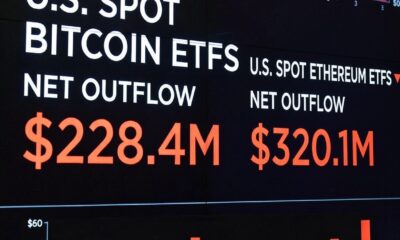
Bitcoin and Ethereum Spot ETFs Record Substantial Weekly Outflows
-

 DeFi4 weeks ago
BNB Standard Corporation
-

 DeFi4 weeks ago
Nine Crypto Firms Launch Quantum Alliance to Set Post-Quantum Standards
-

 DeFi4 weeks ago
Swiss FINMA Approves First Retail Bitcoin ETF Holding BTC Directly
-

 Crypto3 weeks ago
DTCC Launches Tokenization Service Covering Approximately $30 Trillion in Securities
-

 DeFi1 month ago
Inflation Shock Triggers Nearly $1 Billion in Liquidations as Bitcoin Tests $80,000
-

 DeFi3 weeks ago
Binance-Linked Transfer Triggers 347 Million LUNC Burn
-

 DeFi4 weeks ago
U.S. Spot Bitcoin ETFs Post Best Inflow Day in Nearly a Month
-

 DeFi4 weeks ago
World Liberty Financial’s USD1 Stablecoin Sheds Over $400 Million in Market Cap Amid Redemptions
-

 DeFi4 weeks ago
Strive Discloses Additional Bitcoin Purchases, Holdings Reach 36,818 BTC
-

 DeFi4 weeks ago
Crypto Hacks and Losses Reach $1.18 Billion in Q3 2026 Across 107 Incidents
-

 Crypto3 weeks ago
Memecoin PEPE Rallies on Reported Large Holdings Linked to Justin Sun; Broader Tokenization Debate Continues
-

 DeFi3 weeks ago
Crypto Liquidations Surge Past $400 Million in Hours as Bitcoin Briefly Dips Below $80,000
-

 DeFi3 weeks ago
Ripple Secures Final OCC Approval for National Trust Bank to Oversee RLUSD
-

 Bitcoin3 weeks ago
Federal Reserve Holds Rates Steady as Bitcoin Trades Near $80,000; December Hike Odds Rise
-

 DeFi4 weeks ago
Bitcoin Slides Below $81,500 as Tech Sell-Off and Elevated Oil Prices Hit Risk Assets
-

 DeFi1 month ago
Bitcoin Drops Below $81,000 as Hotter U.S. CPI Revives Rate-Hike Fears and Asian Equities Tumble
-
DeFi6 days ago
Bitcoin Tests $75,200 Support
-

 DeFi4 weeks ago
Mt. Gox Extends Creditor Repayment Deadline to October 2027
-

 DeFi4 weeks ago
Strive Adds $335 Million in Bitcoin to Corporate Treasury
-

 DeFi4 weeks ago
JPMorgan Expands JPM Coin Deposit Token to Ethereum Mainnet for Institutional Clients
-

 DeFi4 weeks ago
Circle Targets 40 Emerging Markets
-

 DeFi3 weeks ago
Stablecoin Issuers and Partners Freeze Billions Linked to Binance Incident
-

 DeFi4 weeks ago
Strategy Adds 267 Bitcoin for $22.1 Million, Bringing Holdings to 848,517 BTC
-

 Crypto3 weeks ago
Hyperliquid Permanently Burns Nearly 5% of Maximum HYPE Supply Amid Broader Token Burn Trends
-
DeFi2 weeks ago
Bitcoin Rebounds Past $80,000 as Midterms Conclude and Markets Digest Binance Hack Details
-

 DeFi4 weeks ago
BlackRock Files for “Buffer” Bitcoin ETF (Ticker: PBIT)
-

 DeFi3 weeks ago
Moody’s Assigns Investment-Grade A2 Rating to Ripple’s RLUSD; Coinbase Lists the Stablecoin
-
DeFi2 weeks ago
Bitcoin Dips to Multi-Week Lows Near $75,200 Before Recovering Above $76,000
-

 DeFi4 weeks ago
Mastercard Advances AI Agent Payments
-
DeFi1 week ago
Bitcoin Crashes Toward $75K
-
DeFi2 weeks ago
Bitcoin Falls Below $77,000 as Chip Stocks Sell Off Ahead of U.S. Midterms
-

 DeFi4 weeks ago
JPMorgan
-

 DeFi2 weeks ago
U.S. Spot Bitcoin ETFs See Multi-Hundred-Million Outflows as Post-Hack Caution Weighs