DeFi
Ethereum’s Sandwich Bot Exploit Highlights DeFi Security Risks


In a striking incident that underscores ongoing security challenges in decentralized finance (DeFi), Ethereum’s largest “sandwich” trading bot was drained of approximately $7.5 million. The attacker reportedly tricked the bot into granting approvals, allowing the siphoning of significant amounts of WETH, USDC, and USDT.
Security firm Blockaid reported the exploit, which highlights persistent vulnerabilities in smart contract interactions and the complex mechanics of automated trading bots on Ethereum.
How the Exploit Unfolded
Sandwich bots are designed to profit from front-running and back-running user transactions on decentralized exchanges. Ironically, this sophisticated tool became the target of a sophisticated attack itself. The incident serves as a reminder that even advanced DeFi infrastructure can be susceptible to approval-based exploits if smart contract permissions are not rigorously managed.
Market Reaction and Ethereum’s Resilience
Despite the high-profile security incident, Ethereum (ETH) showed relative stability, trading in the range of $1,700–$1,735. The limited immediate price impact suggests that broader market participants are increasingly distinguishing between isolated smart contract risks and the network’s overall fundamentals.
Analysts continue to monitor key technical levels, with many remaining constructive on Ethereum’s longer-term outlook. Potential upside targets around $4,600 are frequently cited, supported by ongoing network upgrades, growing Layer-2 activity, and increasing institutional engagement.
Broader Implications for DeFi Security
This exploit adds to a series of incidents that highlight the need for stronger security practices across the DeFi ecosystem:
- Rigorous auditing of smart contracts and approval mechanisms.
- Improved user and developer education around permission management.
- Adoption of advanced security tools and monitoring solutions like those offered by firms such as Blockaid.
As DeFi matures, security remains one of the most critical factors for mainstream adoption. Incidents like this, while damaging in the short term, often accelerate industry-wide improvements in infrastructure and best practices.
Conclusion
The $7.5 million drain of Ethereum’s largest sandwich bot serves as a stark reminder of DeFi’s evolving security landscape. While the exploit caused losses for the bot operator, Ethereum’s price resilience points to growing confidence in the network’s fundamentals.
Moving forward, the industry must prioritize robust security measures to protect users and infrastructure. For Ethereum, continued development of Layer-2 solutions and protocol upgrades will be key to maintaining its position as the leading smart contract platform while addressing these persistent risks.

The content on CoinReporter.io is for informational purposes only and is not financial or investment advice. Cryptocurrency investments are highly volatile and risky. Always conduct your own research and consult a qualified financial advisor before making any investment decisions. CoinReporter.io and its authors are not liable for any losses resulting from actions based on this website’s content.


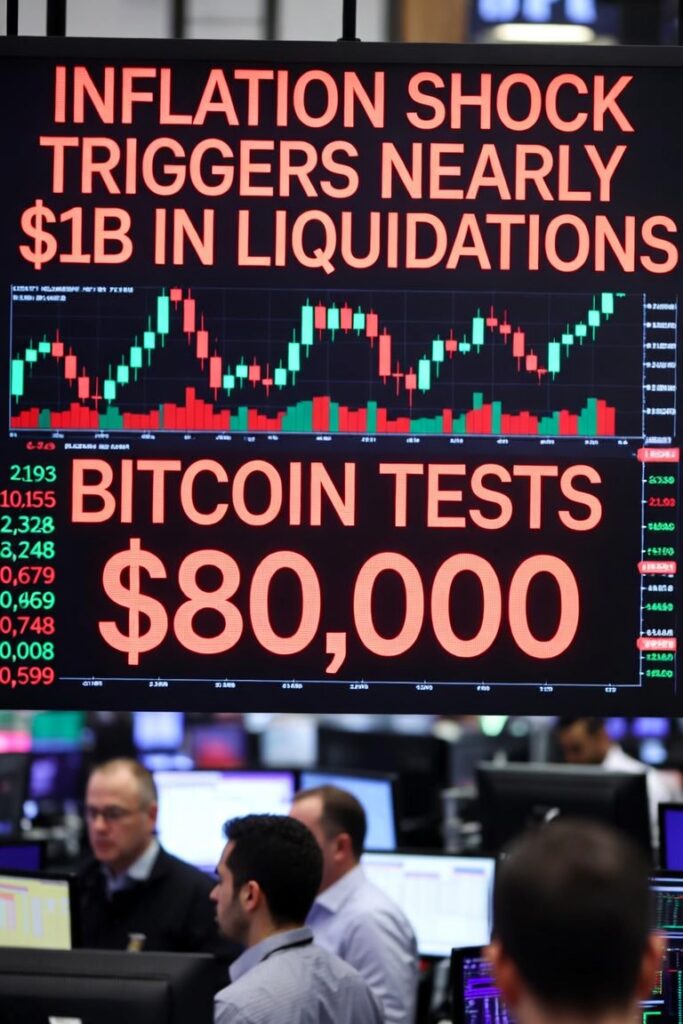
Hotter-than-expected U.S. inflation data rattled risk assets on October 15, 2026. September CPI rose 3.7% year-over-year, above the 3.6% forecast and up from 3.4% in August, while core CPI firmed to 2.6%. The following day’s Producer Price Index for final demand jumped 1.3% month-over-month—the largest monthly advance since March 2022—and 6.3% annually, well above expectations near 0.5% monthly and roughly 5.4% yearly. Energy costs drove much of the PPI spike.
Bitcoin briefly fell near or below $80,000 during Asian trading hours, with lows reported around $80,210–$80,500 in various snapshots, before buyers stepped in. It recovered to trade near $82,000–$82,400 later in the session. On the CoinMarketCap October 15 snapshot, BTC printed around $82,141 with a modest daily gain after the dip, and a market capitalization near $1.65 trillion. Ethereum underperformed, dipping below $2,400 before recovering toward $2,440. Broader altcoins and indices such as the CoinDesk 80 fell harder amid the risk-off move.
Nearly $1 billion in leveraged crypto positions were liquidated over 24 hours, with figures ranging from roughly $937 million to $977 million across reports. Long positions accounted for the vast majority (around 85–91%), and Ethereum led the wipeout with roughly $280–$290 million in liquidations, followed by Bitcoin near $200 million. More than 170,000 traders were affected. The cascade reflected crowded long positioning into the data releases and correlated selling in equities, including declines in the Nasdaq and S&P 500, while Asian markets such as South Korea’s Kospi saw sharp drops.
Analysts noted that the inflation prints revived “higher-for-longer” rate concerns and increased odds of a Federal Reserve hike at the late-October meeting. Bitcoin’s correlation with risk assets remained elevated, and the move pushed the cryptocurrency briefly below the approximate average cost basis of U.S. spot ETF holders near $81,500–$82,300. By the evening of October 15 and into October 16, majors stabilized or edged higher as yields eased and dip-buying emerged, with trading volume rising significantly.
The episode underscores crypto’s ongoing sensitivity to macro data even as institutional adoption advances. Support near the early-October lows held for Bitcoin, but further inflation or labor-market surprises remain key risks ahead of the Fed’s October 27–28 decision window.


Inflation Shock Triggers Nearly $1 Billion in Liquidations as Bitcoin Tests $80,000
Hotter-than-expected U.S. inflation data rattled risk assets on October 15, 2026. September CPI rose 3.7% year-over-year, above the 3.6% forecast...


Bitcoin Drops Below $81,000 as Hotter U.S. CPI Revives Rate-Hike Fears and Asian Equities Tumble
Bitcoin fell sharply below $81,000 in early Asian trading on October 15, 2026, extending losses after a hotter-than-expected U.S. September...


U.S. Spot Bitcoin and Ethereum ETFs See Significant Weekly Outflows
U.S.-listed spot Bitcoin ETFs recorded roughly $681 million in net outflows over the trading week of October 5–9, 2026—the largest...


Binance Rolls Out AI Trading Interface Globally After 150,000-User Beta
Binance launched its free Binance AI personalized trading interface to all English-language users on October 12, 2026, following a beta...


Ethereum Foundation-Linked Wallets Transfer 4,393 ETH (~$11 Million) to Kraken
On October 12, 2026, two wallets historically linked to the Ethereum Foundation transferred a combined 4,393 ETH—valued at approximately $11.13...

TRON Q3 2026 Report: $2.21 Trillion in Stablecoin Settlement Volume
TRON’s State of TRON Q3 2026 report, released in mid-October, highlighted $2.21 trillion (precisely $2.2126 trillion) in stablecoin settlement volume...


South Korea Blocks Domestic Access to 27 Unregistered Crypto Exchange Websites, Including KuCoin and MEXC
South Korea’s Financial Intelligence Unit (FIU), under the Financial Services Commission, announced on October 13, 2026, that domestic access would...


Bitcoin Drops Below $82,000 Amid $770M+ in Liquidations as Volatility Spikes
Bitcoin fell sharply on October 12, 2026, sliding below $82,000 and triggering more than $770 million in cryptocurrency liquidations, the...


Bitcoin Holds Above $84,000, Shrugging Off Heavy ETF Outflows as Oil Declines
Bitcoin rebounded to trade near or above $84,000 on Monday, October 12, 2026, recovering from earlier dips toward the low...


ESMA gives EU crypto firms three months to exit non-MiCA stablecoins
The European Securities and Markets Authority on 8 October told national supervisors that MiCA-authorised crypto firms should stop providing services...
-

 DeFi4 weeks ago
Bitcoin Reclaims $81,000 and Closes Above Key 50-Week Moving Average
-

 DeFi2 weeks ago
Hong Kong Moves Licensed Stablecoins Onto Exchanges and Into Fund Settlement
-
Crypto1 week ago
ESMA gives EU crypto firms three months to exit non-MiCA stablecoins
-

 DeFi3 weeks ago
Coinbase Adds Fixed-Rate Bitcoin-Backed Loans via Morpho Midnight
-

 Crypto2 weeks ago
Binance Burns 334.88 Million LUNC in October Fee Batch as Second Transaction Lifts the Day’s Total
-

 Bitcoin1 week ago
SEC clears listing path for first U.S. 3x Bitcoin and Ether ETFs
-

 DeFi2 weeks ago
Robinhood Puts Hedge-Fund Tools in the App as Macro Turns Softer
-

 DeFi2 weeks ago
TOKEN2049 Opens in Singapore Next Week as the City Leads Regional Crypto Flow
-

 DeFi1 month ago
Senate Rejects CLARITY Act Cloture in 49-50 Vote, Dealing Major Blow to U.S. Crypto Market Structure
-

 DeFi2 weeks ago
HSBC Names Its Hong Kong Stablecoin RedCoin, and Starts With PayMe
-

 DeFi3 weeks ago
Solana Advances Alpenglow Upgrade to Public Testnet
-

 Bitcoin2 weeks ago
Strategy Adds Another 1,665 BTC, Lifting Holdings to 847,666
-

 DeFi4 weeks ago
CFTC Submits Crypto Market Rules to White House Amid Congressional Stall
-
 DeFi3 weeks ago
Bitcoin Surges Above $87,000 as Crypto Market Cap Reclaims $3 Trillion
-

 DeFi2 weeks ago
South Korea Ranks Second in On-Chain Crypto Holdings as the Tax Date Holds
-

 DeFi3 weeks ago
Bitcoin Surges Above $87,000 on ETF Inflows and Massive Short Squeeze
-

 Bitcoin1 week ago
Bitcoin breaks under $84,000 as oil spikes on Hormuz tanker attacks
-

 Bitcoin3 weeks ago
Record ETF Inflows and a Short Squeeze Drive Bitcoin’s $87,000 Break
-

 Bitcoin2 weeks ago
Coinbase Receives CFTC Approval for U.S. Derivatives Clearinghouse
-

 Bitcoin3 weeks ago
X Partners With Coinbase, Kraken, Gemini and Brokers to Trade From the Timeline
-

 Crypto1 week ago
Treasury and FinCEN drop unhosted-wallet and mixer surveillance proposals
-

 DeFi1 month ago
Senate Republicans Release “Final” CLARITY Act Draft Ahead of September 15 Cloture Vote
-

 DeFi2 weeks ago
BTSE Receives a Full Licence to Trade and Custody Crypto in Bhutan
-

 DeFi4 weeks ago
SEC Opens Pathway for Tokenized U.S. Equities After Legislative Setback
-
DeFi3 days ago
Bitcoin Drops Below $82,000 Amid $770M+ in Liquidations as Volatility Spikes
-

 Bitcoin3 weeks ago
Strategy Resumes Bitcoin Buying, Adds 950 BTC
-

 DeFi4 weeks ago
Circle Launches Arc Mainnet with Institutional Validators Including BlackRock and Visa
-

 Bitcoin1 month ago
Metaplanet Reverses Course, Erasing ~$220 Million in Warrant Value
-

 DeFi1 week ago
Government-linked wallets move seized coins
-

 DeFi4 weeks ago
Crypto Market Suffers Broad Decline; Bitcoin Briefly Drops Below $75,000 Before Stabilizing
-

 DeFi4 weeks ago
Avalanche Gains on NYSE Tokenization Testing Reports
-

 Crypto1 week ago
CFTC opens Regulation CTX and CAM after Clarity Act stalls
-

 DeFi4 weeks ago
Federal Reserve
-

 Bitcoin1 month ago
Bitcoin Spot ETFs Record $463 Million in Outflows
-

 Bitcoin4 weeks ago
Institutional Crypto Infrastructure Advances: Deutsche Bank Custody and Related Moves
-

 DeFi1 month ago
Crypto Markets Slide as Clarity Failure, Rising Yields and Oil Prices Weigh; Bitcoin Briefly Tests Below $75,000