Crypto
Global Crypto Policy Momentum Builds Under Pro-Innovation Tone


Regulatory tailwinds are strengthening across major jurisdictions in mid-2026, as governments shift from cautious experimentation to structured integration of digital assets into traditional finance. A pro-innovation stance — particularly in the United States — is setting the pace, with clear frameworks reducing uncertainty and encouraging institutional participation.
United States: CLARITY Act and Stablecoin Progress
The Trump administration continues to prioritize digital asset growth. Following the signing of the GENIUS Act in 2025 — which established a federal framework for payment stablecoins with full reserves, redemption rights, and prudential standards — attention has turned to broader market structure reform.
The Digital Asset Market Clarity Act (CLARITY Act), which passed the House in 2025, is advancing in the Senate. The bill aims to delineate jurisdiction between the SEC (for digital securities) and CFTC (for digital commodities), introduce a “mature blockchain test,” protect self-custody, and provide legal certainty for decentralized finance and tokenized assets. Recent bipartisan negotiations have addressed stablecoin yield provisions, with compromises allowing certain rewards while protecting traditional banking.
Prediction markets, such as Polymarket and Kalshi, currently price the odds of the CLARITY Act becoming law in 2026 at around 60–65%, reflecting optimism tempered by midterm election dynamics.
Complementing legislative efforts, the administration’s recent executive order on payment rails review signals further openness for crypto and fintech firms to access Fed systems like FedNow and Fedwire.
International Developments Reinforce Momentum
Japan is advancing its stablecoin framework. On May 19, 2026, the Financial Services Agency finalized rules allowing qualifying foreign-issued trust-type stablecoins into its payment system effective June 1, 2026. This “reverse CLARITY” approach applies strict equivalence standards on reserves, audits, and AML, enabling seamless cross-border integration while maintaining high safeguards.
Other jurisdictions are also executing:
- Hong Kong’s stablecoin licensing regime is operational.
- Singapore continues expanding its institutional and stablecoin infrastructure.
- The EU’s MiCA framework is in full enforcement mode.
- Australia, South Korea, Thailand, and Vietnam are rolling out comprehensive digital asset rules.
PwC’s 2026 Global Crypto Regulation Report describes the current year as the transition “from drafts to reality,” with enforcement, tokenization, and compliance becoming central themes.
Analysis: Clarity Drives Institutional Adoption
Policy momentum is a powerful catalyst. Regulatory clarity directly reduces compliance risk and legal uncertainty — historically two of the biggest barriers to large-scale institutional entry. With clearer rules on custody, stablecoins, market structure, and taxation emerging globally, banks, asset managers, and corporates are increasingly allocating to digital assets and building on-chain infrastructure.
Markets are pricing in long-term upside. Bitcoin and broader crypto valuations reflect expectations of deeper liquidity, tokenized real-world assets, and programmable finance. However, near-term volatility remains influenced by macroeconomic factors — interest rate trajectories, geopolitical tensions, and traditional risk sentiment.
Looking Ahead
2026 is shaping up as a pivotal year of execution rather than announcement. Success in passing the CLARITY Act in the U.S., combined with operational rollout of stablecoin and derivatives frameworks in Asia, could accelerate mainstream integration and position regulated crypto as core financial infrastructure.
While challenges such as enforcement capacity, cross-border harmonization, and political cycles persist, the dominant global tone is one of pragmatic innovation. For the industry, the message is clear: the regulatory environment is evolving from constraint to enabler, paving the way for sustained institutional growth in the years ahead.

The content on CoinReporter.io is for informational purposes only and is not financial or investment advice. Cryptocurrency investments are highly volatile and risky. Always conduct your own research and consult a qualified financial advisor before making any investment decisions. CoinReporter.io and its authors are not liable for any losses resulting from actions based on this website’s content.




The post ChangeNOW Announces NOW AI After Resolving Website Integration Vulnerability appeared first on Coinpedia Fintech News
On October 15, with the help of independent security researchers, we found a vulnerability affecting one of the integrations used on the ChangeNOW website. The vulnerability has now been fixed. We currently have no evidence that it was exploited. But we also can’t assume that the researchers who reported it were the only ones to …


Inflation Shock Triggers Nearly $1 Billion in Liquidations as Bitcoin Tests $80,000
Hotter-than-expected U.S. inflation data rattled risk assets on October 15, 2026. September CPI rose 3.7% year-over-year, above the 3.6% forecast...


Bitcoin Drops Below $81,000 as Hotter U.S. CPI Revives Rate-Hike Fears and Asian Equities Tumble
Bitcoin fell sharply below $81,000 in early Asian trading on October 15, 2026, extending losses after a hotter-than-expected U.S. September...


U.S. Spot Bitcoin and Ethereum ETFs See Significant Weekly Outflows
U.S.-listed spot Bitcoin ETFs recorded roughly $681 million in net outflows over the trading week of October 5–9, 2026—the largest...


Binance Rolls Out AI Trading Interface Globally After 150,000-User Beta
Binance launched its free Binance AI personalized trading interface to all English-language users on October 12, 2026, following a beta...


Ethereum Foundation-Linked Wallets Transfer 4,393 ETH (~$11 Million) to Kraken
On October 12, 2026, two wallets historically linked to the Ethereum Foundation transferred a combined 4,393 ETH—valued at approximately $11.13...
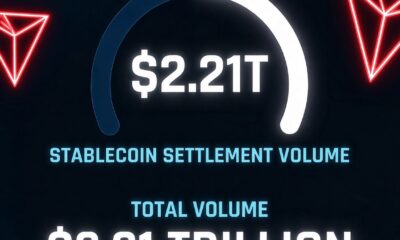

TRON Q3 2026 Report: $2.21 Trillion in Stablecoin Settlement Volume
TRON’s State of TRON Q3 2026 report, released in mid-October, highlighted $2.21 trillion (precisely $2.2126 trillion) in stablecoin settlement volume...


South Korea Blocks Domestic Access to 27 Unregistered Crypto Exchange Websites, Including KuCoin and MEXC
South Korea’s Financial Intelligence Unit (FIU), under the Financial Services Commission, announced on October 13, 2026, that domestic access would...


Bitcoin Drops Below $82,000 Amid $770M+ in Liquidations as Volatility Spikes
Bitcoin fell sharply on October 12, 2026, sliding below $82,000 and triggering more than $770 million in cryptocurrency liquidations, the...


Bitcoin Holds Above $84,000, Shrugging Off Heavy ETF Outflows as Oil Declines
Bitcoin rebounded to trade near or above $84,000 on Monday, October 12, 2026, recovering from earlier dips toward the low...


ESMA gives EU crypto firms three months to exit non-MiCA stablecoins
The European Securities and Markets Authority on 8 October told national supervisors that MiCA-authorised crypto firms should stop providing services...
-

 DeFi4 weeks ago
Bitcoin Reclaims $81,000 and Closes Above Key 50-Week Moving Average
-

 DeFi2 weeks ago
Hong Kong Moves Licensed Stablecoins Onto Exchanges and Into Fund Settlement
-
Crypto1 week ago
ESMA gives EU crypto firms three months to exit non-MiCA stablecoins
-

 DeFi3 weeks ago
Coinbase Adds Fixed-Rate Bitcoin-Backed Loans via Morpho Midnight
-

 Crypto2 weeks ago
Binance Burns 334.88 Million LUNC in October Fee Batch as Second Transaction Lifts the Day’s Total
-

 Bitcoin1 week ago
SEC clears listing path for first U.S. 3x Bitcoin and Ether ETFs
-

 DeFi2 weeks ago
Robinhood Puts Hedge-Fund Tools in the App as Macro Turns Softer
-

 DeFi2 weeks ago
TOKEN2049 Opens in Singapore Next Week as the City Leads Regional Crypto Flow
-

 DeFi1 month ago
Senate Rejects CLARITY Act Cloture in 49-50 Vote, Dealing Major Blow to U.S. Crypto Market Structure
-

 DeFi2 weeks ago
HSBC Names Its Hong Kong Stablecoin RedCoin, and Starts With PayMe
-

 DeFi3 weeks ago
Solana Advances Alpenglow Upgrade to Public Testnet
-

 Bitcoin2 weeks ago
Strategy Adds Another 1,665 BTC, Lifting Holdings to 847,666
-
 DeFi4 weeks ago
CFTC Submits Crypto Market Rules to White House Amid Congressional Stall
-
 DeFi3 weeks ago
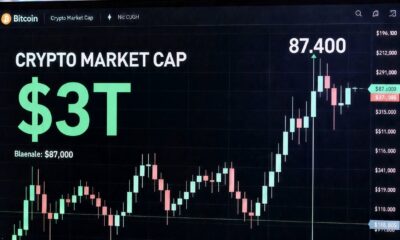
Bitcoin Surges Above $87,000 as Crypto Market Cap Reclaims $3 Trillion
-

 DeFi2 weeks ago
South Korea Ranks Second in On-Chain Crypto Holdings as the Tax Date Holds
-

 DeFi3 weeks ago
Bitcoin Surges Above $87,000 on ETF Inflows and Massive Short Squeeze
-

 Bitcoin1 week ago
Bitcoin breaks under $84,000 as oil spikes on Hormuz tanker attacks
-

 Bitcoin3 weeks ago
Record ETF Inflows and a Short Squeeze Drive Bitcoin’s $87,000 Break
-

 Bitcoin2 weeks ago
Coinbase Receives CFTC Approval for U.S. Derivatives Clearinghouse
-

 Bitcoin3 weeks ago
X Partners With Coinbase, Kraken, Gemini and Brokers to Trade From the Timeline
-

 Crypto1 week ago
Treasury and FinCEN drop unhosted-wallet and mixer surveillance proposals
-

 DeFi1 month ago
Senate Republicans Release “Final” CLARITY Act Draft Ahead of September 15 Cloture Vote
-

 DeFi2 weeks ago
BTSE Receives a Full Licence to Trade and Custody Crypto in Bhutan
-

 DeFi4 weeks ago
SEC Opens Pathway for Tokenized U.S. Equities After Legislative Setback
-
DeFi4 days ago
Bitcoin Drops Below $82,000 Amid $770M+ in Liquidations as Volatility Spikes
-

 Bitcoin3 weeks ago
Strategy Resumes Bitcoin Buying, Adds 950 BTC
-

 DeFi4 weeks ago
Circle Launches Arc Mainnet with Institutional Validators Including BlackRock and Visa
-

 Bitcoin1 month ago
Metaplanet Reverses Course, Erasing ~$220 Million in Warrant Value
-

 DeFi1 week ago
Government-linked wallets move seized coins
-

 DeFi4 weeks ago
Crypto Market Suffers Broad Decline; Bitcoin Briefly Drops Below $75,000 Before Stabilizing
-

 DeFi4 weeks ago
Avalanche Gains on NYSE Tokenization Testing Reports
-
 Crypto1 week ago
CFTC opens Regulation CTX and CAM after Clarity Act stalls
-

 DeFi4 weeks ago
Federal Reserve
-

 Bitcoin4 weeks ago
Institutional Crypto Infrastructure Advances: Deutsche Bank Custody and Related Moves
-

 Bitcoin1 month ago
Bitcoin Spot ETFs Record $463 Million in Outflows
-
DeFi4 days ago
Bitcoin Holds Above $84,000, Shrugging Off Heavy ETF Outflows as Oil Declines