DeFi
Ripple Expands RLUSD to Six New African Corridors via Local Bank Partnerships


Ripple has significantly expanded the footprint of its USD-pegged stablecoin RLUSD across Africa, integrating the asset into payment rails in six key markets: Nigeria, Kenya, Ghana, South Africa, Egypt, and Morocco. The expansion was enabled through strategic partnerships with six licensed local banking and payment institutions, allowing RLUSD to serve as a fast, low-cost bridge for cross-border remittances, B2B settlements, and treasury operations in some of the continent’s highest-volume corridors.
Under the agreements, the partner banks now offer RLUSD on/off-ramps directly to their customers, enabling instant conversion between local fiat currencies and the stablecoin. Transactions settle on the XRP Ledger (XRPL) in 3–5 seconds with fees typically below $0.01, providing a compelling alternative to traditional correspondent banking rails that often take 1–5 business days and charge 5–8% in combined fees. RLUSD’s 1:1 backing by U.S. Treasuries, cash equivalents, and other high-quality liquid assets—combined with monthly independent attestations and on-chain proof-of-reserve—meets the compliance and transparency requirements of African regulators and institutional users.
The six banking partners include leading players in each market, many of whom already utilize RippleNet or On-Demand Liquidity (ODL) for XRP-based settlement. By layering RLUSD on top of existing infrastructure, the partnerships create a hybrid model: XRP for ultra-fast, low-cost bridging of liquidity between fiat corridors, and RLUSD for stable, predictable value storage and final payouts.
Early results have been striking. Monthly transfer volume denominated in RLUSD across the six corridors jumped 57% within the first month of expanded availability, driven by both retail remittances and increasing B2B usage. Remittance corridors such as Nigeria–U.S., Kenya–U.K., and Ghana–U.S. showed particularly strong uptake, where cost savings and speed translate directly to higher disposable income for recipients.
Corresponding liquidity pools on the XRP Ledger—especially XRP/RLUSD and RLUSD/local stablecoin pairs—saw substantial depth increases, with tighter spreads and higher total value locked. The improved on-chain liquidity reduces slippage for large transfers and strengthens RLUSD’s utility as a settlement layer for enterprise and institutional flows.
Ripple executives described the expansion as a natural extension of the company’s long-standing focus on emerging markets. “Africa represents one of the world’s largest and fastest-growing remittance corridors,” said a Ripple spokesperson. “By partnering with trusted local banks and offering RLUSD as a stable, programmable dollar alternative, we’re delivering real economic impact—lower costs, faster access, and greater inclusion.”
The move aligns with broader momentum for Ripple and XRPL in Africa. Recent partnerships with central banks (e.g., Chainlink’s oracle collaboration with the Central Bank of Kenya), growing adoption of XRP for cross-border payments, and the recent activation of the native AMM with $420 million in seeded liquidity have all contributed to rising ecosystem activity on the continent.
XRP has maintained positive momentum in recent sessions, supported by increased on-chain volume, deeper liquidity pools, and broader institutional interest in Ripple’s infrastructure. The African corridor expansion further strengthens the case for XRP and RLUSD as foundational tools for modernizing international payments in high-growth regions.
Cryptocurrency markets remain highly volatile—volumes, liquidity, and adoption trends can shift rapidly based on regulatory developments, partner integrations, and macro conditions. Always verify the latest RLUSD metrics, corridor volumes, and XRPL data from official Ripple announcements (ripple.com), XRPL explorers (xrpscan.com), or trusted trackers such as CoinMarketCap and CoinGecko before transacting or investing.

The content on CoinReporter.io is for informational purposes only and is not financial or investment advice. Cryptocurrency investments are highly volatile and risky. Always conduct your own research and consult a qualified financial advisor before making any investment decisions. CoinReporter.io and its authors are not liable for any losses resulting from actions based on this website’s content.
























- U.S. spot bitcoin ETFs lost a net $68.6 million on Monday, excluding BlackRock’s IBIT, extending their outflow streak to eight trading days, Farside data show.
- About $2 billion in crypto positions were liquidated over the weekend as bitcoin fell to roughly $62,100, its lowest since July.
- Traders are watching Nvidia’s quarterly results on Tuesday and minutes of the Fed’s October meeting on Wednesday.
U.S. spot bitcoin exchange-traded funds recorded net outflows of $68.6 million on Monday, according to data from Farside Investors, extending their losing streak to eight straight trading days. The figure does not yet include BlackRock’s iShares Bitcoin Trust (IBIT), the largest fund, which had not reported its flows.
Grayscale’s GBTC led Monday’s withdrawals with $34.6 million, followed by Fidelity’s FBTC with $11.3 million. The streak began on Nov. 5, and the funds lost $1.91 billion over the first seven sessions alone, with IBIT accounting for $143.5 million of Friday’s $185.4 million outflow, Farside data show.
Spot ether ETFs were also slightly negative. They lost a net $8.4 million on Monday, excluding two funds, including BlackRock’s ETHA, that had not yet reported, according to Farside. Ether funds had already posted seven straight weeks of outflows, as the selling spread beyond bitcoin.
Weekend Liquidations and the $60,000 Line
The outflows followed a sharp weekend sell-off. Bitcoin fell to around $62,100 on Sunday, its lowest since July 14, as roughly $2 billion of crypto derivatives positions were forcibly closed, mostly bets on rising prices, Decrypt reported. It marked a sixth straight weekly loss for the cryptocurrency.
Market makers see more risk ahead. “This is a rates tape in which bitcoin is the non-yielding funding leg, the ETF bid is gone and the technicals have broken,” Wintermute’s OTC desk said, according to CoinDesk. The desk expects pressure into the $50,000s, with $62,000 and $60,000 the next levels to watch.
Rates are a large part of that view. Markets are pricing roughly a 92% chance of a Federal Reserve rate hike in December, and the 10-year Treasury yield has climbed to 5.15%, Wintermute said. Higher yields make assets that pay no interest, such as bitcoin, less attractive to investors.
Technical signals point both ways. Bitcoin’s daily Relative Strength Index sat near 24, in oversold territory, Decrypt said, while the trend indicator remained bearish. A recovery would face resistance around $66,500 to $67,200 and then near $69,300, while a decisive break below $62,000 would put $60,000 back in focus.
Nvidia reports results on Tuesday, its first since Jensen Huang stepped down as chief executive. “AI and crypto draw on the same pool of risk capital, so when Nvidia sells off the money goes to cash, not into bitcoin,” Nansen analyst Nicolai Søndergaard told CoinDesk, warning that weak earnings could push bitcoin below $60,000.
Wintermute said it would turn less defensive if bitcoin reclaimed its 200-week moving average near $68,000 alongside renewed ETF inflows. Deribit data show more than $800 million in open $60,000 puts, much of it expiring in December, and a heavily watched options expiry falls on Nov. 27, Decrypt reported.
As of 06:59 UTC on Nov. 17, bitcoin traded at $64,511, down 0.3% over 24 hours, and ether at $1,824.76, up 0.5%, according to CoinGecko. Minutes of the Fed’s October meeting are due on Wednesday, Nov. 18.


Bitcoin ETFs Extend Outflow Streak to Eight Days as Traders Brace for Nvidia Earnings
U.S. spot bitcoin exchange-traded funds recorded net outflows of $68.6 million on Monday, according to data from Farside Investors, extending...


Aster CEO Blames Likely Malicious Liquidations as ASTER Token Plunges 32% in Minutes
Key takeaways Aster chief executive Leonard Leung said the team is investigating after the ASTER token jumped above $0.71 and...


Coinone Warns of Phishing After Breach at Support Contractor Exposes 11 Data Types
Key takeaways South Korean crypto exchange Coinone has warned customers about phishing and identity theft after an attacker breached MetaM,...


Bitcoin Tests $75,200 Support
Total crypto market capitalization hovered near $2.50–2.54 trillion on November 9, 2026. Bitcoin dominance remained elevated at roughly 59–60%. The...


Bitcoin Slips Toward $74,600
Bitcoin traded in a tight range near $75,000–$76,000 for much of November 8 before settling lower, closing the CoinMarketCap snapshot...


Bitcoin Crashes Toward $75K
Bitcoin closed November 6 near $75,900 after an intense sell-off that pushed it as low as roughly $74,800 intraday—its weakest...


Crypto Market Stabilizes After Sharp Dip
Bitcoin recovered from multi-week lows near $75,200 and stabilized above $76,000 on November 6, 2026, as the market absorbed a...


Elizabeth Warren Expected to Chair Senate Banking Committee After Democratic Midterm Sweep
Longtime crypto critic Senator Elizabeth Warren is positioned to lead the powerful Senate Banking Committee when the new Congress convenes...


Bitcoin Dips to Multi-Week Lows Near $75,200 Before Recovering Above $76,000
Bitcoin briefly tumbled below $76,000 on November 6, 2026, reaching multi-week lows near $75,200 before buyers stepped in and the...


Bitcoin Rebounds Past $80,000 as Midterms Conclude and Markets Digest Binance Hack Details
Bitcoin staged a sharp V-shaped recovery on November 4, reclaiming $80,000 after briefly touching a seven-week low near $75,600–$75,700. The...
-

 DeFi3 weeks ago
LUNC Hits 462B Burned After v4.1.1 Upgrade
-
 DeFi1 month ago
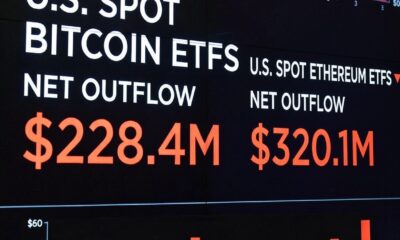
Bitcoin and Ethereum Spot ETFs Record Substantial Weekly Outflows
-

 DeFi4 weeks ago
Arbitrum Rallies on Stablecoin Growth Program as DeFi Tokens Outperform
-

 DeFi4 weeks ago
BNB Standard Corporation
-

 DeFi1 month ago
Nine Crypto Firms Launch Quantum Alliance to Set Post-Quantum Standards
-

 Crypto3 weeks ago
DTCC Launches Tokenization Service Covering Approximately $30 Trillion in Securities
-

 DeFi4 weeks ago
Binance-Linked Transfer Triggers 347 Million LUNC Burn
-
 DeFi4 weeks ago
Swiss FINMA Approves First Retail Bitcoin ETF Holding BTC Directly
-

 DeFi4 weeks ago
U.S. Spot Bitcoin ETFs Post Best Inflow Day in Nearly a Month
-

 DeFi4 weeks ago
World Liberty Financial’s USD1 Stablecoin Sheds Over $400 Million in Market Cap Amid Redemptions
-

 DeFi4 weeks ago
Strive Discloses Additional Bitcoin Purchases, Holdings Reach 36,818 BTC
-

 Crypto3 weeks ago
Memecoin PEPE Rallies on Reported Large Holdings Linked to Justin Sun; Broader Tokenization Debate Continues
-

 DeFi3 weeks ago
Ripple Secures Final OCC Approval for National Trust Bank to Oversee RLUSD
-

 DeFi4 weeks ago
Crypto Hacks and Losses Reach $1.18 Billion in Q3 2026 Across 107 Incidents
-

 Bitcoin3 weeks ago
Federal Reserve Holds Rates Steady as Bitcoin Trades Near $80,000; December Hike Odds Rise
-

 DeFi4 weeks ago
Crypto Liquidations Surge Past $400 Million in Hours as Bitcoin Briefly Dips Below $80,000
-

 Crypto3 days ago
Ether ETFs Lose $399 Million for Seventh Straight Week, Nearing Record Outflow Streak
-

 DeFi4 weeks ago
Bitcoin Slides Below $81,500 as Tech Sell-Off and Elevated Oil Prices Hit Risk Assets
-
DeFi1 week ago
Bitcoin Tests $75,200 Support
-

 DeFi4 weeks ago
Mt. Gox Extends Creditor Repayment Deadline to October 2027
-

 DeFi4 weeks ago
JPMorgan Expands JPM Coin Deposit Token to Ethereum Mainnet for Institutional Clients
-

 DeFi4 weeks ago
Strive Adds $335 Million in Bitcoin to Corporate Treasury
-

 DeFi1 month ago
Circle Targets 40 Emerging Markets
-

 DeFi3 weeks ago
Stablecoin Issuers and Partners Freeze Billions Linked to Binance Incident
-

 Crypto3 weeks ago
Hyperliquid Permanently Burns Nearly 5% of Maximum HYPE Supply Amid Broader Token Burn Trends
-
DeFi2 weeks ago
Bitcoin Rebounds Past $80,000 as Midterms Conclude and Markets Digest Binance Hack Details
-

 DeFi4 weeks ago
Strategy Adds 267 Bitcoin for $22.1 Million, Bringing Holdings to 848,517 BTC
-
Bitcoin2 days ago
Bitcoin ETFs Extend Outflow Streak to Eight Days as Traders Brace for Nvidia Earnings
-
DeFi2 weeks ago
Bitcoin Crashes Toward $75K
-

 DeFi4 weeks ago
BlackRock Files for “Buffer” Bitcoin ETF (Ticker: PBIT)
-

 DeFi4 weeks ago
Mastercard Advances AI Agent Payments
-

 Crypto6 days ago
DTCC Adds Solana to Tokenization Service, Targeting Second Half of 2027
-

 DeFi3 weeks ago
Moody’s Assigns Investment-Grade A2 Rating to Ripple’s RLUSD; Coinbase Lists the Stablecoin
-

 DeFi2 weeks ago
Bitcoin Falls Below $77,000 as Chip Stocks Sell Off Ahead of U.S. Midterms
-
DeFi2 weeks ago
Bitcoin Dips to Multi-Week Lows Near $75,200 Before Recovering Above $76,000
-

 Bitcoin11 hours ago
Crypto Market Analysis: Bitcoin Slips Below $63,000 as Fear Grips Traders