Bitcoin
China Expands Crackdown on Offshore Yuan Stablecoins and Tokenized Assets


China has significantly tightened its longstanding cryptocurrency restrictions with a new multi-agency directive issued on February 6, 2026, explicitly banning the unauthorized issuance of yuan-pegged (RMB-linked) stablecoins offshore and imposing strict oversight on tokenized real-world assets (RWAs) tied to onshore Chinese assets.
The joint notice — released by the People’s Bank of China (PBOC) together with seven other government bodies including the China Securities Regulatory Commission (CSRC) — reaffirms that virtual currencies (including Bitcoin and other major cryptocurrencies) have no legal tender status in China and classifies most related activities as illegal financial operations unless explicitly approved.
Key Provisions of the February 2026 Notice
- Offshore yuan stablecoins prohibited without approval
No entity or individual — domestic or foreign — may issue stablecoins pegged to the renminbi (RMB/yuan) overseas without explicit authorization from relevant authorities. This closes a potential loophole for private “shadow yuan” instruments operating outside China’s direct monetary control. - Tokenized assets under tight scrutiny
Domestic institutions and any offshore entities they control are prohibited from issuing virtual currencies or tokenized assets abroad without permission. Regulators will now strictly vet offshore tokenization projects backed by Chinese onshore assets (e.g., bonds, equities, receivables, or other real-world financial instruments). - Broader enforcement scope
The rules extend to foreign platforms and individuals offering crypto or RWA-related services to Chinese residents, reinforcing the extraterritorial reach of China’s crypto ban.
The PBOC and co-signatories cited increasing speculative activity in virtual currencies and real-world asset tokenization as creating “new challenges and situations for risk prevention and control,” particularly threats to monetary sovereignty, financial stability, and cross-border capital flow management.
Reinforcing the 2021 Ban in a Stablecoin Era
The announcement builds directly on China’s 2021 comprehensive crypto prohibition (which banned mining, trading, and most intermediary services) but goes further by addressing the explosive global growth of stablecoins and tokenized RWAs.
While stablecoins like Tether (USDT) — currently trading near $1.00 with a market capitalization of around $184–186 billion — dominate global crypto liquidity, the new rules make clear that any attempt to issue RMB-linked versions without state approval is now explicitly forbidden.
At the same time, analysts note a subtle but important nuance: the language emphasizes “without approval” rather than an outright, unconditional ban. Some observers interpret this as leaving a narrow theoretical path for compliant, state-sanctioned RMB stablecoins or tokenized products — although practically, such approval appears highly unlikely for private issuers given Beijing’s strong preference for its own digital yuan (e-CNY).
Market and Regional Implications
The move arrives amid a global crypto market downturn (total market cap ~$2.46 trillion) and could have ripple effects across Asian crypto ecosystems:
- TRON (TRX) — which has historically hosted significant USDT volume — trades around $0.2784 with a $26 billion market cap. Any reduction in offshore RMB-stablecoin experimentation could indirectly influence liquidity patterns on networks popular in Asia.
- Regional exchanges and OTC desks serving Chinese users may face renewed compliance pressure.
- Global stablecoin issuers and RWA platforms will likely avoid any RMB linkage to stay clear of enforcement risk.
The policy stands in sharp contrast to the more permissive or pro-crypto stances seen in jurisdictions such as the United States, Hong Kong, Singapore, and parts of the EU.
Dual Message: Crackdown + Controlled Innovation?
While the headline message is restrictive, some industry commentators point out that the issuance of detailed “Regulatory Guidelines for Offshore Issuance of Asset-Backed Tokenized Securities Based on Onshore Assets” (included as an annex) may indicate China is simultaneously laying groundwork for tightly controlled, state-supervised RWA tokenization in the future — potentially under the umbrella of the digital yuan ecosystem.
For now, however, the dominant signal is clear: Beijing continues to view unregulated stablecoins and tokenized assets as threats to monetary sovereignty and financial stability, and is willing to use broad enforcement tools to maintain strict control.
Investors holding or transacting in stablecoins — particularly any experimental or offshore RMB-linked products — should closely monitor compliance developments and be prepared for potential shifts in accessibility and liquidity in Asian markets.

The content on CoinReporter.io is for informational purposes only and is not financial or investment advice. Cryptocurrency investments are highly volatile and risky. Always conduct your own research and consult a qualified financial advisor before making any investment decisions. CoinReporter.io and its authors are not liable for any losses resulting from actions based on this website’s content.






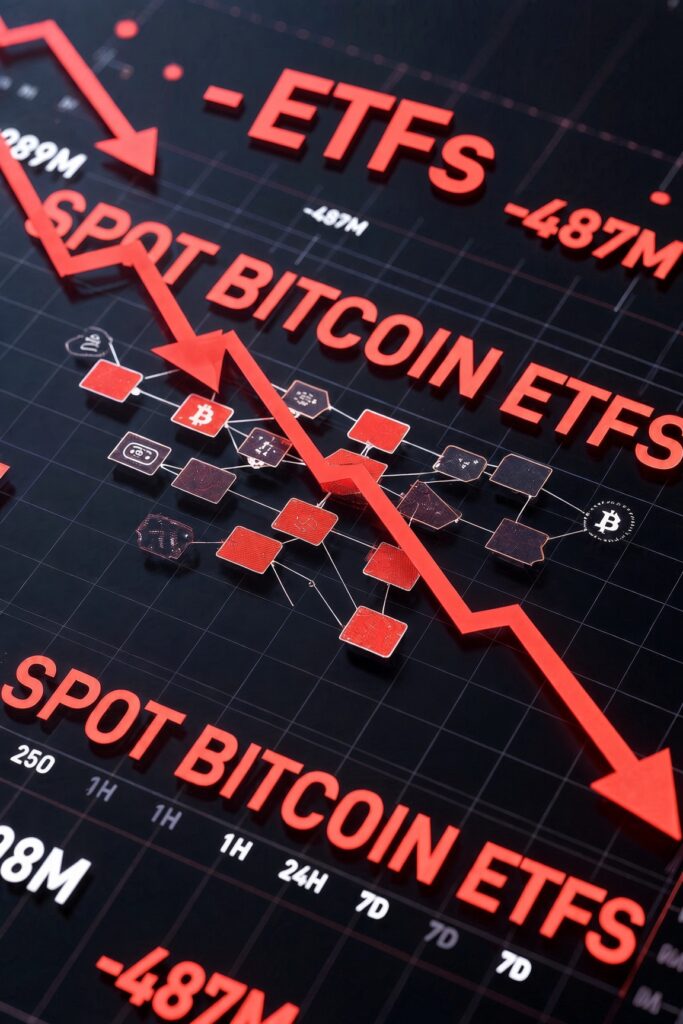
Tuesday’s US spot bitcoin ETFs took in about $119 million, the fourth inflow in five sessions. Wednesday reversed that. SoSoValue-linked reports put net outflows at $487 million, the largest day since 25 June on one compilation, at $484.9 million. BlackRock’s IBIT led with about $208 million, Fidelity’s FBTC with about $105 million, then ARKB at about $102 million, GBTC at about $39 million, BITB at about $28 million and HODL at about $3.5 million.
The day before had looked like the thin bid was stabilizing. Creations in the week ended 2 October had already fallen to the low hundreds of millions, with IBIT the main buyer and FBTC the fund seeing outflows. Tuesday’s $119 million fit that pattern. Wednesday did not. IBIT, the fund that had been absorbing shares while others leaked, led the redemption. That is a different tape from a rotation inside the complex. It is the complex selling.
The stock is still large: about $107.4 billion in net assets, roughly 6.41% of bitcoin’s market cap, and $57.3 billion of cumulative net inflows. A one-day redemption does not unwind that base. It does remove the marginal buyer on the day the range broke. Bitcoin closed at $83,275.93, down 2.67%, after trading near $86,600 a day earlier and printing a Bloomberg low near $82,759. The post-breakout band of roughly $83,000–$87,000 was tested from underneath on the same session the creations flipped.
Ether funds had already been bleeding. US spot ether ETFs logged about $202 million of outflows on Tuesday, a six-session streak near $408 million, while bitcoin funds were still taking in cash. Wednesday closed that gap from the other side. Ether finished at $2,573.53, down 4.60%. The base asset and the beta asset redeemed together into a Hormuz shock that had Brent above $101 and the 10-year near a 24-year high.
For the range, the flow number is the one that matters more than the oil headline. A reclaim of $85,500 was the resistance that would restore the band. That reclaim needs a buyer. A $487 million outflow is the opposite print, and it landed on the day $84,000 failed. If Thursday’s creations do not flip back, $81,000 is the figure CoinMarketCap’s desk already flagged, and the cumulative $57.3 billion does not trade against it. The stock is the base. The daily creation is the bid. Wednesday took the bid off.


Bitcoin Holds Above $84,000, Shrugging Off Heavy ETF Outflows as Oil Declines
Bitcoin rebounded to trade near or above $84,000 on Monday, October 12, 2026, recovering from earlier dips toward the low...


ESMA gives EU crypto firms three months to exit non-MiCA stablecoins
The European Securities and Markets Authority on 8 October told national supervisors that MiCA-authorised crypto firms should stop providing services...


Uptober stalls ahead of the Fed minutes
Seasonality lost to bonds. October has been positive for bitcoin in 10 of the past 13 years, and 21Shares had...


Government-linked wallets move seized coins
Early on-chain reads put about $103 million in motion: 833.6 BTC, roughly $71.6 million, to Coinbase Prime, and 40,285 BNB,...


Winklevoss files a 0.25% Zcash ETF
Winklevoss Asset Services filed for a spot Zcash ETF, proposed Nasdaq ticker WINK, with Gemini as custodian and a 0.25%...


Spot bitcoin ETFs flip to a ~$487 million outflow
Tuesday’s US spot bitcoin ETFs took in about $119 million, the fourth inflow in five sessions. Wednesday reversed that. SoSoValue-linked...


Bitcoin loses $84,000 as Hormuz attacks lift oil and yields
Bitcoin closed at $83,275.93, down 2.67%, after Iran stepped up attacks on tankers in the Strait of Hormuz. Brent rose...


Binance Burns 334.88 Million LUNC in October Fee Batch as Second Transaction Lifts the Day’s Total
Binance removed 334,879,422 Terra Luna Classic (LUNC) from circulation on October 1, the headline transaction in its monthly exchange burn...


TOKEN2049 Opens in Singapore Next Week as the City Leads Regional Crypto Flow
TOKEN2049 runs October 7–8 at Marina Bay Sands. Organisers expect more than 25,000 people, from more than 7,000 companies and...


BTSE Receives a Full Licence to Trade and Custody Crypto in Bhutan
BTSE has a full financial-services licence in Gelephu Mindfulness City. The company said on September 29 that the Gelephu Financial...
-

 DeFi3 weeks ago
Bitcoin Reclaims $81,000 and Closes Above Key 50-Week Moving Average
-

 DeFi1 month ago
Solana Sets Record with Over 263,000 New Tokens Minted in a Single Day
-

 DeFi2 weeks ago
Hong Kong Moves Licensed Stablecoins Onto Exchanges and Into Fund Settlement
-
Crypto4 days ago
ESMA gives EU crypto firms three months to exit non-MiCA stablecoins
-

 DeFi3 weeks ago
Coinbase Adds Fixed-Rate Bitcoin-Backed Loans via Morpho Midnight
-
 DeFi1 month ago
Visa Stablecoin Settlement Volume Hits $20 Billion Annualized Run Rate
-
Crypto1 week ago
Binance Burns 334.88 Million LUNC in October Fee Batch as Second Transaction Lifts the Day’s Total
-

 DeFi2 weeks ago
Robinhood Puts Hedge-Fund Tools in the App as Macro Turns Softer
-

 DeFi4 weeks ago
Senate Rejects CLARITY Act Cloture in 49-50 Vote, Dealing Major Blow to U.S. Crypto Market Structure
-
DeFi2 weeks ago
TOKEN2049 Opens in Singapore Next Week as the City Leads Regional Crypto Flow
-

 Bitcoin7 days ago
SEC clears listing path for first U.S. 3x Bitcoin and Ether ETFs
-

 Bitcoin2 weeks ago
Strategy Adds Another 1,665 BTC, Lifting Holdings to 847,666
-
 DeFi3 weeks ago
CFTC Submits Crypto Market Rules to White House Amid Congressional Stall
-

 DeFi2 weeks ago
HSBC Names Its Hong Kong Stablecoin RedCoin, and Starts With PayMe
-

 DeFi3 weeks ago
Solana Advances Alpenglow Upgrade to Public Testnet
-
 DeFi3 weeks ago
Bitcoin Surges Above $87,000 as Crypto Market Cap Reclaims $3 Trillion
-

 DeFi2 weeks ago
South Korea Ranks Second in On-Chain Crypto Holdings as the Tax Date Holds
-

 DeFi3 weeks ago
Bitcoin Surges Above $87,000 on ETF Inflows and Massive Short Squeeze
-

 DeFi1 month ago
Bitmine Immersion Continues Aggressive ETH Accumulation
-

 Bitcoin2 weeks ago
Coinbase Receives CFTC Approval for U.S. Derivatives Clearinghouse
-

 Bitcoin3 weeks ago
X Partners With Coinbase, Kraken, Gemini and Brokers to Trade From the Timeline
-

 Bitcoin3 weeks ago
Record ETF Inflows and a Short Squeeze Drive Bitcoin’s $87,000 Break
-
 Bitcoin6 days ago
Bitcoin breaks under $84,000 as oil spikes on Hormuz tanker attacks
-

 DeFi1 month ago
First U.S. Staked TRX ETF (Canary TRXS) Debuts
-

 Bitcoin1 month ago
Block (Jack Dorsey) Applies for U.S. Trust Bank Charter
-

 DeFi4 weeks ago
Senate Republicans Release “Final” CLARITY Act Draft Ahead of September 15 Cloture Vote
-

 Crypto7 days ago
Treasury and FinCEN drop unhosted-wallet and mixer surveillance proposals
-
DeFi2 weeks ago
BTSE Receives a Full Licence to Trade and Custody Crypto in Bhutan
-

 DeFi4 weeks ago
SEC Opens Pathway for Tokenized U.S. Equities After Legislative Setback
-

 Bitcoin1 month ago
Crypto Market Faces Pressure as Bitcoin Tests Support Near $78K Amid Macro Headwinds
-

 Bitcoin3 weeks ago
Strategy Resumes Bitcoin Buying, Adds 950 BTC
-

 DeFi4 weeks ago
Circle Launches Arc Mainnet with Institutional Validators Including BlackRock and Visa
-

 Bitcoin4 weeks ago
Metaplanet Reverses Course, Erasing ~$220 Million in Warrant Value
-
 DeFi4 weeks ago
Federal Reserve
-

 DeFi1 month ago
Circle to Acquire Tazapay for $400 Million
-

 DeFi4 weeks ago
Crypto Markets Slide as Clarity Failure, Rising Yields and Oil Prices Weigh; Bitcoin Briefly Tests Below $75,000