Crypto
South Korea’s Crypto Trading Volume Surpasses Stock Market in Historic Turn

In an unprecedented financial phenomenon, South Korea’s cryptocurrency market has outstripped the traditional stock market in trading volume, marking a significant shift in investor behavior and market dynamics. Data from the past 24 hours shows that crypto trading volumes reached an astonishing $18 billion, surpassing the country’s stock market by a notable 22%.
The Surge in Crypto Trading
This surge in crypto trading can largely be attributed to a frenzied interest among South Korean retail investors in what analysts describe as “high-momentum” tokens. Leading the charge was Ripple’s XRP, which saw over $6.3 billion in trading volume alone, followed by Dogecoin at $1.6 billion, Stellar (XLM) at $1.3 billion, Ethereum Name Service (ENS) at $900 million, and Hedera (HBAR) at $800 million. This enthusiasm for altcoins, often referred to in the crypto space as “dino coins” due to their established presence, underscores a robust retail demand in South Korea.
Analyzing the Market Divergence
A significant aspect of this trend is the “Kimchi premium,” where cryptocurrencies trade at a higher price in South Korea compared to global markets. This premium has been particularly pronounced with Bitcoin, which has been trading at an average 10% higher on Korean exchanges. Markus Thielen from 10x Research pointed out the divergence between a mild Bitcoin funding rate and the blockbuster trading volumes in Korea, indicating that the real action is in the altcoin market.
Cultural and Economic Factors
The preference for cryptocurrencies among South Korean investors is not just about chasing returns; it’s also reflective of broader cultural and economic trends. South Korea has a history of high-risk tolerance among investors, driven by rapid economic growth and a cultural inclination towards speculative investments. The increasing wealth disparity within the country has further pushed individuals towards high-volatility assets like altcoins, which promise higher rewards.
Regulatory Environment and Future Outlook
The South Korean government has been proactive in crafting regulations to manage this surge in crypto trading. The implementation of the Virtual Asset User Protection Act aims to protect investors while fostering a legitimate and transparent market. Despite these efforts, the crypto market’s growth continues unabated, suggesting that regulatory frameworks are adapting to rather than stifling this new investment frontier.
Looking ahead, this trend could signal the beginning of an “altseason,” where altcoins outperform Bitcoin, drawing more eyes and investments to less mainstream cryptocurrencies. The impact on South Korea’s stock market might be temporary, but the implications for global crypto markets are profound, highlighting South Korea’s role as a bellwether for crypto adoption and trading behavior.
Conclusion
South Korea’s crypto market has not just caught up with the stock market; it has momentarily surpassed it, showcasing the nation’s significant influence in the global cryptocurrency landscape. With a vibrant community of retail traders and a regulatory environment trying to keep pace, South Korea’s crypto scene is a space to watch for both investors and policymakers alike. As the year closes, all eyes will be on how this trend evolves and what it means for the future of finance in one of the world’s most tech-savvy economies.

The content on CoinReporter.io is for informational purposes only and is not financial or investment advice. Cryptocurrency investments are highly volatile and risky. Always conduct your own research and consult a qualified financial advisor before making any investment decisions. CoinReporter.io and its authors are not liable for any losses resulting from actions based on this website’s content.




Key takeaways
- Binance said on Nov. 12 that it has completed coverage of assets affected by the Oct. 29 security incident, in which about $6.3 billion was stolen, and published a new Proof of Reserves snapshot.
- The snapshot was taken at 00:00 UTC on Nov. 12 and covers 198 tokens; Binance said a zero-knowledge proof would take about 40 to 50 hours to generate before users can independently verify at least 1:1 backing.
- Binance founder Changpeng Zhao quoted the announcement on X, writing: “100% 1:1 backing. Funds are SAFU!”
Binance said on Thursday it has completed coverage of assets from its record Oct. 29 hack, in which about $6.3 billion was stolen, and published a new Proof of Reserves snapshot, according to an official announcement and a post on X.
At 4:49 p.m. London time on Nov. 12, the exchange said it had “completed coverage of assets impacted in the security incident.” “Once the zero-knowledge proof is generated, users can independently verify that their assets are backed at a minimum of 1:1,” Binance wrote, thanking users for their patience and linking to its Proof of Reserves website.
At 6:19 p.m. London time, Binance founder Changpeng Zhao quoted the post, writing: “100% 1:1 backing. Funds are SAFU!” SAFU is the exchange’s Secure Asset Fund for Users, an emergency reserve that can be used to cover losses from incidents such as this.
A longer Thursday announcement, reported by Bitcoin Magazine, said the snapshot was taken at 00:00 UTC on Nov. 12 and covers 198 tokens, up from 10 tokens in an Oct. 31 snapshot published after the breach. Binance said generating the full zero-knowledge proof would take about 40 to 50 hours because of the computational workload.
Until that proof is ready, the 1:1 backing is Binance’s statement, not something customers can confirm on their own. The new figures are posted on the exchange’s Proof of Reserves website. Users will be able to check their balances against the snapshot once the proof has been generated.
Coverage Replaces Tokens, but Stolen Assets Remain Missing
The exchange said it committed more than $6.34 billion in company funds and bought the affected tokens through market and over-the-counter channels. Funding came from a partial deployment of SAFU, a portion of Binance’s Futures insurance fund above the level required under its risk-management framework, and its corporate treasury. Binance also said it would replenish SAFU to about $1 billion.
The announcement concerns the same Oct. 29 incident CoinReporter first reported as a record $6.3 billion theft from Binance’s hot wallets. Binance later said the attackers used a fake job interview and compromised employee devices to reach its wallet-signing systems.
The U.S. Department of Justice has attributed the hack to North Korean military hackers and, also on Thursday, said it had obtained court authorization to seize or restrain more than $1.2 billion in stolen funds, The Block reported.
Coverage means Binance has replaced the affected tokens on its own books, not that it has recovered the stolen coins from the attackers. In the days after the breach, stablecoin issuers and partners froze billions of dollars in stolen assets.
A very small number of tokens Binance no longer lists were also affected. The exchange said those holdings will be handled under its delisting process and that users who hold them will be covered.
Binance said it is still reopening withdrawals in phases and continues to work on its security infrastructure. Thursday’s announcement did not say how much of the stolen crypto has been retrieved, or give an asset-by-asset breakdown of the final purchases.


Bitcoin Tests $75,200 Support
Total crypto market capitalization hovered near $2.50–2.54 trillion on November 9, 2026. Bitcoin dominance remained elevated at roughly 59–60%. The...


Bitcoin Slips Toward $74,600
Bitcoin traded in a tight range near $75,000–$76,000 for much of November 8 before settling lower, closing the CoinMarketCap snapshot...


Bitcoin Crashes Toward $75K
Bitcoin closed November 6 near $75,900 after an intense sell-off that pushed it as low as roughly $74,800 intraday—its weakest...


Crypto Market Stabilizes After Sharp Dip
Bitcoin recovered from multi-week lows near $75,200 and stabilized above $76,000 on November 6, 2026, as the market absorbed a...


Elizabeth Warren Expected to Chair Senate Banking Committee After Democratic Midterm Sweep
Longtime crypto critic Senator Elizabeth Warren is positioned to lead the powerful Senate Banking Committee when the new Congress convenes...


Bitcoin Dips to Multi-Week Lows Near $75,200 Before Recovering Above $76,000
Bitcoin briefly tumbled below $76,000 on November 6, 2026, reaching multi-week lows near $75,200 before buyers stepped in and the...


Bitcoin Rebounds Past $80,000 as Midterms Conclude and Markets Digest Binance Hack Details
Bitcoin staged a sharp V-shaped recovery on November 4, reclaiming $80,000 after briefly touching a seven-week low near $75,600–$75,700. The...


Bitcoin Volatility and ETF Outflows Amid Elections and Hack Fallout
Bitcoin experienced sharp swings in early November, dipping below $76,000 to multi-week lows near $75,700 as residual fallout from the...


Binance SAFU Fund Falls Below $800 Million Threshold After Record Hack Coverage
Binance has drawn down roughly half of its Secure Asset Fund for Users (SAFU), leaving the Bitcoin reserve near 7,500...


Bitcoin Falls Below $77,000 as Chip Stocks Sell Off Ahead of U.S. Midterms
Bitcoin traded under $77,000 on November 3, 2026, down roughly 2% over 24 hours, as a deepening sell-off in semiconductor...
-

 Bitcoin1 month ago
Strategy (MicroStrategy) Adds 250 Bitcoin, Holdings Reach 848,250 BTC
-

 DeFi1 month ago
Bitcoin Drops Below $82,000 Amid $770M+ in Liquidations as Volatility Spikes
-

 DeFi1 month ago
U.S. Spot Bitcoin and Ethereum ETFs See Significant Weekly Outflows
-
DeFi1 month ago
Bitcoin Holds Above $84,000, Shrugging Off Heavy ETF Outflows as Oil Declines
-

 DeFi2 weeks ago
LUNC Hits 462B Burned After v4.1.1 Upgrade
-
 DeFi1 month ago
TRON Q3 2026 Report: $2.21 Trillion in Stablecoin Settlement Volume
-

 DeFi3 weeks ago
Arbitrum Rallies on Stablecoin Growth Program as DeFi Tokens Outperform
-
 DeFi4 weeks ago
Bitcoin and Ethereum Spot ETFs Record Substantial Weekly Outflows
-

 DeFi3 weeks ago
BNB Standard Corporation
-

 DeFi4 weeks ago
Nine Crypto Firms Launch Quantum Alliance to Set Post-Quantum Standards
-

 DeFi1 month ago
South Korea Blocks Domestic Access to 27 Unregistered Crypto Exchange Websites, Including KuCoin and MEXC
-
 DeFi3 weeks ago
Swiss FINMA Approves First Retail Bitcoin ETF Holding BTC Directly
-
 DeFi3 weeks ago
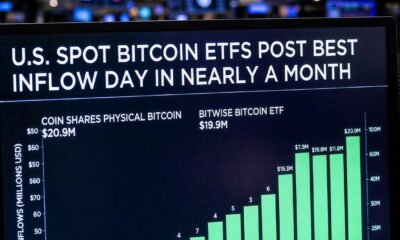
U.S. Spot Bitcoin ETFs Post Best Inflow Day in Nearly a Month
-

 DeFi3 weeks ago
World Liberty Financial’s USD1 Stablecoin Sheds Over $400 Million in Market Cap Amid Redemptions
-

 DeFi1 month ago
Ethereum Foundation-Linked Wallets Transfer 4,393 ETH (~$11 Million) to Kraken
-
 DeFi4 weeks ago
Inflation Shock Triggers Nearly $1 Billion in Liquidations as Bitcoin Tests $80,000
-

 DeFi3 weeks ago
Strive Discloses Additional Bitcoin Purchases, Holdings Reach 36,818 BTC
-

 DeFi3 weeks ago
Binance-Linked Transfer Triggers 347 Million LUNC Burn
-

 Crypto2 weeks ago
DTCC Launches Tokenization Service Covering Approximately $30 Trillion in Securities
-

 DeFi1 month ago
Binance Rolls Out AI Trading Interface Globally After 150,000-User Beta
-
 DeFi3 weeks ago
Crypto Hacks and Losses Reach $1.18 Billion in Q3 2026 Across 107 Incidents
-

 Crypto2 weeks ago
Memecoin PEPE Rallies on Reported Large Holdings Linked to Justin Sun; Broader Tokenization Debate Continues
-

 DeFi3 weeks ago
Crypto Liquidations Surge Past $400 Million in Hours as Bitcoin Briefly Dips Below $80,000
-

 DeFi2 weeks ago
Ripple Secures Final OCC Approval for National Trust Bank to Oversee RLUSD
-
 DeFi3 weeks ago
Bitcoin Slides Below $81,500 as Tech Sell-Off and Elevated Oil Prices Hit Risk Assets
-

 Bitcoin2 weeks ago
Federal Reserve Holds Rates Steady as Bitcoin Trades Near $80,000; December Hike Odds Rise
-

 DeFi4 weeks ago
Bitcoin Drops Below $81,000 as Hotter U.S. CPI Revives Rate-Hike Fears and Asian Equities Tumble
-

 DeFi3 weeks ago
Strive Adds $335 Million in Bitcoin to Corporate Treasury
-

 DeFi3 weeks ago
Mt. Gox Extends Creditor Repayment Deadline to October 2027
-

 DeFi4 weeks ago
Circle Targets 40 Emerging Markets
-

 DeFi3 weeks ago
Strategy Adds 267 Bitcoin for $22.1 Million, Bringing Holdings to 848,517 BTC
-

 DeFi3 weeks ago
JPMorgan Expands JPM Coin Deposit Token to Ethereum Mainnet for Institutional Clients
-

 DeFi2 weeks ago
Stablecoin Issuers and Partners Freeze Billions Linked to Binance Incident
-

 DeFi3 weeks ago
BlackRock Files for “Buffer” Bitcoin ETF (Ticker: PBIT)
-

 DeFi3 weeks ago
Mastercard Advances AI Agent Payments
-

 Crypto2 weeks ago
Hyperliquid Permanently Burns Nearly 5% of Maximum HYPE Supply Amid Broader Token Burn Trends